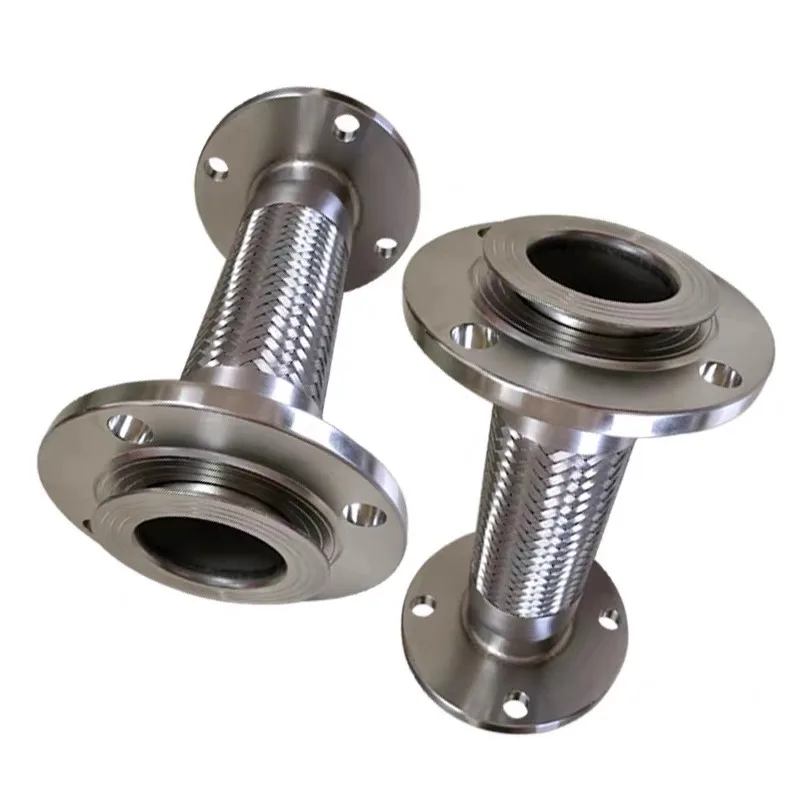
Short answer: Specify a flanged flexible metal hose as a complete assembly, not as a hose diameter alone. The approved drawing should define the medium, design pressure and temperature, type and direction of movement, installed geometry, minimum bend radius, flange interfaces, materials and test requirements. A braid, corrugated core and welded end fittings work together; the weakest qualified element and actual service conditions govern the assembly selection.
AODSON supplies custom stainless steel flanged braided flexible metal hose assemblies for drawing-based projects. This guide helps buyers prepare a usable specification. The piping designer must verify suitability for the complete system, including anchors, guides, flange joints and operating conditions.
1. Define the service before choosing a hose
A flexible connector may accommodate a limited lateral offset, thermal movement or equipment motion. Those are different duties. A hose installed once in a fixed bend may have a different allowable bend radius from one that flexes repeatedly. State whether movement is static, occasional or cyclic, and describe its direction, travel and expected frequency. Do not assume a highly flexible hose will automatically have a long fatigue life at the required pressure.
Record the process medium, normal and design pressure, vacuum conditions where relevant, operating and cleaning temperatures, pressure cycling, external exposure and any vibration. Check chemical compatibility for every wetted part, not just the visible braid. The Penflex engineering bulletin on flexibility and service life explains why bend radius and internal pressure affect cyclic performance.
2. Distinguish overall length from active hose length
Overall length is the end-to-end dimension of the complete assembly. Active length is the portion able to flex after allowing for the rigid ends, collars and fittings. Two assemblies with the same overall length can behave differently if their rigid end sections are different. A drawing should therefore show the flange-to-flange dimension, active length, installation envelope and the expected location of the bend.
Provide enough length for the intended movement without creating a tight bend at a weld or fitting. A short connector can transfer load into the end connection; an unsupported oversized loop can sag and create another failure mode. The Swagelok hose installation guide emphasizes length, bend radius, strain relief and avoiding bending close to the fitting.
3. Apply the correct bend radius to the movement duty
Minimum bend radius is measured along the hose centerline. Ask for the specific assembly’s minimum radius for the intended static or dynamic duty; do not copy a value from a visually similar hose. Repeated motion below the specified dynamic radius can increase stress at the corrugations. Flange alignment should not be achieved by forcing the hose into a tighter shape.
Route motion in one plane and avoid twisting the hose while tightening the flanges. Where the layout demands compound movement, review the geometry with the designer rather than assuming one hose will absorb it. Penflex’s metal hose handling guide addresses torsion, overbending, support and axial compression.
4. Specify the whole flange and pressure boundary
“Flanged end” is not a complete connection specification. Provide the flange standard and size, pressure class, bolt-hole pattern, facing type, sealing surface, gasket requirement and mating equipment drawing. Confirm whether any rotating or lap-joint arrangement is needed to align bolt holes without twisting the hose. The buyer should also state the required weld examination and documentation.
Do not infer a working pressure from braid appearance or the nominal diameter. The allowable assembly rating depends on the corrugated hose, braid construction, end fittings, welds, temperature and the manufacturer’s qualified design. Pressure thrust must be addressed by the piping support design; the flexible hose should not be used as an unplanned anchor or to carry the weight of adjoining pipework.
5. Select materials against actual exposure
Specify materials for the wetted hose core, braid, end fittings and flanges separately. A request such as “316 stainless hose” leaves uncertainty about the braid wire, flange material and weld filler. Where chloride, cleaning agents, temperature or external corrosion are relevant, describe those conditions and request a materials review. A material certificate verifies the supplied grade; it does not by itself prove corrosion resistance for every operating environment.
For a removable hose connection, the interface may instead involve a quick coupling. Compare the required connection and disassembly method with AODSON’s stainless steel camlock couplings and hose fittings; the coupling and hose still need to be specified and assessed as an assembly.
6. Put inspection and acceptance criteria on the order
Before production, agree on dimensional inspection of overall length and flange interfaces, material identification, weld inspection scope, leakage or pressure test method, and documentation. Specify the test medium, test pressure, hold time and acceptance criteria in the approved purchase documents rather than assuming one test fits every service. Ask how the finished assembly will be protected during packing and transport so the braid, sealing faces and end fittings are not damaged.
AODSON’s quality-control overview describes its general inspection capabilities. The exact tests and records available for a particular hose must be confirmed in the quotation.
Practical RFQ checklist
- Drawing revision, quantity, overall length and required active length.
- Nominal size, corrugated core construction and braid requirement.
- Medium, normal and design pressure, temperature range and vacuum duty if applicable.
- Movement type, direction, travel, cycle frequency and installation layout.
- Required static or dynamic bend radius and available space.
- Flange standard, class, facing, bolt pattern, gasket interface and mating drawing.
- Material grades for core, braid, fittings and flanges; external corrosion exposure.
- Weld, dimensional and leak-test acceptance criteria; traceability and packing needs.
Example of a useful inquiry: “Two flanged hose assemblies for a pump skid; attached drawing shows the equipment nozzles, flange interface and installed loop. Please review the stated operating and design conditions, periodic lateral movement, material requirements and test plan, then confirm a suitable assembly drawing.” This is more actionable than “quote a 316 flexible hose.”
Frequently asked questions
Can a flexible metal hose absorb any pipe misalignment?
No. The allowed movement and installed geometry must be checked for the selected assembly. Do not force a hose into alignment or impose torsion at the flanges.
Is the bend radius printed for a hose valid for continuous movement?
Not necessarily. Confirm whether the figure is for a one-time installed bend or dynamic service, and obtain the applicable value for the exact assembly and pressure conditions.
Is a visible wire braid proof of the pressure rating?
No. The complete assembly, including core, braid, welds and ends, needs a qualified rating for the specified temperature and service.
What should be sent to AODSON for a quotation?
Send the flange and installation drawings, medium, pressure, temperature, movement duty, length, materials, quantity and required test documents through the request-a-quote form. AODSON can then review the manufacturable configuration and clarify missing specifications.
Technical references
- Penflex, Metal Hose Handling Guide — installation geometry and handling.
- Penflex, Flexibility and Service Life — bend radius, pressure and cyclic duty.
- Swagelok, Hose and Flexible Tubing — selection and installation considerations.
These references provide general engineering context. Product-specific ratings and approvals must come from the selected assembly’s confirmed documentation.