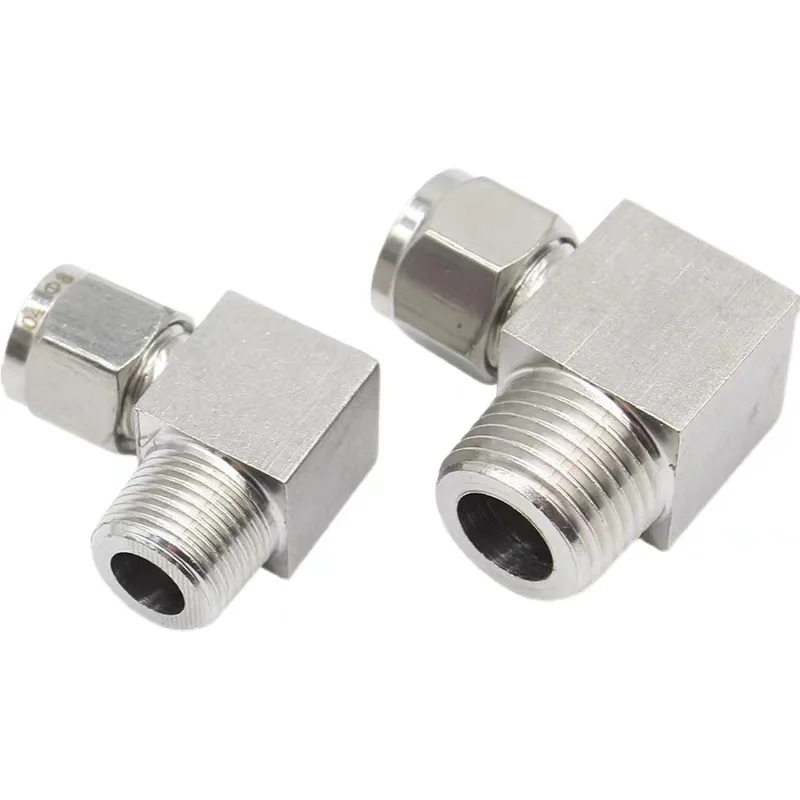
A male elbow compression tube fitting turns a metal tube through 90 degrees into a threaded equipment port. It is a small, ready-to-install component, but an order based only on “stainless 90-degree elbow” can leave several critical interfaces undefined. The tube end, port thread, sealing method and installed envelope must all match the assembly.
This guide gives OEM buyers and maintenance teams a practical specification checklist. AODSON’s male elbow compression tube fitting is made to an approved drawing or sample; the product photograph is a configuration example, not a statement of pressure rating or interchangeability.
Define two different connections
The compression end grips a tube. The male threaded end connects to a female port. Their nominal sizes are independent: a tube outside diameter does not identify the port thread, and a thread size does not establish the tube wall or fitting series. Record both interfaces on the same drawing.
| Specify | Why it matters | Useful evidence |
|---|---|---|
| Tube outside diameter and wall thickness | Controls the fit and the tube’s suitability for the fitting and service | Tube drawing, tolerance and material specification |
| Tube material, hardness and surface condition | Affects ferrule grip and the sealing surface | Tube certificate and fitting maker’s tubing limits |
| Compression fitting series and ferrule arrangement | Determines the nut, ferrules, body geometry and assembly procedure | Approved fitting drawing or complete sample set |
| Male thread form and size | Must match the female port and its sealing arrangement | Port drawing with thread standard and seal detail |
| Elbow orientation and clearance | Determines whether the tube and tools fit after installation | Assembly drawing or measured envelope |
Identify the port thread and seal separately
“1/4-inch male thread” is incomplete. NPT and BSPT are tapered thread families; BSPP and some metric ports are parallel and can use a separate sealing face, washer or O-ring depending on the port design. A thread that appears to start in a port is not proof of a sound seal. State the thread designation, pitch, port standard, sealing feature and any required seal material.
If the elbow must point in a specific direction after tightening, include that requirement. Do not assume a conventional tapered-thread elbow can always be tightened further to reach the desired position. An alternative port or positionable fitting design may be needed, subject to engineering review.
Match the tube to the compression end
Tube outside diameter alone does not establish a reliable compression joint. Check wall thickness, hardness, ovality and surface damage against the chosen fitting system’s installation guidance. Scratches where the ferrule seals can create leak paths, particularly in gas service. The fitting supplier’s approved components and assembly instructions should remain together; a nut or ferrule from a different series should not be assumed interchangeable because it looks similar.
For retrofit work, send an unused fitting sample or the original manufacturer’s identification along with the tube and port drawings. An assembled fitting may not reveal every ferrule and seat dimension without disassembly.
Check service conditions before selecting material
Material choice follows the medium, temperature, external exposure and the connected tube and port. Stainless steel, duplex and other alloys are possible manufacturing options, but their availability does not make any photographed part suitable for a particular chemical or pressure. Specify the wetted material grades, operating and design conditions, cleaning exposure and the required certificates. Where dissimilar metals meet, review corrosion and maintenance implications as part of the assembly.
The allowable rating must be confirmed for the complete connection, including tubing, ferrules, fitting body, thread and port. Do not transfer a rating from another manufacturer’s catalog or from a visually similar part.
Leave room to assemble and inspect
On a compact skid, the elbow may clear the port but leave no room to turn the nut or inspect the tube. Show the tube route, bend radius, adjacent valves, wrench flats and minimum service space. The tube should enter the fitting on its intended axis without forcing the connection to correct a misaligned run. For an instrument air header, check the spacing between outlets and the access needed to isolate each branch.
What to send with a request for quotation
- Tube outside diameter, wall thickness, grade and surface requirement;
- complete compression-end series or approved sample, including nut and ferrules;
- male port thread standard, size and sealing method;
- medium, pressure, temperature, corrosion exposure and quantity;
- installed orientation, envelope and wrench-access limits;
- required dimensional, material and leak-test records.
Send these details through the AODSON request form with a drawing or sample. We can review the manufacturing configuration and agree the inspection scope before production. See the site’s quality-control overview for documentation and traceability capabilities.
Frequently asked questions
Can I specify the elbow from a photograph?
A photograph can identify the general shape. It cannot confirm the ferrule geometry, exact thread, seal, tube tolerance or service rating. Use a drawing or complete sample for the final order.
Can different brands of compression nuts and ferrules be mixed?
Do not assume so. Treat the fitting as an approved system and follow the selected maker’s instructions. If a substitution is required, it needs its own engineering and validation review.
Does a 316 stainless body mean the whole connection is 316?
No. Specify the body, nut, ferrules, tube and any other wetted or exposed components separately, then verify the supplied material records.
Technical references
For examples of thread-specific product configurations and fitting installation requirements, consult Parker’s ISO threaded tube connector catalog and Swagelok’s Installer’s Pocket Guide. Their dimensions and assembly instructions apply to their named products, not automatically to a custom AODSON fitting.