Material selection for a water manifold often starts with a shortcut: 304 for ordinary water, 316 for “corrosive” water, brass for plumbing and carbon steel when cost matters. That shortcut is useful only until the water chemistry, temperature, cleaning method and joining details become real.
A compact manifold has several features that make selection less forgiving than a straight pipe. Welded branch bosses create heat-affected zones. Thread roots and seals create crevices. Dead legs can concentrate chlorides or treatment chemicals. Mixed-metal fittings can create galvanic couples. The correct question is not “Which metal is best?” but which material-and-connection system is suitable for this water and this maintenance plan?
Begin with the water, not the metal list
Before comparing grades, collect the service data:
- potable, raw, softened, deionized, cooling, process or seawater;
- chloride concentration and pH;
- normal temperature, cleaning temperature and shutdown conditions;
- oxidizing disinfectants, biocides or cleaning chemicals;
- continuous flow, intermittent use or stagnant periods;
- contact with copper, galvanized steel, aluminum or other alloys;
- inside and outside corrosion exposure;
- regulatory requirements for potable or hygienic service.
Water described simply as “clean” can still be aggressive to a crevice or an unsuitable brass alloy. Conversely, an expensive alloy is not a cure for poor drainage, rough welds or contaminated fabrication.
304 and 304L stainless steel
304 is widely available, readily fabricated and a practical starting point for many mild fresh-water and indoor utility applications. For a welded manifold, the low-carbon 304L grade is often preferred because it reduces sensitization risk around welds, subject to the applicable material and welding specification.
Its limitation is localized corrosion in chloride-bearing water, particularly at warm, stagnant or tightly creviced locations. Threads, gaskets and incompletely drained branches provide exactly those geometries. A bright external polish does not prove the internal weld or heat tint has been treated correctly.
316 and 316L stainless steel
316 contains molybdenum and generally offers better resistance to chloride pitting and crevice corrosion than 304. That makes 316L a common choice for more demanding water systems, outdoor equipment and manifolds exposed to cleaning chemicals. It is still not “seawater proof,” and it does not remove the need to control crevices, heat tint, contamination and stagnation.
The Nickel Institute’s water-industry fabrication guidance treats chloride level as a useful first screening factor while stressing the effects of pH, temperature, crevice geometry, flow and oxidizing conditions. Its tables are guidance, not a substitute for a project corrosion review.
Duplex and higher-alloy stainless steels
Duplex 2205 combines higher strength with improved resistance to chloride stress corrosion cracking and localized attack compared with common austenitic grades in many environments. Super duplex and higher-molybdenum alloys extend the range further. They may be justified in high-chloride, warmer or safety-critical systems, but fabrication control becomes more important.
Material certificates alone do not guarantee a sound duplex manifold. Welding procedure, filler selection, heat input, interpass temperature, phase balance, pickling/passivation and inspection must suit the grade. A design that is difficult to weld or clean internally can erase much of the alloy advantage.
Brass and bronze
Brass is compact, machinable and familiar in water fittings. It can be a sensible choice when the approved alloy meets the water chemistry and potable-water requirements. The word “brass,” however, covers many compositions. Some higher-zinc brasses are susceptible to dezincification in aggressive or stagnant waters, leaving a porous copper-rich structure.
The Copper Development Association describes how alloy composition and inhibitors change dezincification resistance. For a purchasing specification, name the exact alloy and any dezincification-resistant or lead-content requirement. Do not accept a generic yellow-metal description for regulated drinking-water service.
Carbon steel and coated steel
Carbon steel can be economical for closed, treated circuits and industrial systems where corrosion control is part of the operating plan. It is less forgiving in oxygenated or intermittently wet service. Coatings may protect accessible surfaces, but threaded ports, weld interiors and coating holidays need a realistic treatment and inspection method.
Ask how the internal surface will be prepared and coated, whether the coating is compatible with the fluid and temperature, and how damaged areas will be repaired. A cheap manifold body is not cheap if rust scale blocks small branches or contaminates downstream equipment.
Aluminum, titanium and nickel alloys
Aluminum offers low mass and good machinability but is not a universal water-system material. Water chemistry, coating, galvanic contact and cleaning chemicals require careful review. It should not be introduced into a mixed-metal circuit merely to reduce weight.
Titanium and nickel alloys are used where corrosion, temperature or contamination requirements justify them. These projects usually need grade-specific welding, cleanliness and inspection requirements. Their higher material price makes it especially important to confirm whether the whole manifold needs the alloy or whether a different system architecture is more practical.
| Material family | Where it may fit | Questions to resolve |
|---|---|---|
| 304/304L stainless | Mild fresh water and general utility service | Chlorides, stagnation, weld cleaning, external exposure |
| 316/316L stainless | More demanding water and cleaning environments | Temperature, crevices, disinfectants, chloride concentration |
| Duplex stainless | Higher chloride or strength requirements | Welding procedure, phase control, post-weld treatment |
| Brass/bronze | Compact plumbing and machined fittings | Exact alloy, lead limits, dezincification resistance |
| Carbon/alloy steel | Closed treated industrial circuits | Oxygen ingress, coating, corrosion allowance, water treatment |
| Titanium/nickel alloy | Specialized severe-corrosion service | Grade, fabrication route, contamination control and cost |
NPT, BSPT and BSPP: the seal is the important difference
Thread choice is not a regional naming detail. It determines geometry, gauging and sealing.
- NPT: a tapered inch pipe thread covered by ASME B1.20.1. The threaded engagement and approved sealant form the joint.
- BSPT: a tapered pipe thread within the ISO 7-1 family, used where pressure-tight joints are made on the threads.
- BSPP: a parallel thread within the ISO 228-1 family. The thread provides mechanical retention; the pressure seal is normally made at a face, shoulder, gasket, bonded seal or O-ring.
ASME B1.20.1 covers dimensions and gauging for common US pipe threads including NPT. ISO 7-1 explicitly covers threads where pressure-tight joints are made on the threads. Those standard scopes explain why a drawing must state NPT, BSPT or BSPP rather than writing only “1/2-inch pipe thread.”
A male NPT part may appear to enter a BSPT or BSPP port, but partial engagement does not prove conformity or sealing reliability. Do not qualify mixed-thread assemblies by hand feel. Use the specified gauges and mating components.
Sealants, gaskets and galling
Tapered threads commonly use a project-approved tape or liquid sealant. Compatibility must be checked with the fluid, temperature and downstream cleanliness requirement. Excess tape or compound can enter small branches and instruments.
Parallel-thread ports require a controlled sealing face and the correct gasket or O-ring material. Its pressure and temperature capability can govern the connection even when the metal body has ample strength.
Stainless threaded pairs can gall during assembly. Surface finish, thread tolerance, cleanliness, lubrication compatible with the service and controlled tightening all matter. “Tighten harder” is not a reliable corrective action and may damage the manifold port.
Mixed-metal connections and galvanic corrosion
A stainless manifold connected to copper, brass, galvanized steel or aluminum becomes part of an electrochemical system when a conductive liquid bridges the metals. Risk depends on alloy potential, area ratio, conductivity, temperature and exposure. Small anodic components coupled to a large cathodic area deserve particular attention.
Possible controls include compatible material pairing, electrical isolation, coatings designed for the joint, water-chemistry control and replaceable transition fittings. Isolation needs to be complete; a metal mounting bracket can bypass an insulating connector.
Fabrication details that influence corrosion life
For welded stainless manifolds, specify the internal condition as seriously as the external finish. Important points include:
- full or specified weld penetration without crevice-forming gaps;
- shielding and purge appropriate to the weld procedure;
- removal of harmful heat tint and embedded iron contamination;
- pickling, passivation or electropolishing when required;
- drainable branch orientation and controlled dead-leg length;
- cleaning and pressure-test media compatible with the alloy;
- material traceability and weld inspection matched to service risk.
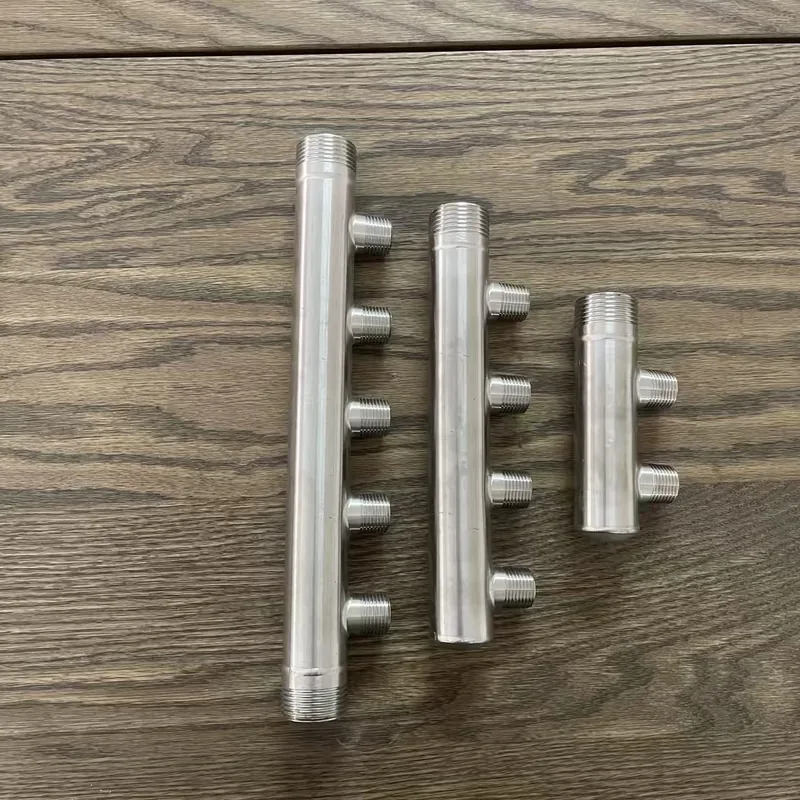
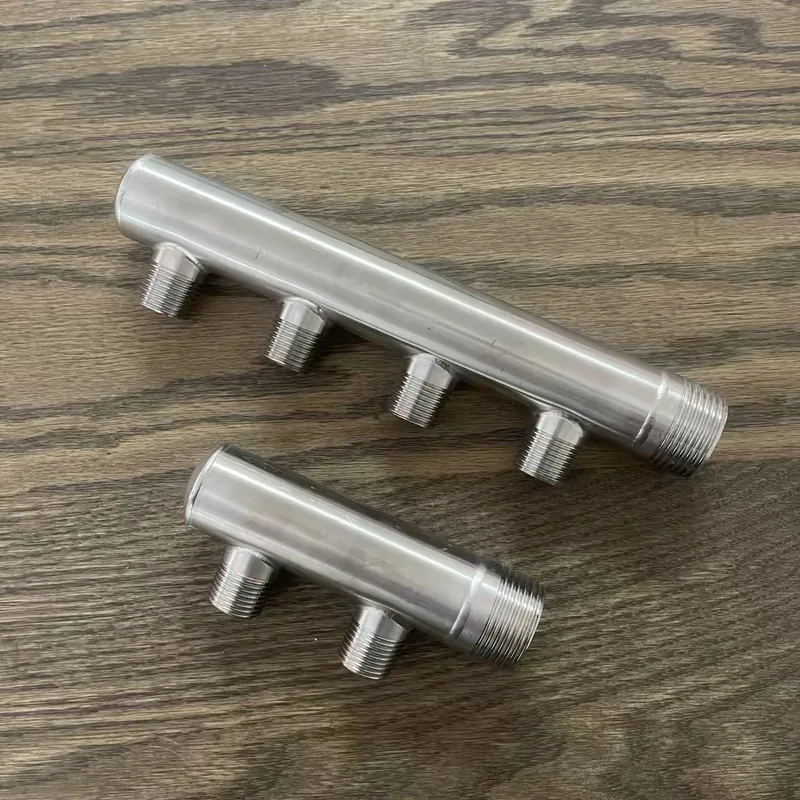
The AODSON threaded water distribution manifold is available with multiple materials, port standards and outlet configurations to drawing. The photos show real fabricated stainless bodies; final alloy, bore, wall thickness and test scope are selected from the application rather than inferred from appearance.
A practical selection sequence
- Describe the water chemistry, temperature, cleaning and stagnation conditions.
- Identify pressure, transient load and regulatory requirements.
- Screen material families for corrosion and fabrication suitability.
- Select the exact grade and product form, not only a family name.
- Choose the thread standard and define how each port seals.
- Review dissimilar-metal connections, mounting and external exposure.
- Define welding, surface treatment, inspection and pressure testing.
- Confirm dimensions and flow performance using the method in How to Size a Water Distribution Manifold.
What to put on the RFQ and drawing
- material designation and governing standard;
- fluid composition, temperature and cleaning chemicals;
- main and branch thread standard, size, gender and gauge requirement;
- seal type and sealing-face dimensions for parallel threads;
- weld procedure or qualification requirement where applicable;
- internal and external surface treatment;
- design pressure, test pressure, test medium and hold time;
- material certificates, traceability and inspection records;
- outlet count, spacing, orientation and mounting details.
Frequently asked questions
Is 316 always enough for salt water?
No. Chloride concentration, temperature, oxygen, crevices, flow and cleaning conditions all matter. Natural seawater and warm concentrated chloride service often require a higher-alloy system and a corrosion review.
Can BSPP threads seal with thread tape?
BSPP is a parallel thread system in which the pressure-tight joint is normally made by a separate sealing surface and seal. Do not replace the specified gasket or O-ring design with tape unless the connection manufacturer explicitly approves it.
Is brass acceptable for potable water?
It can be when the exact alloy and finished component meet the applicable potable-water and lead-content requirements. “Brass” by itself is not a sufficient specification.
What should I send for material review?
Send the water analysis, temperature, pressure, cleaning chemicals, connected metals, thread schedule, required certifications and drawing through the AODSON request form.