




A black jacket can make a cable visually discreet, but it also hides the dimensions and contact surfaces that determine how the assembly behaves. When specifying coated stainless steel wire rope for signs, displays, hanging systems or general utility installations, start with the metallic rope and its end fittings—not the finished outside diameter alone.
This guide explains the information needed for a technically useful enquiry. The photographs show AODSON’s black coated stainless steel wire rope; they do not establish a breaking force, working load or approval for lifting, fall protection or other life-safety service.
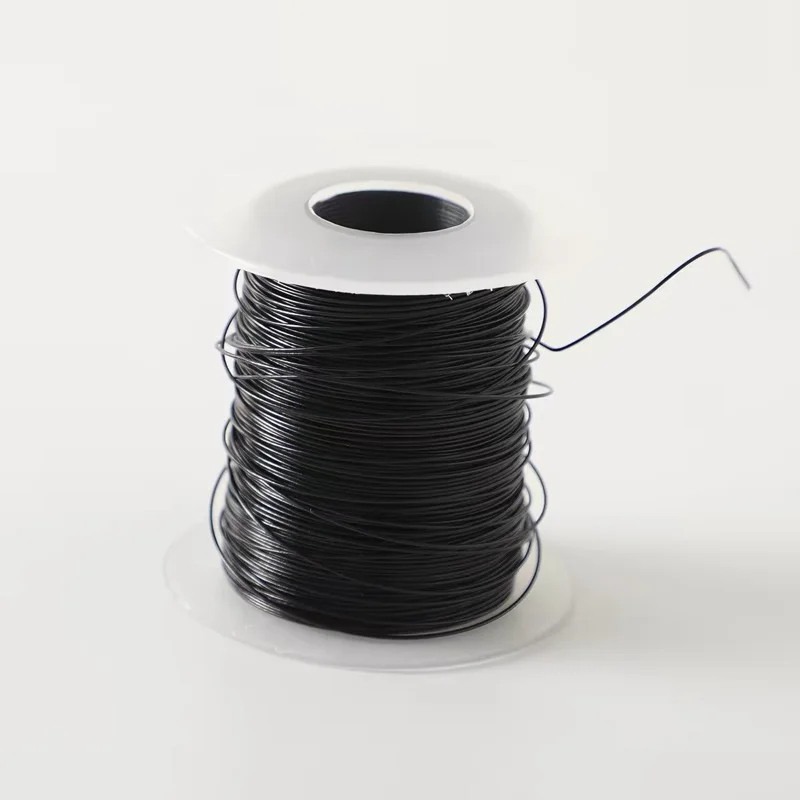
1. Specify two diameters, not one
Use separate drawing callouts for metallic rope diameter d and finished coated diameter D. For a uniform concentric jacket, nominal radial coating thickness is (D − d)/2. A hypothetical 1.5 mm metallic rope with a 2.0 mm finished diameter therefore has a nominal 0.25 mm radial jacket. That geometry says nothing about the actual rope construction, coating chemistry or strength.
The two diameters answer different questions. Metallic diameter belongs with the rope construction, material specification and verified minimum breaking force. Finished diameter controls passage through guides, appearance, contact with adjacent surfaces and compatibility with fittings that are explicitly designed for a coated assembly. Confirm tolerances for both, particularly where a small cable must pass through a narrow bore.
Do not treat the jacket as load-bearing metal or calculate rope strength using the area of a solid cylinder of diameter D. A stranded rope is not a solid rod. Its mechanical properties depend on individual wires, lay, construction and manufacturing data. A generic “304 stainless” description cannot replace a rope-specific test record.
2. Select the termination as part of the cable system
A rope may be strong while its connection slips. A jacket can compress beneath a clamp, and time-dependent deformation can change contact pressure. A fitting that grips an uncoated rope cannot automatically be assigned the same performance on a coated one.
This is not merely a theoretical caution: Crosby’s G-450 clip instructions specifically prohibit use with plastic coated wire rope. That restriction applies to the identified Crosby fitting; it is not a universal installation procedure or a rating for AODSON cable.
Ask the termination supplier to identify the approved rope construction, metallic diameter, coating condition, fitting size and assembly process. If an instruction calls for a prepared end, use only the documented procedure for that complete combination. Do not improvise by removing coating, changing a sleeve or copying a tightening torque from another brand. Factory-made samples and assembly testing are useful when a project needs repeatable finished lengths.
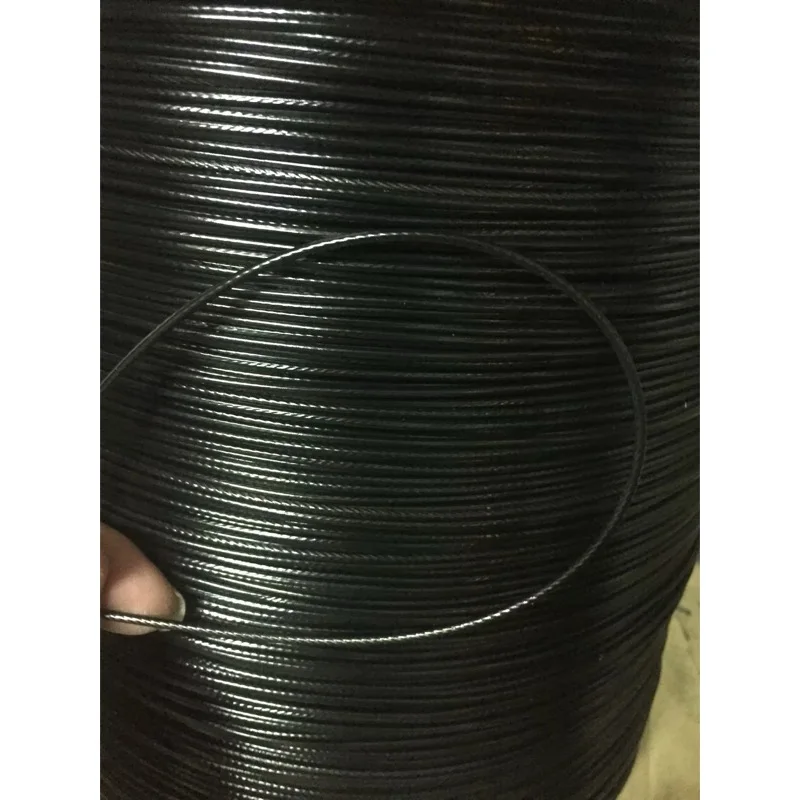
3. Shallow cable angles increase tension
For an ideal symmetric two-leg static arrangement carrying a central downward force W, each leg’s tension is T = W/(2 sin θ), where θ is measured from the horizontal. This follows from vertical force balance: the two vertical tension components must sum to W.
As an illustrative calculation, W = 100 N produces approximately 100 N per leg at 30°, but about 288 N per leg at 10°. Each anchor also receives a horizontal component T cos θ. A nearly horizontal layout can therefore impose substantial anchor forces even when the supported object seems light.
This example is not a working-load recommendation. It assumes symmetry and static loading and excludes wind, impact, installation preload, unequal leg lengths, movement and connection losses. A continuous sagging cable with distributed loads requires a different model. Have the complete load path—cable, end fittings, adjusters, brackets and supporting structure—evaluated for the actual installation.
4. Bends, movement and the jacket need separate checks
A small bend can be convenient for routing but demanding for the wires and coating. Obtain the rope manufacturer’s minimum bend or sheave diameter for the selected construction and duty. Do not derive it solely from the coated diameter or assume a cable intended for a stationary display is suitable for repeated pulley cycling.
Identify every place where the cable rubs, changes direction or enters a fitting. Protect against sharp edges and provide compatible guides. Check the coating’s confirmed temperature range and resistance to the intended cleaners, sunlight and environment. The black appearance does not identify PVC, nylon or another polymer, and it does not prove outdoor durability.
For wet or chloride-exposed installations, specify the metallic material and the environmental conditions explicitly. A jacket does not justify describing stainless steel as corrosion-proof, nor does it remove the need to inspect exposed ends and connections.
5. Diagnose assembly problems before changing rope size
- Slipping connection: investigate fitting compatibility and assembly preparation, not just rope diameter.
- Increasing sag: distinguish fitting movement, support movement and rope seating from intentional adjustment.
- Damaged jacket at a guide: inspect the edge, bend geometry and movement pattern.
- Unequal cable tension: check installation geometry and adjustment procedure before assuming equal load sharing.
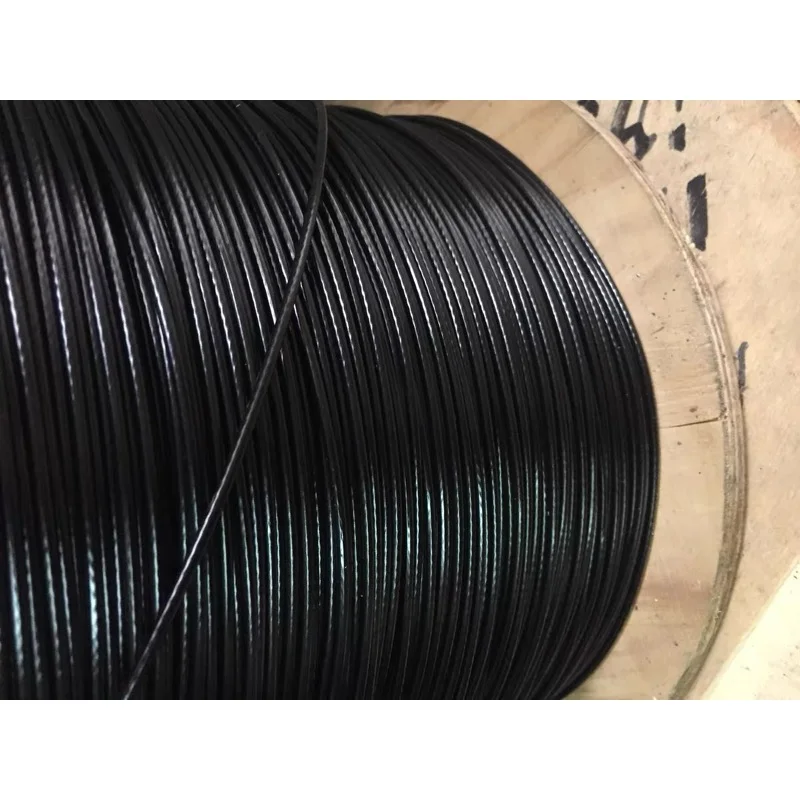
6. A better RFQ produces a better cable proposal
Include the application, metallic and finished diameters, required construction if known, finished length and tolerance, quantity, reel or cut-length supply, approved termination details, attachment geometry, static and dynamic loads, environment, inspection access and required documentation. If the construction is undecided, state that clearly and ask for a proposed specification rather than accepting an ambiguous diameter listing.
For a starting point, review the AODSON coated wire rope product page and send the installation sketch with your enquiry. Explain how the cable will be connected and used; a photo of the desired appearance alone is not enough to define an engineered assembly.
Frequently asked questions
Does “2 mm coated cable” mean a 2 mm stainless rope?
Not necessarily. It may describe the overall coated diameter. Request both dimensions and their tolerances.
Can ordinary wire rope clips be used over the coating?
Only if the exact fitting manufacturer’s instructions explicitly permit the supplied coated rope combination. Some clip instructions prohibit it.
Can AODSON’s photographed cable be used for lifting?
The referenced product photographs do not establish a lifting rating. Lifting and life-safety systems require purpose-specified, documented equipment and qualified engineering; this article does not qualify the cable for those uses.