




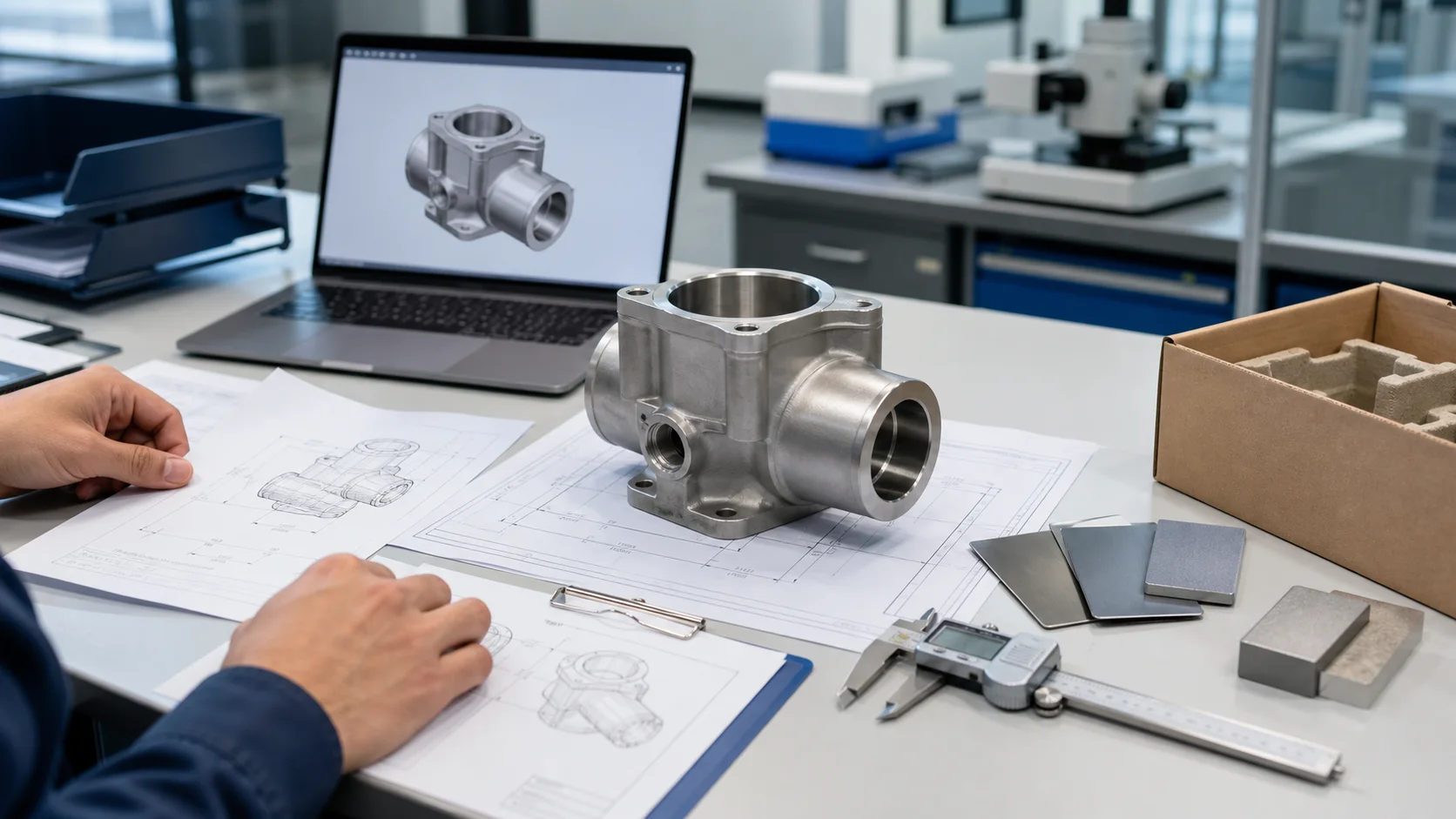
A complete metal part RFQ checklist helps a supplier quote the right component, process and inspection scope the first time. A short message with only a photo and target price may be enough to begin a conversation, but it is rarely enough for a firm production quotation.
Buyers do not need perfect engineering documentation before contacting a manufacturer. They do need to separate known requirements from open questions. This guide explains what to send, why each item matters and how to avoid quotation assumptions that later become cost or delivery problems.
Quick Metal Part RFQ Checklist
- 2D drawing and 3D model, or clear sample information
- Drawing revision and units
- Material grade and governing standard
- Critical dimensions, tolerances and datums
- Application and operating environment
- Prototype quantity, order quantity and annual demand
- Surface finish, heat treatment and appearance requirements
- Inspection, testing and documentation scope
- Packaging, delivery destination and required date
- Contact person for technical questions and approvals
1. Send Both a 2D Drawing and 3D Model When Available
The 3D model communicates shape and supports process planning, tooling design and CNC programming. The 2D drawing communicates tolerances, datums, threads, surface finish, material, notes and acceptance requirements that a model may not contain.
| File | Best Use | Common Missing Information |
|---|---|---|
| STEP / STP / IGS model | Geometry, volume, tooling and machining review | Tolerances, finish, material and inspection notes |
| PDF / DWG / DXF drawing | Dimensions, tolerances, datums and specifications | Complete 3D geometry |
| Physical sample | Reverse engineering and functional reference | Original design intent and material confirmation |
| Photos | Initial orientation and application discussion | Scale, hidden geometry and accurate dimensions |
When only a sample exists, explain which surfaces are worn, repaired or intentionally modified. AODSON can review sample-based projects, but the final manufacturing drawing still requires approval. See reverse engineering a metal part without drawings.
2. Identify Revision, Units and File Authority
Every RFQ should identify the current drawing revision and measurement units. If the 2D drawing and 3D model conflict, state which file controls. Unmarked revisions can cause suppliers to quote an obsolete design or compare different scopes.
Use consistent filenames and send all related specifications together. If a new revision is issued during quotation, summarize what changed so tooling, process and price can be reviewed efficiently.
3. Specify Material by Grade and Standard
“Stainless steel” is not a complete material specification. 304, 316L, 2205, 2507, 17-4PH, 310S and nickel alloys have different corrosion behavior, strength, heat treatment, availability and processing requirements.
State the grade and standard, such as an ASTM, EN, JIS or customer specification. Also describe the operating environment: seawater, temperature, pressure, food contact, chemical media, cyclic load or outdoor exposure. This helps identify conflicts between the requested grade and actual service.
4. Separate Critical Tolerances From General Tolerances
A drawing becomes expensive when every dimension is treated as critical. Mark functional datums, sealing faces, bearing fits, threads, hole patterns and assembly relationships. Apply a realistic general tolerance to non-critical features.
Geometric dimensioning and tolerancing should reflect how the part is located and inspected. If a tolerance is based on a mating part, sharing the assembly drawing can prevent a supplier from optimizing the wrong dimension.
5. Explain the Part’s Function and Failure Risk
Application information is not marketing background. It helps the manufacturer understand what cannot fail. A decorative handle, pressure-containing valve body and rotating impeller require different material control, process planning and inspection.
Describe load, motion, pressure, temperature, corrosion exposure, sealing, wear, hygiene, appearance and maintenance requirements. Where confidentiality matters, a functional summary is still more useful than no context.
6. Provide Prototype, Order and Annual Quantities
Quantity affects process selection and tooling strategy. CNC machining may suit prototypes, while investment casting, forging, stamping or dedicated fixtures may become economical at repeat volume. The best process for 10 pieces may not be the best process for 10,000.
Share the sample quantity, expected first order and estimated annual demand. Label forecasts honestly. A supplier can then quote a practical development route and an appropriate production route instead of forcing one price structure onto every stage.
7. Define Surface Finish and Heat Treatment
State functional and visual finish separately. Passivation, pickling, electropolishing, satin brushing, mirror polishing, coating and painting each require different preparation and inspection. Identify visible surfaces and acceptable appearance using a standard or approved sample.
If heat treatment is required, provide the material condition, hardness range and applicable standard. Avoid specifying a process name without the property or condition the finished part must achieve.
8. Define Inspection and Documentation
An accurate quotation needs the inspection scope before production. Identify critical dimensions, sampling plan, material certificates, heat-number traceability, PMI, CMM reports, NDT, pressure testing, first-article inspection and third-party witness requirements.
More inspection is not automatically better. Each test should connect to a known risk and an agreed acceptance method. Review AODSON quality control when preparing project documentation requirements.
9. State Packaging and Delivery Requirements
Polished architectural hardware, sharp castings, machined sealing faces and heavy industrial parts need different protection. Tell the supplier whether parts require individual sleeves, protective caps, rust prevention, foam separation, barcodes, customer labels, export pallets or wooden cases.
Include destination country, delivery address or port, requested date and preferred Incoterms. These details help distinguish ex-works part cost from the total delivered scope.
10. Clarify Approval and Change Control
Identify who approves DFM changes, drawings, samples, color, finish and inspection results. A project can stall when the technical contact, purchasing contact and final approver use different acceptance criteria.
After approval, changes should be documented by revision. Tooling changes, material substitutions and process changes may affect cost, lead time and validation, even when the finished part looks similar.
Common RFQ Mistakes That Delay a Quote
| RFQ Problem | Why It Causes Delay | Better Approach |
|---|---|---|
| Only a screenshot | No scale, hidden geometry or tolerances | Add dimensions, sample or CAD data |
| Material listed as “steel” | Cost and performance cannot be confirmed | Provide grade, standard and environment |
| No quantity | Process and tooling cannot be selected | Share prototype, order and annual demand |
| All tolerances are extremely tight | Unnecessary machining and inspection | Mark critical functional features |
| Finish described as “high quality” | Appearance is subjective | Use a finish standard or approved sample |
| Testing requested without a method | Scope and acceptance are unclear | Name the standard, sample level and criteria |
How the RFQ Supports Process Selection
A good RFQ does not assume that one process fits every part. Geometry, alloy, tolerance and volume may lead to investment casting, CNC machining, fabrication, stamping or a combined route.
AODSON’s DFM engineering review considers near-net-shape production, machining datums, tooling, fixtures, surface finish and inspection together. The objective is to meet the approved requirement with a stable process, not simply to use the buyer’s first process assumption.
What a Useful Supplier Quotation Should Confirm
- Quoted part number and drawing revision
- Material grade and manufacturing route
- Tooling, fixture and sample scope
- Unit price by quantity break
- Included machining, finishing and inspection
- Packaging and commercial terms
- Sample and production lead time
- Technical assumptions and exclusions
Compare quotations on the same scope. A low unit price may exclude tooling correction, inspection reports, protective packaging or critical secondary operations.
Submit Your Custom Metal Part RFQ
AODSON supports custom metal components from drawing or sample through DFM, casting, CNC machining, fabrication, finishing, inspection and export preparation. Send the information you already have through Request a Quote. Open items can be reviewed with the engineering team before the quotation is finalized.
Frequently Asked Questions
Can I request a quote without a 3D model?
Yes. A dimensioned 2D drawing or physical sample may be enough for an initial review. Complex geometry usually benefits from a 3D model before tooling or CNC programming.
Should I hide the target quantity until I receive a price?
No. Quantity is needed to select the manufacturing and tooling route. Ask for quantity breaks if demand is uncertain rather than withholding volume information.
Do I need to specify every tolerance?
General tolerances can cover non-critical dimensions. Clearly identify datums and functional features that affect fit, sealing, motion or safety.
What if I do not know the correct material?
Describe the environment, load, temperature, corrosion exposure and applicable regulations. The supplier can discuss options, but final material approval should remain with the responsible designer.