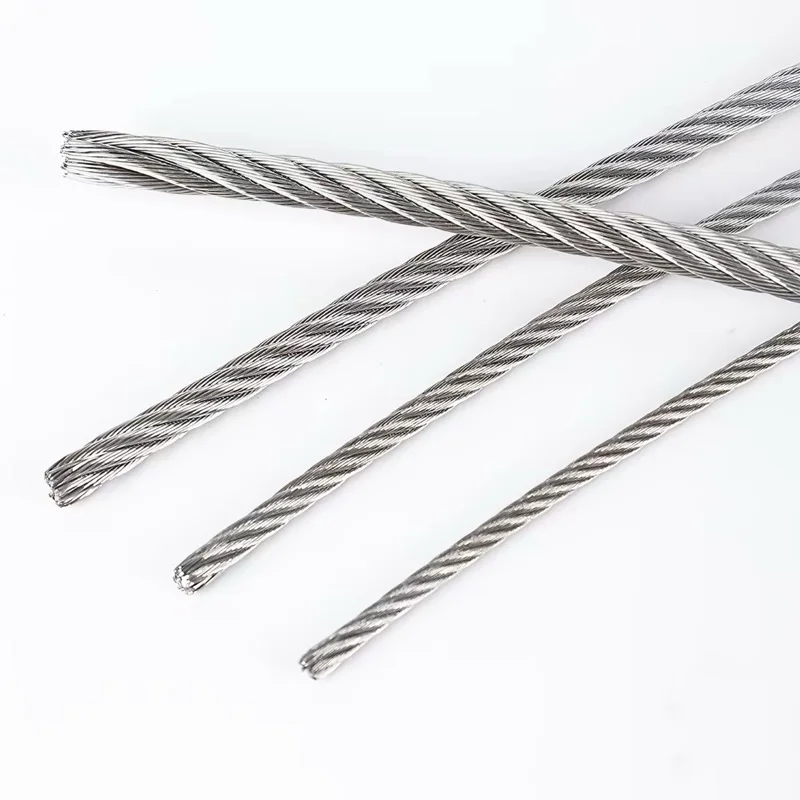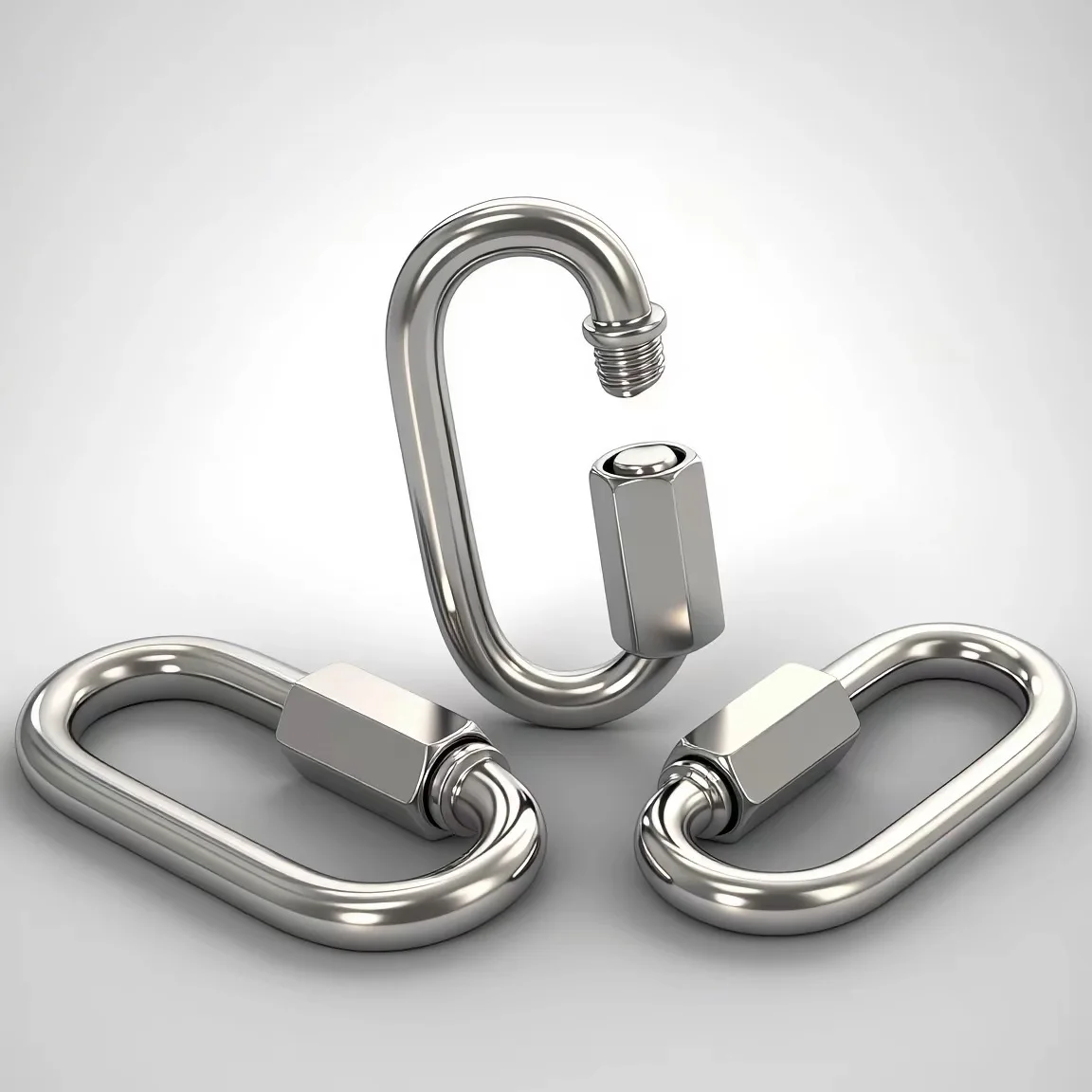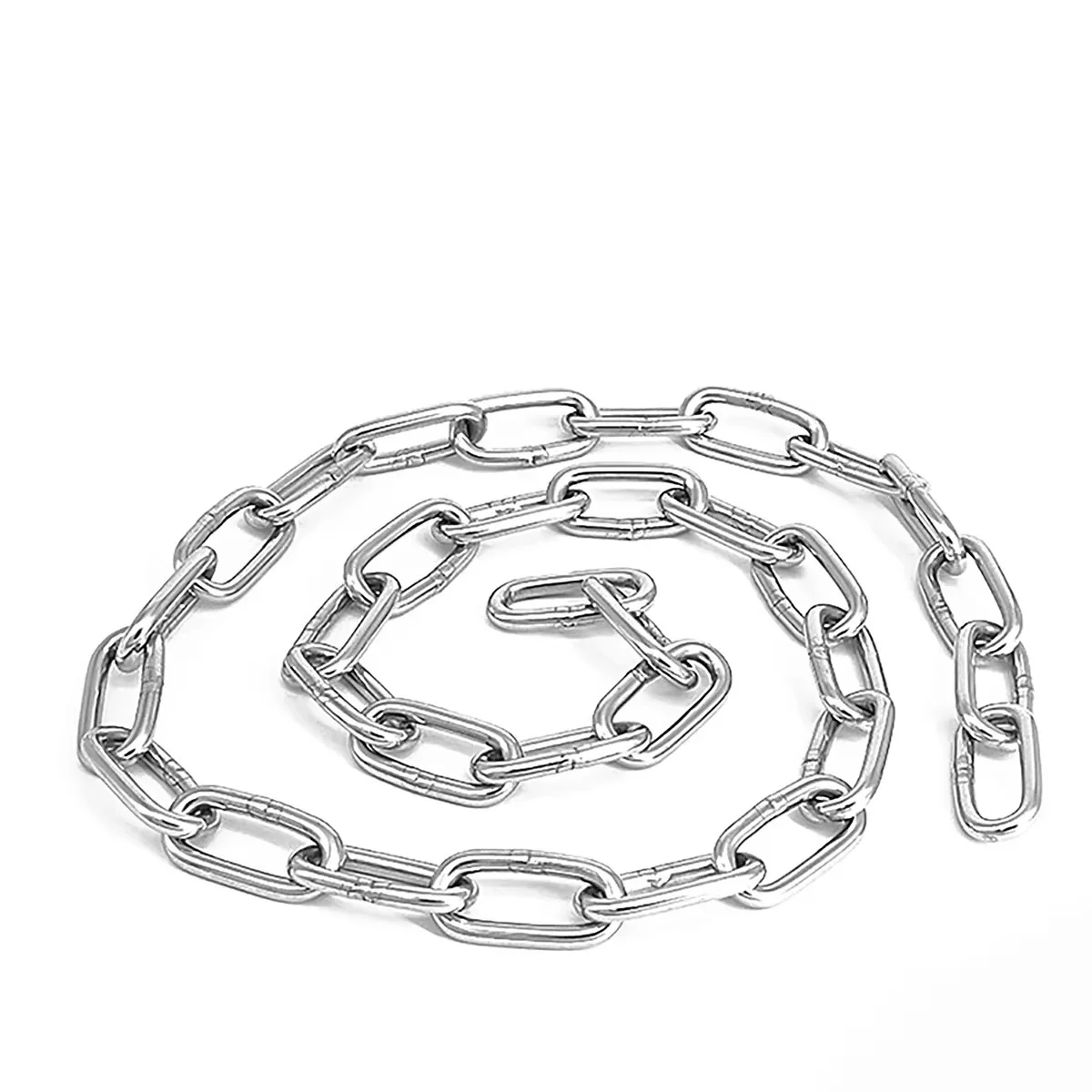




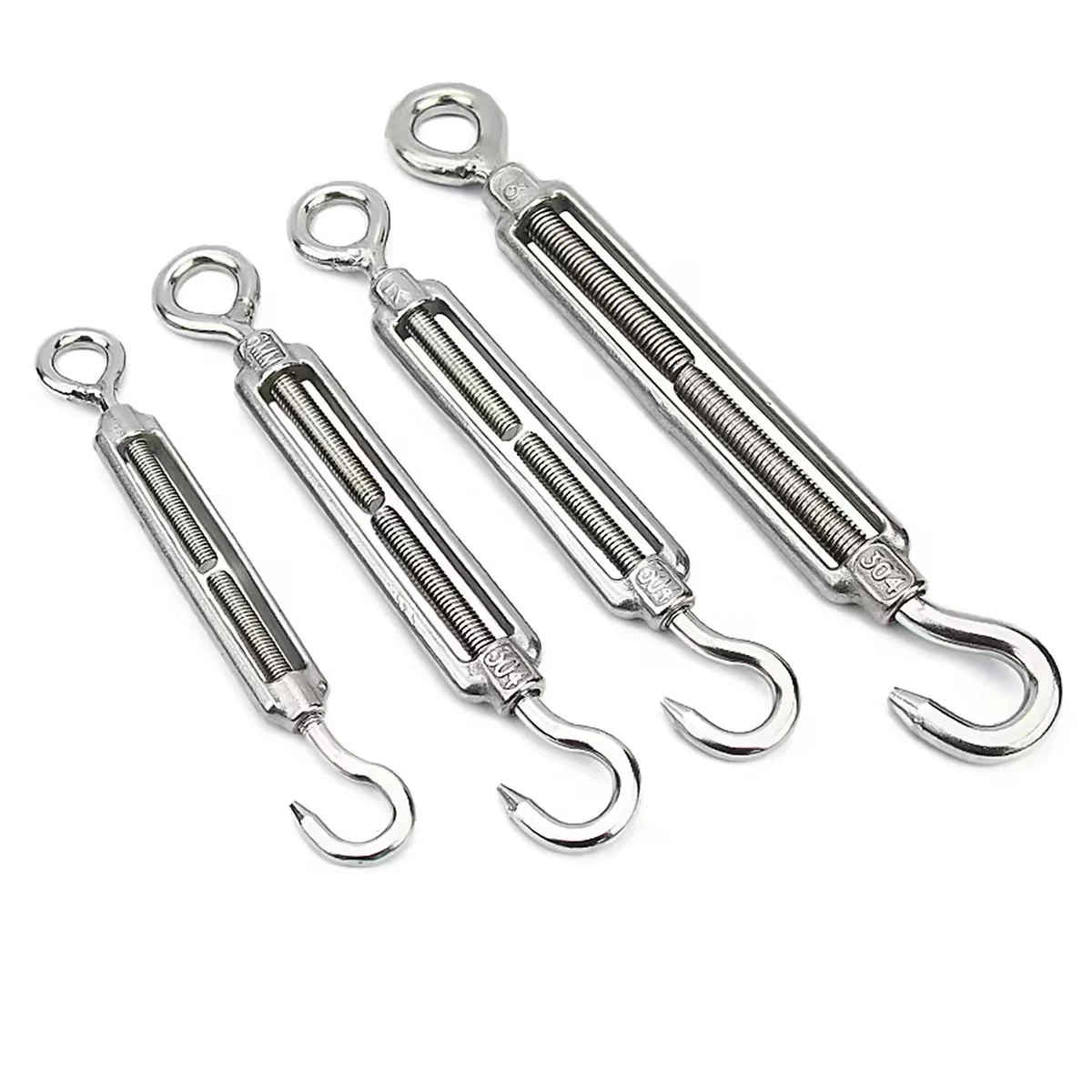
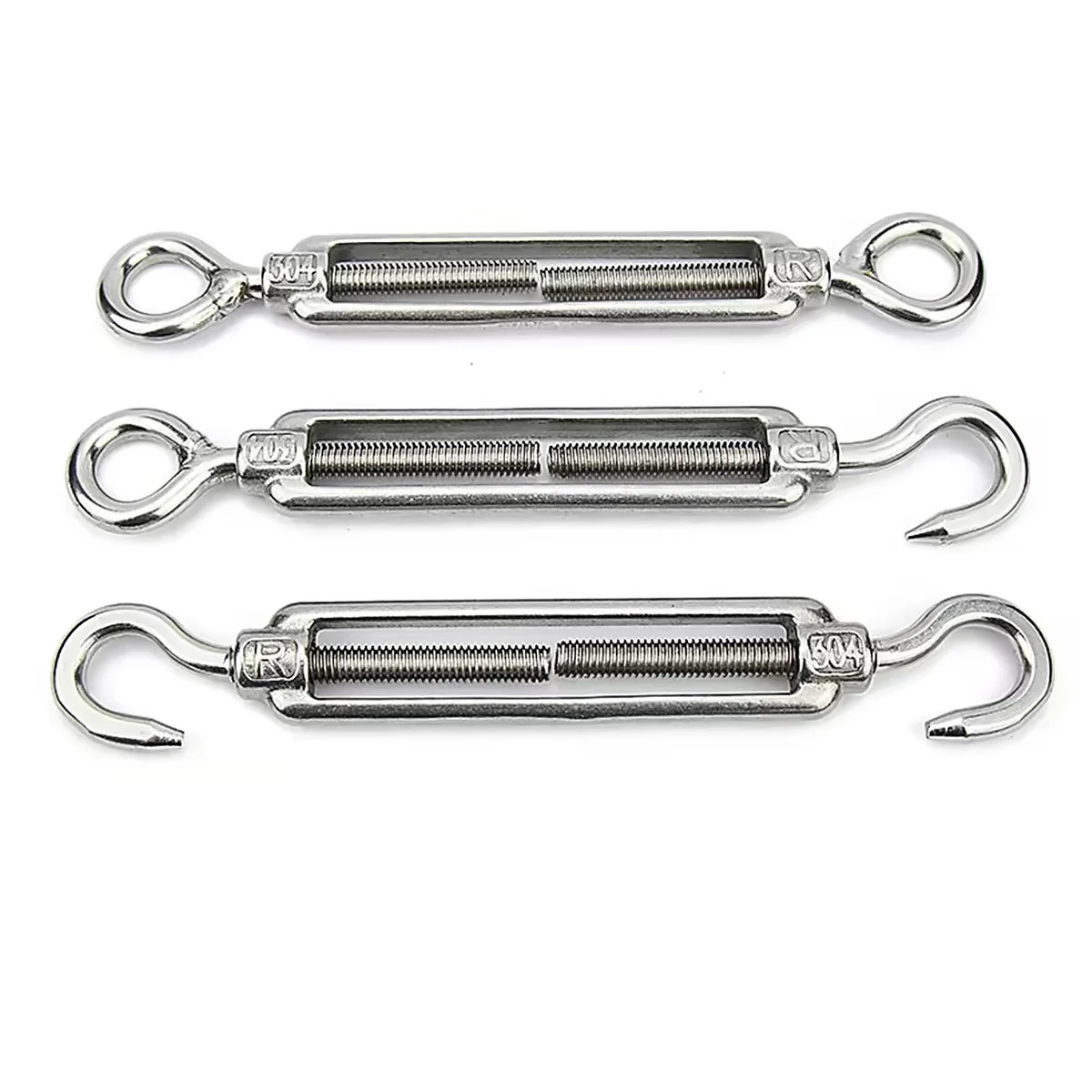
304 stainless steel open body turnbuckles provide adjustable tension between wire rope, cable, rods and fixed connection points. The photographed range includes eye-eye, eye-hook and hook-hook configurations with an open frame body that allows the thread engagement and remaining adjustment to be inspected.
Product Overview
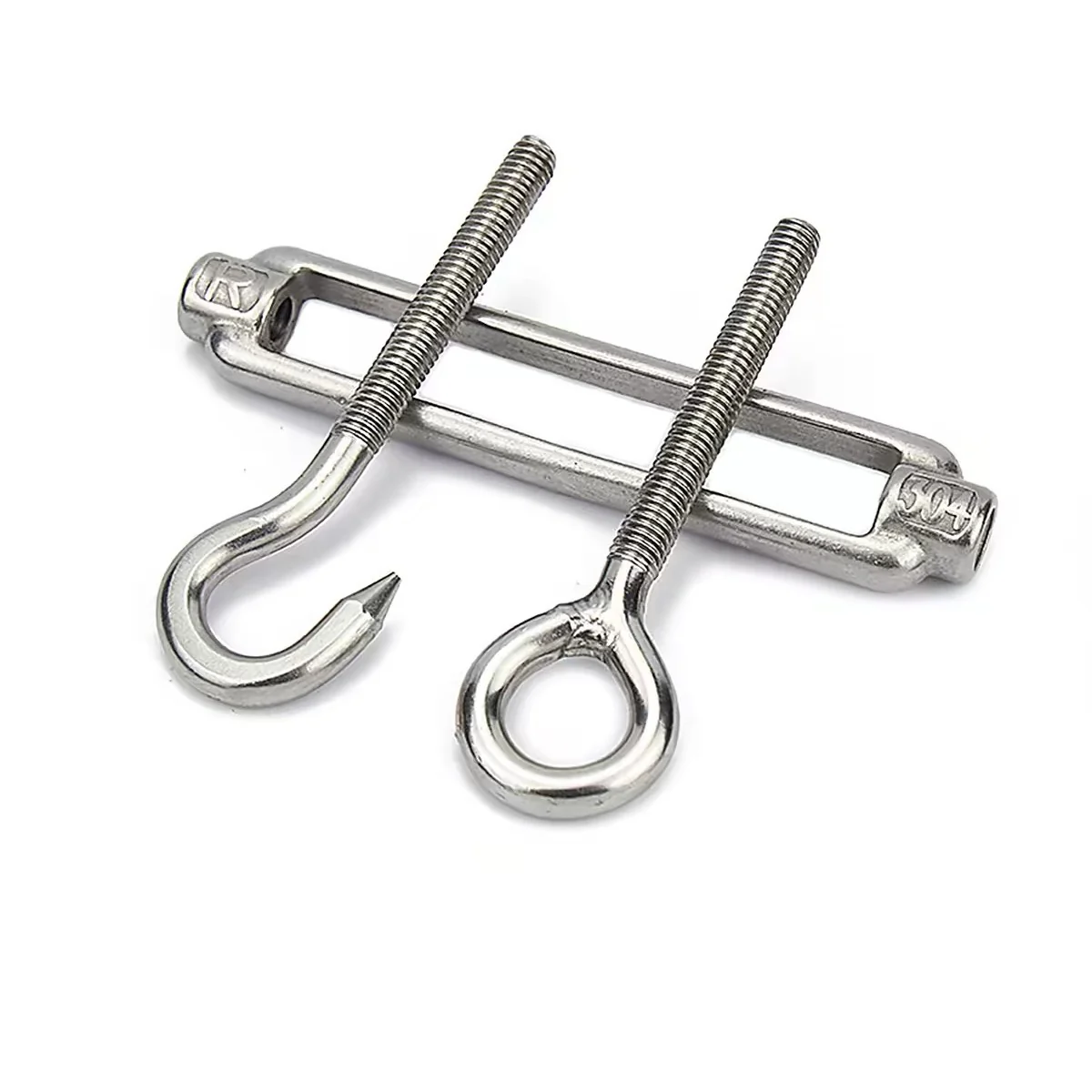
A turnbuckle uses one right-hand threaded end and one left-hand threaded end inside a common body. Rotating the body draws both end fittings inward to increase tension or moves them outward to increase assembly length. The connection can therefore be adjusted without rotating the attached cable or rod.
The open body design provides access for visual inspection and tool engagement. End fittings can be selected to suit closed pins and shackles, quick hook connections or combinations of both.
Specifications and Custom Options
| Product type | Open body / open frame turnbuckle |
|---|---|
| Pictured material | Components marked 304 stainless steel |
| Available materials | 304, 316, duplex stainless steel or customer-specified alloy |
| End configurations | Eye-eye, eye-hook, hook-hook or drawing-specific terminals |
| Threads | Opposed right-hand and left-hand metric or imperial threads |
| Finish | Natural, polished, passivated or project-specific stainless finish |
| Customization | Thread size, body length, take-up, eye diameter, hook geometry, marking and testing |
Available End Configurations
- Eye-eye: closed connection points at both ends for pins, shackles or other retained hardware.
- Eye-hook: one retained eye and one open hook for faster connection and removal.
- Hook-hook: two open hooks for non-permanent tensioning where the application permits open-end fittings.
- Custom terminals: threaded rods, jaws, forks or project-specific interfaces can be reviewed from drawings.
How the Adjustment Works
The left-hand and right-hand threads are essential to turnbuckle operation. When the body is rotated in one direction, both terminals move toward the center; reversing rotation moves both terminals outward. Correct thread engagement must remain inside the body at every approved adjustment position.
The useful adjustment range, often called take-up, should be defined separately from total open and closed lengths. Over-extension can leave insufficient thread engagement and create an unsafe assembly.
Material Selection: 304, 316 and Duplex
The photographed fittings carry visible 304 markings. Grade 304 is suitable for many general industrial, architectural and outdoor tensioning applications. Grade 316 may be preferred for coastal, marine and chloride-rich exposure, while duplex grades can be reviewed for more demanding corrosion and strength requirements.
Material selection should cover the body and both end fittings, not just one marked component. When material verification is contractual, certificates, PMI and lot traceability should be included in the RFQ.
Manufacturing Route
Open bodies and terminals may be cast, forged, formed or machined depending on size, geometry, material, quantity and load requirement. Threads are produced with matched left-hand and right-hand forms, followed by assembly, surface finishing and inspection. Polishing and passivation can be specified for stainless components.
Hook shape, eye transition and thread runout require controlled geometry. Surface defects, sharp transitions or damaged threads can reduce reliability, especially in repeatedly adjusted assemblies.
Typical Applications
- Wire-rope and cable tensioning systems
- Fencing, trellis and shade-structure assemblies
- Marine, dock and outdoor hardware using the approved grade
- Architectural railing and support-cable adjustment
- Industrial bracing, machinery guards and equipment tie-down systems
- Custom OEM tensioning assemblies
Load Rating and Safety
A 304 marking and physical size do not establish a working load limit. Load capacity depends on material, manufacturing route, thread size and engagement, body section, end-fitting geometry, load direction, proof testing and safety factor.
Open hooks can disengage when a system becomes slack, rotates or receives side load. Eye or jaw terminals may be more appropriate where connection retention is critical. Turnbuckles used for lifting, overhead suspension, fall protection or life-safety service require a governing standard, certified rating, traceability and approved installation. Do not use the pictured products for lifting without that verification.
Standards and Dimensional Control
Open body turnbuckles may be specified to customer drawings or DIN 1480-style dimensional requirements. The photographed components should not be assumed to comply with a particular standard only because they have a similar appearance. Standard edition, size, material, terminal combination, proof load and marking requirements must be stated in the order.
Quality Control
Inspection can include material identity, body length, thread diameter and pitch, left-hand and right-hand thread gauging, terminal geometry, eye opening, hook profile, minimum engagement, take-up range, surface condition and marking. Project-specific proof-load, break-load, corrosion or fatigue testing can be arranged when the buyer defines the method and acceptance criteria.
RFQ Information
For an accurate quotation, provide the required terminal combination, thread size, closed length, open length, take-up, material and quantity. Explain the application and identify whether a certified load rating is required.
- Eye-eye, eye-hook, hook-hook or other terminal arrangement
- Thread size, pitch and hand
- Body length, closed length, open length and take-up
- Eye inside diameter or hook opening
- Material, finish and corrosion environment
- Working load, safety factor, proof test and documentation
Send your turnbuckle specification for review. Continue with Rigging Systems, Marine Hardware, Precision Casting and Quality Control & Traceability.
Frequently Asked Questions
What is the difference between eye-eye, eye-hook and hook-hook turnbuckles?
Eyes provide closed connection points, while hooks allow faster attachment but can disengage if the system becomes slack or receives an unsuitable load. Terminal choice depends on retention and installation requirements.
Are these turnbuckles suitable for lifting?
Not automatically. Lifting requires a certified product with a stated standard, working load limit, proof testing, traceability and correct end connections. Appearance and a 304 marking are not sufficient.
Can 316 stainless steel be supplied?
Yes. Grade 316 and duplex options can be reviewed for coastal, marine or chloride exposure. All body and terminal materials should be stated in the order.
Can AODSON supply DIN 1480 turnbuckles?
AODSON can review DIN 1480-style or customer-specified turnbuckles. Compliance is confirmed only after the exact dimensional, material, load, testing and marking requirements are approved.