




Direct Answer
304 vs 316 for marine use: the short answer
304 stainless steel can be suitable for dry interiors, freshwater service and components that are cleaned regularly. For exposed saltwater, coastal spray or critical boat hardware, 316 or 316L is normally the safer choice because its molybdenum content improves resistance to chloride pitting.
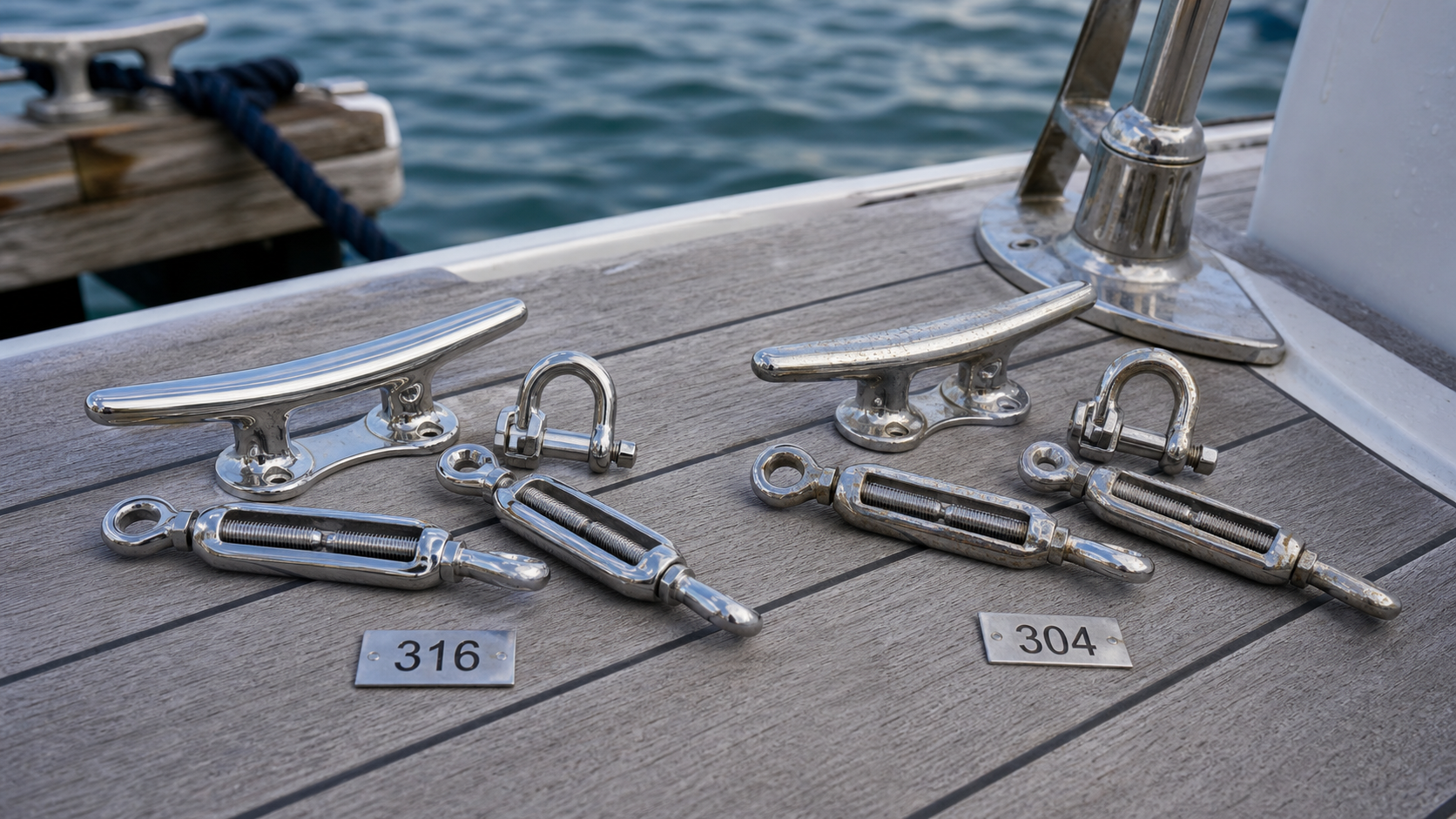
If you are choosing stainless steel hardware for a boat, the usual answer is quick: use 316. It is the grade most people expect to see on quality marine hardware because it resists salt better than 304. But the useful answer is a little more careful. 316 is better for most exposed boat fittings, especially in saltwater, yet it is not magic. Poor polishing, trapped seawater, mixed metals, bad weld cleaning, or stagnant crevices can make even 316 stain or pit.
That is why a smart comparison of 316 vs 304 stainless steel marine hardware should look beyond the grade name. The real question is where the part is installed, how wet it stays, whether salt can dry on the surface, and how easy it is to rinse and inspect.
Sourcing Custom Marine Hardware
For an OEM fitting or a replacement component, start with the drawing or sample, installation location, material specification, finish and order quantity. Identify load-bearing features and the inspection requirements on the drawing.
Review our custom marine hardware manufacturing services and marine hardware product range, then request a quote for your fitting. Include sample photographs if the part must match an existing assembly.
Why Stainless Steel Is Used on Boats
Marine hardware has to survive a hard combination of loads and chemistry. Cleats, shackles, turnbuckles, hinges, deck plates, bow eyes, rail fittings, fasteners, and rigging parts are pulled, vibrated, splashed, and handled constantly. Stainless steel is popular because it offers good strength, a clean appearance, and a naturally protective chromium oxide layer on the surface.
That passive layer is the reason stainless steel looks so durable. When oxygen is available, the surface can repair itself after minor scratches. Saltwater changes the story. Chloride ions attack weak points in the passive film, especially inside small gaps where oxygen is limited. The result is not usually uniform rust like carbon steel. It is more often tea staining, pitting, or crevice corrosion around threads, washers, gaskets, welds, and trapped deposits.
What Is 304 Stainless Steel?
304 stainless steel is the general-purpose austenitic stainless grade used across many industries. It is strong, formable, weldable, and attractive after polishing. For indoor parts, freshwater use, decorative trim, and many general hardware applications, 304 can perform well.
The limitation is chloride resistance. 304 does not contain the molybdenum addition that gives 316 its advantage in salty and coastal environments. On a boat, 304 may be acceptable for cabin interiors, dry storage areas, freshwater-only craft, or non-critical fittings that can be cleaned often and replaced easily. It is usually not the best choice for exposed deck hardware on a saltwater boat.
What Is 316 Stainless Steel?
316 stainless steel is similar to 304, but it includes molybdenum, commonly around 2-3% depending on the standard. That molybdenum improves resistance to chloride-related pitting and crevice corrosion. In practical marine hardware terms, 316 is more forgiving when the part is splashed with seawater, exposed to salt air, or mounted on an exterior deck.
316L is the low-carbon version of 316. It is often preferred for welded parts because it reduces the risk of sensitization near welds and helps preserve corrosion resistance in the heat-affected zone. For cast, machined, or forged hardware that is not welded, standard 316 may be enough. For welded rails, brackets, custom fittings, and fabricated assemblies, 316L is usually the safer specification.
316 vs 304 on a Boat: The Real Difference
The difference between 316 and 304 is most visible when chloride exposure is regular. A polished 304 part may look fine when new, but after months of salt spray it can develop brown staining around corners, stamped marks, threads, and contact points. Those stains are often early signs of localized attack or contamination. A 316 part in the same position has a better chance of staying clean and structurally reliable, especially if it has a smooth finish and is rinsed after use.
For boat owners, this means 316 is usually the better material for cleats, shackles, turnbuckles, deck hinges, eye plates, bow/stern fittings, rail bases, swim platform hardware, and fasteners exposed to saltwater. 304 can still make sense for interior trim, freshwater boats, temporary fixtures, low-cost accessories, or hardware used well above the splash zone in mild coastal conditions.
Where 316 Is Worth the Extra Cost
The price difference between 304 and 316 is usually smaller than the cost of replacing failed hardware, repairing gelcoat damage, or dealing with a seized fastener. If a part is load-bearing, safety-related, difficult to replace, or exposed to salt spray, 316 is the sensible choice.
Use 316 or 316L for deck cleats, pad eyes, shackles, turnbuckles, marine fasteners, rail fittings, boarding ladder hardware, canopy fittings, and any part installed near wet rope, chain, or trapped salt deposits. These locations see repeated wet-dry cycles. When seawater dries, chlorides concentrate on the surface, and that concentrated salt can be more aggressive than a simple rinse of seawater.
Where 304 May Still Be Acceptable
304 is not a bad stainless steel; it is just not the best answer for many saltwater positions. It can be reasonable in dry cabin interiors, freshwater environments, decorative panels, instrument brackets, storage hardware, and inland use where salt exposure is light. It can also be used when the customer understands the maintenance tradeoff and the part is not safety-critical.
For manufacturers, the important thing is to be honest in the specification. Calling 304 “marine grade” because it is shiny stainless steel leads to disappointed customers. If the product is intended for saltwater use, 316 should be the baseline unless there is a strong engineering reason to choose another alloy.
Why Even 316 Can Corrode
One common mistake is treating 316 as corrosion-proof. It is not. 316 is corrosion resistant, not corrosion immune. Crevice corrosion can start under washers, rubber pads, sealing compounds, barnacle growth, rope contact, or dirt that blocks oxygen from reaching the steel surface. Pitting can also begin where polishing is poor, iron contamination remains from tooling, or weld scale has not been removed.
Design matters as much as grade. A smooth, polished, free-draining 316 deck fitting will usually last much longer than a rough 316 part with sharp grooves and trapped water pockets. If the hardware has threads, blind holes, overlapping plates, or tight contact areas, it needs better finishing and more careful maintenance.
Surface Finish and Passivation Matter
For marine hardware, buyers should ask not only “Is it 316?” but also “How was it finished?” A good surface finish reduces places where chloride deposits can settle. Electropolishing, mechanical polishing, proper pickling after welding, and passivation can all improve the durability of stainless marine parts.
Casting quality also matters. Stainless steel investment castings should be dense, clean, and properly heat treated. Machined faces should be free of embedded carbon steel particles. If ordinary steel brushes, contaminated abrasives, or carbon steel tooling are used during finishing, the final stainless surface may show rust staining even when the base alloy is correct.
Galvanic Corrosion and Mixed Metals
Boats often combine stainless steel with aluminum, carbon steel, bronze, galvanized chain, and composite materials. When different metals touch in seawater, galvanic corrosion can occur. Stainless steel is relatively noble, so the less noble metal nearby may corrode faster. This is especially important when stainless fasteners are installed into aluminum masts, rails, or deck structures.
Use suitable isolating washers, sealants, anti-seize compounds, and bedding materials where required. Also avoid trapping seawater behind the fitting. A well-bedded part should keep water out without creating a hidden wet crevice that never dries.
A Practical Selection Guide
For saltwater deck hardware, choose 316 or 316L. For welded marine assemblies, specify 316L. For freshwater boats or interior hardware, 304 may be acceptable when cost matters and exposure is limited. For permanently submerged parts, warm seawater, stagnant water, or high-load critical components, 316 may still not be enough; duplex stainless, super duplex, titanium, bronze, or other marine alloys may be more appropriate depending on the design.
A simple rule works well: if the fitting is outside, load-bearing, hard to inspect, or frequently wet with saltwater, choose 316. If it is inside, dry, easy to replace, and not safety-related, 304 can be considered.
Maintenance Tips for Stainless Marine Hardware
Rinse stainless hardware with fresh water after saltwater trips, especially around threads, hinges, cleats, and rails. Remove salt crystals, dirt, and rope residue instead of letting them sit. Use pH-neutral, chloride-free cleaners where possible, and avoid bleach or strong chlorine-based products. Inspect early staining before it becomes deep pitting. If tea staining appears, clean it with a stainless-safe cleaner and check whether water is being trapped in that area.
For fasteners, use the correct anti-seize compound to reduce galling, especially with 316 stainless threads. Galling is a mechanical seizure problem, not a corrosion problem, but it is common with stainless fasteners and can damage the installation.
Buying Checklist for Marine Hardware
- Confirm whether the part is 316, 316L, or 304.
- Check the relevant standard, material certificate, and traceability for load-bearing parts.
- Inspect the polish quality, weld cleaning, thread roots, corners, and underside surfaces.
- Match the alloy to the real service environment: freshwater, saltwater, splash zone, or interior use.
- Consider mating metals, bedding method, expected loads, and maintenance access.
Final Verdict: Which Is Better for Boats?
For most boats, especially saltwater boats, 316 stainless steel is better than 304 for marine hardware. It offers stronger resistance to chloride-related staining, pitting, and crevice corrosion, and it is the more trustworthy choice for exposed deck fittings and safety-related components.
304 still has a place in dry, mild, freshwater, or interior applications. The wrong move is using 304 for exposed saltwater hardware and expecting it to behave like 316. The best marine hardware choice is not only the right grade but also the right design, clean finishing, correct installation, and regular rinsing. When all of those are in place, 316 stainless steel gives boat owners the durability and confidence they are usually looking for.