




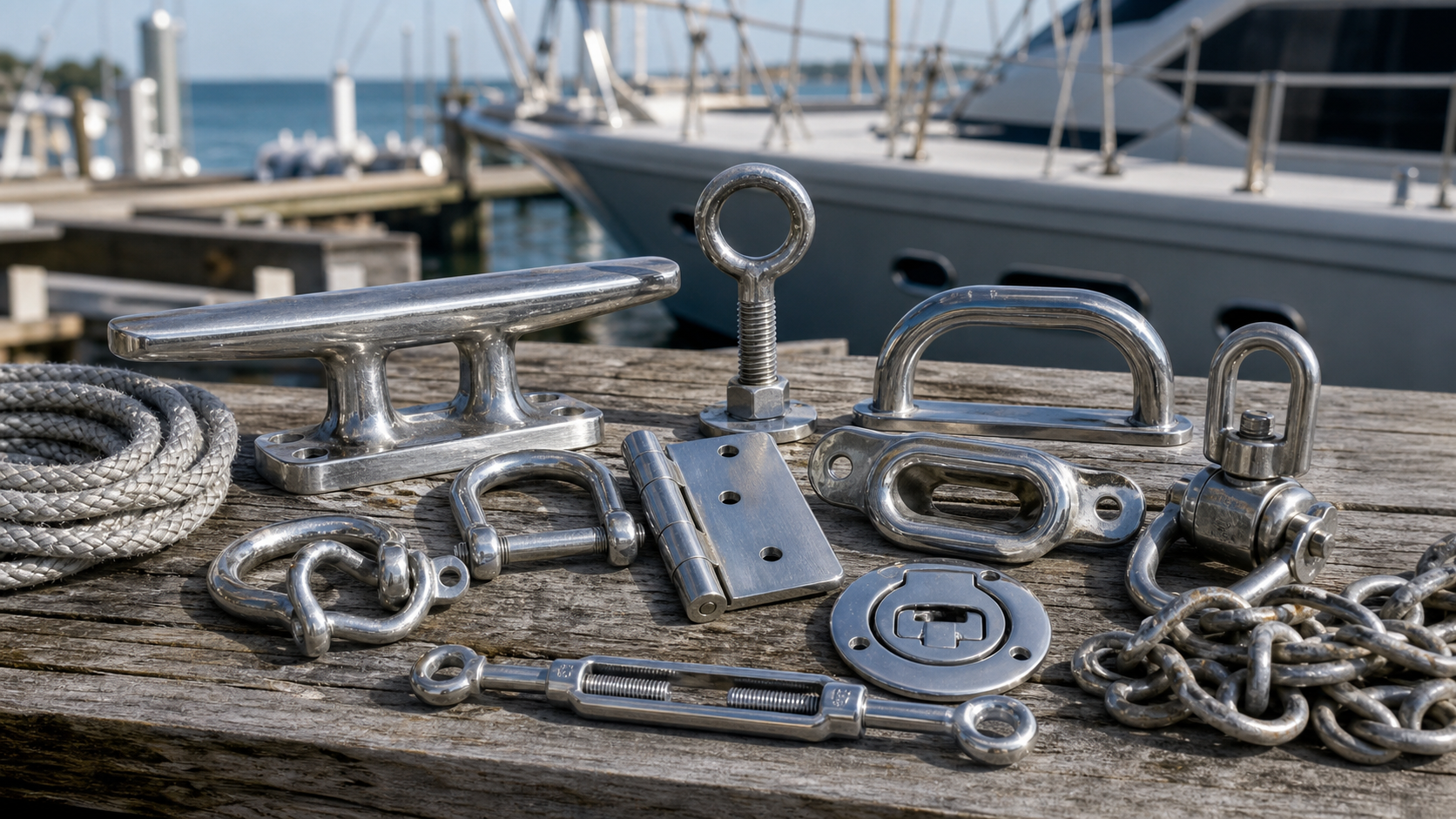
Marine hardware components are often treated as secondary details, but modern vessels depend on them as much as engines, navigation electronics, and hull design. The small pieces of hardware fitted across the deck, rail, hatch, rigging, and access points often decide whether a vessel feels safe, dependable, and easy to maintain after years in saltwater service. A cleat that deforms under load, a hinge that starts binding, or a latch that will not seal properly can turn a routine voyage into an expensive repair.
For builders, refit yards, distributors, and vessel owners, choosing marine hardware is therefore not just a catalog exercise. The right component must match the vessel type, expected load, installation environment, material compatibility, inspection schedule, and long-term corrosion exposure. Below are ten essential marine hardware components that modern vessels rely on, along with practical notes on what to look for before specifying or purchasing them.
1. Deck Cleats and Mooring Fittings
Deck cleats, bollards, chocks, and fairleads handle the loads created during docking, towing, short-term mooring, and line handling. They may look simple, but they are among the most highly stressed pieces of deck hardware on many boats. A cleat should have enough bearing surface for the line, a base large enough to spread load into the deck structure, and smooth edges that will not damage rope fibers.
For modern vessels, 316 stainless steel is widely used because it offers strong corrosion resistance in marine atmospheres. For heavier commercial or offshore applications, buyers should also consider load rating, backing plate design, casting quality, weld integrity, and whether the fitting can be inspected easily after installation. A beautiful polished cleat is not useful if the deck underneath cannot carry the load.
2. Shackles, Swivels, and Connecting Links
Shackles and swivels connect anchors, chains, safety lines, blocks, and many moving assemblies. Their job is to transfer load while allowing controlled movement. In real service, they are exposed to shock loads, twisting forces, sand, salt crystals, and repeated wet-dry cycles. That is why the pin fit, thread quality, surface finish, and material grade matter as much as the stated working load.
Look for components with clean machining, reliable pin engagement, and geometry that suits the load direction. Oversizing is common, but it should not replace proper selection. A shackle that is too large for the chain or eye plate can load unevenly; a swivel used in the wrong orientation can become the weak point in the anchoring system.
3. Hinges for Hatches, Doors, and Access Panels
Marine hinges are used on hatches, lockers, engine-room access panels, doors, fold-down seats, and equipment covers. They must resist corrosion while maintaining smooth movement under vibration and misalignment. A poor hinge does not simply look worn; it can cause water leaks, panel distortion, rattling, and premature failure of fasteners around the mounting points.
When choosing hinges, check the pin design, knuckle thickness, mounting hole layout, and whether the hinge can carry the door or hatch weight without sagging. For exposed locations, stainless steel hardware with proper passivation and a controlled surface finish is usually preferred. For concealed or custom hinges, dimensional consistency becomes especially important because small errors can affect the final fit.
4. Latches, Hasps, and Hatch Locks
Latches and locks secure compartments, hatches, deck boxes, and cabin doors. On a vessel, a latch must do more than close. It must remain secure under vibration, tolerate saltwater exposure, and often compress a gasket enough to limit water ingress. Hardware used on outdoor hatches should be easy to operate with wet hands and should not seize after months of exposure.
For procurement teams, the key points are spring quality, cam engagement, gasket compression range, handle clearance, and corrosion resistance around small moving parts. If a latch contains mixed metals, check whether galvanic corrosion could occur when the fitting is mounted to aluminum or carbon steel structures.
5. Eye Bolts, Pad Eyes, and Lifting Points
Eye bolts and pad eyes are used for tie-downs, safety lines, lifting points, fender attachment, and deck equipment restraint. Because they often carry dynamic loads, their installation is just as important as their material. A strong pad eye mounted with weak fasteners or thin backing can fail long before the hardware itself reaches its rated capacity.
Modern marine applications usually favor smooth, fully formed eyes, generous radii, and proper weld or casting quality. If the fitting is used for lifting or personnel safety, it should be selected according to the relevant load requirement, not only by size or appearance. Traceability and repeatable manufacturing quality become more important as the application becomes more critical.
6. Turnbuckles and Rigging Adjusters
Turnbuckles allow precise tension adjustment in standing rigging, railing systems, shade structures, support wires, and some custom deck assemblies. They must combine accurate threads with enough resistance to vibration loosening and corrosion. A rough thread or poorly finished body can make adjustment difficult and can hide early signs of wear.
Good turnbuckles have clean right-hand and left-hand threads, reliable end fittings, and enough engagement length after adjustment. In saltwater service, periodic rinsing and inspection are still necessary, even with stainless steel. Galling can occur if stainless threads are forced dry, so suitable lubrication and careful installation are part of long service life.
7. Rail Fittings and Stanchion Hardware
Rail fittings support guardrails, handrails, ladders, boarding points, and safety barriers. Their role is partly structural and partly ergonomic. Crew and passengers naturally grab rails when the vessel moves, so fittings must feel solid and remain aligned. Loose rail bases are not only inconvenient; they can indicate deck core damage, fastener fatigue, or poor installation.
When specifying rail hardware, consider tube diameter, wall thickness, base angle, welding quality, fastener access, and drainage. Polished stainless steel is common, but the component should also avoid crevices where salt and moisture remain trapped. In custom vessel builds, consistent casting and machining help rail systems assemble cleanly without forcing parts into position.
8. Fasteners, Screws, Nuts, and Washers
Fasteners hold the entire hardware system together. Marine screws, bolts, nuts, and washers must be selected for strength, corrosion behavior, thread compatibility, and contact with surrounding materials. It is common to focus on the visible component and overlook the fastener, but a premium fitting mounted with unsuitable screws will still fail.
316 stainless steel fasteners are a common choice for many marine environments, while duplex grades may be considered where higher strength and corrosion resistance are required. Avoid random mixing of stainless, aluminum, galvanized steel, and copper alloys without considering galvanic potential. Use suitable bedding compounds, isolation washers, and regular inspection where dissimilar metals cannot be avoided.
9. Fairleads, Chocks, and Rope Guides
Fairleads and chocks guide ropes so loads enter the vessel structure at a controlled angle. They protect lines from abrasion and help crew handle docking, anchoring, and towing operations more safely. A poorly shaped fairlead can create sharp bending, accelerate rope wear, and increase friction at exactly the moment smooth line handling is needed.
Buyers should look for smooth radii, adequate wall thickness, secure mounting points, and geometry that matches the rope size. For frequently used mooring positions, surface finish is not cosmetic; it directly affects line life. Cast or forged parts should be free from rough edges, pits, and thin sections that can become stress points.
10. Anchor Rollers, Chain Stoppers, and Windlass Hardware
The anchoring system experiences heavy loads, impacts, and constant movement. Anchor rollers, chain stoppers, chain guides, and windlass-related fittings need to keep the anchor secure while allowing clean deployment and retrieval. Wear surfaces should be strong enough to handle chain contact without deformation, and moving parts should be easy to inspect.
In this area, alignment matters. If the roller, windlass, chain pipe, and locker opening do not work together, even high-quality components will suffer. A good setup reduces chain jumping, protects the bow, and lowers the chance of sudden shock loads reaching the windlass gearbox.
Material Selection: Why Stainless Steel Still Dominates
Marine hardware is commonly made from stainless steel because it offers a useful balance of strength, corrosion resistance, appearance, and manufacturability. Grade 316 is widely used for marine deck hardware because molybdenum improves resistance to chloride attack compared with 304. In more demanding environments, duplex stainless steel can offer higher strength and better resistance to certain forms of corrosion, though cost and fabrication requirements must be considered.
However, stainless steel is not maintenance-free. Crevice corrosion can develop where oxygen is limited, salt remains trapped, or hardware is installed against unsuitable materials. Good design should reduce water traps, allow rinsing, and avoid unnecessary crevices. Proper passivation, surface finishing, and quality control also help the hardware perform as expected.
How to Evaluate Marine Hardware Before Buying
- Check the application load. Decorative fittings and structural fittings should never be treated the same.
- Confirm the material grade. Ask for 316, duplex, or another specified grade when the environment requires it.
- Look at the manufacturing method. Precision casting, forging, machining, and welding each have different strengths.
- Inspect finish quality. Smooth surfaces reduce rope wear and make corrosion easier to spot.
- Review installation details. Backing plates, bedding, fastener choice, and access for maintenance all affect real service life.
- Consider replacement availability. Standardized sizes and consistent production make maintenance simpler.
Final Thoughts
The best marine hardware components are not always the largest, brightest, or most expensive. They are the parts that match the vessel, handle the expected load, resist the environment, and remain serviceable after years of use. For modern vessels, careful hardware selection improves safety, reduces downtime, and protects the value of the entire build.
Whether you are sourcing deck fittings, stainless steel hinges, latches, rail hardware, shackles, or custom cast components, the right supplier should understand both manufacturing quality and marine service conditions. In saltwater, small hardware decisions have long consequences.