




Last Updated: July 4, 2026
Stainless steel tactile indicators are small architectural safety components with a large responsibility. They help people who are blind or visually impaired detect hazards, follow safe routes, and navigate public spaces with greater confidence. For architects, accessibility consultants, contractors, distributors, and OEM buyers, the challenge is not only choosing a good-looking product. The indicators must be correctly specified, precisely manufactured, safely installed, and suitable for the service environment.
AODSON manufactures stainless steel tactile studs, tactile strips, warning indicators, directional indicators, and related accessibility hardware for commercial, transportation, public infrastructure, and OEM projects. This guide explains the main types, materials, manufacturing methods, installation options, design considerations, quality checks, and purchasing questions that matter before an order is placed.
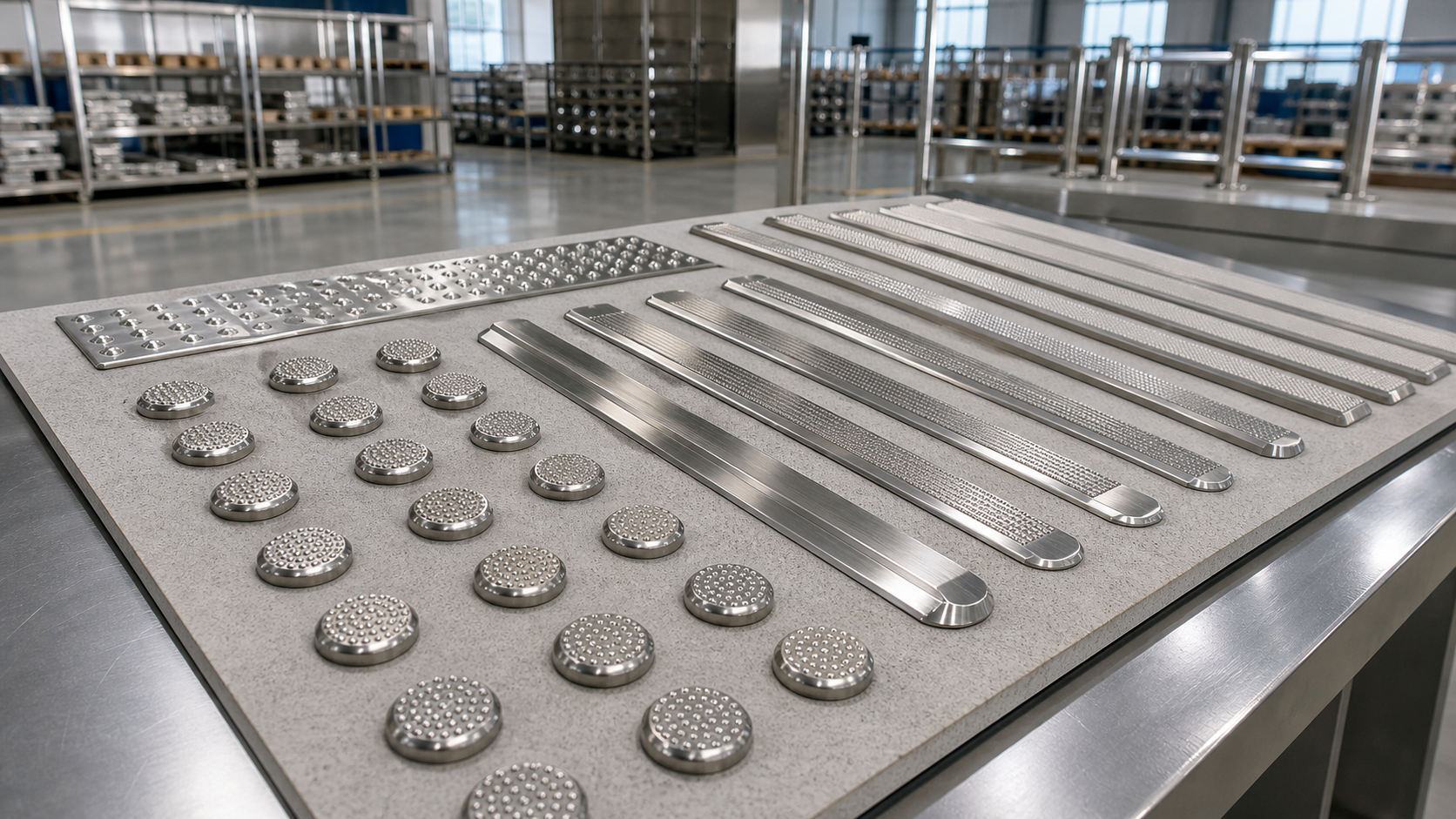
Table of Contents
- What Are Stainless Steel Tactile Indicators?
- Types of Tactile Indicators
- Material Selection
- Manufacturing Process
- Installation Methods
- Accessibility Standards and Design Considerations
- Typical Applications
- Quality Control and Material Traceability
- Why Choose AODSON for OEM Tactile Indicators?
- Frequently Asked Questions
What Are Stainless Steel Tactile Indicators?
Stainless steel tactile indicators are raised ground surface elements installed on walking surfaces to provide tactile and visual cues. They are commonly used at stairs, ramps, escalators, transit platforms, crossings, building entrances, corridors, elevators, and decision points in public buildings.
Depending on the design, tactile indicators may warn users about a hazard, mark the edge of a platform, show a change in level, or guide movement along an accessible route. Stainless steel is selected when the project needs strong wear resistance, corrosion resistance, premium appearance, fire resistance, and a long service life.
In many projects, tactile indicators are part of broader architectural hardware packages, especially when the visible finish must match stainless railings, access covers, drainage hardware, or other building components.
Types of Tactile Indicators
The two most common stainless steel tactile indicator families are tactile studs and tactile strips. Studs are usually used for warning patterns, while strips are commonly used for directional guidance.
| Type | Primary Function | Common Shape | Typical Locations |
|---|---|---|---|
| Tactile studs | Warning or hazard detection | Raised round domes or truncated domes | Stairs, ramps, platform edges, crossings, escalators |
| Tactile strips | Directional route guidance | Raised linear bars or ribs | Airport walkways, station concourses, public corridors |
| Warning indicators | Alert users to danger, level changes, or decision points | Stud pattern | Transit platforms, curb ramps, stair approaches |
| Directional indicators | Guide users along a safe accessible path | Parallel strips | Large public buildings, universities, hospitals, transport hubs |
| Integrated tile systems | Combine tactile elements with a base panel | Studs or strips fixed to plates or tiles | Retrofit projects, modular flooring, temporary route changes |
Tactile Studs
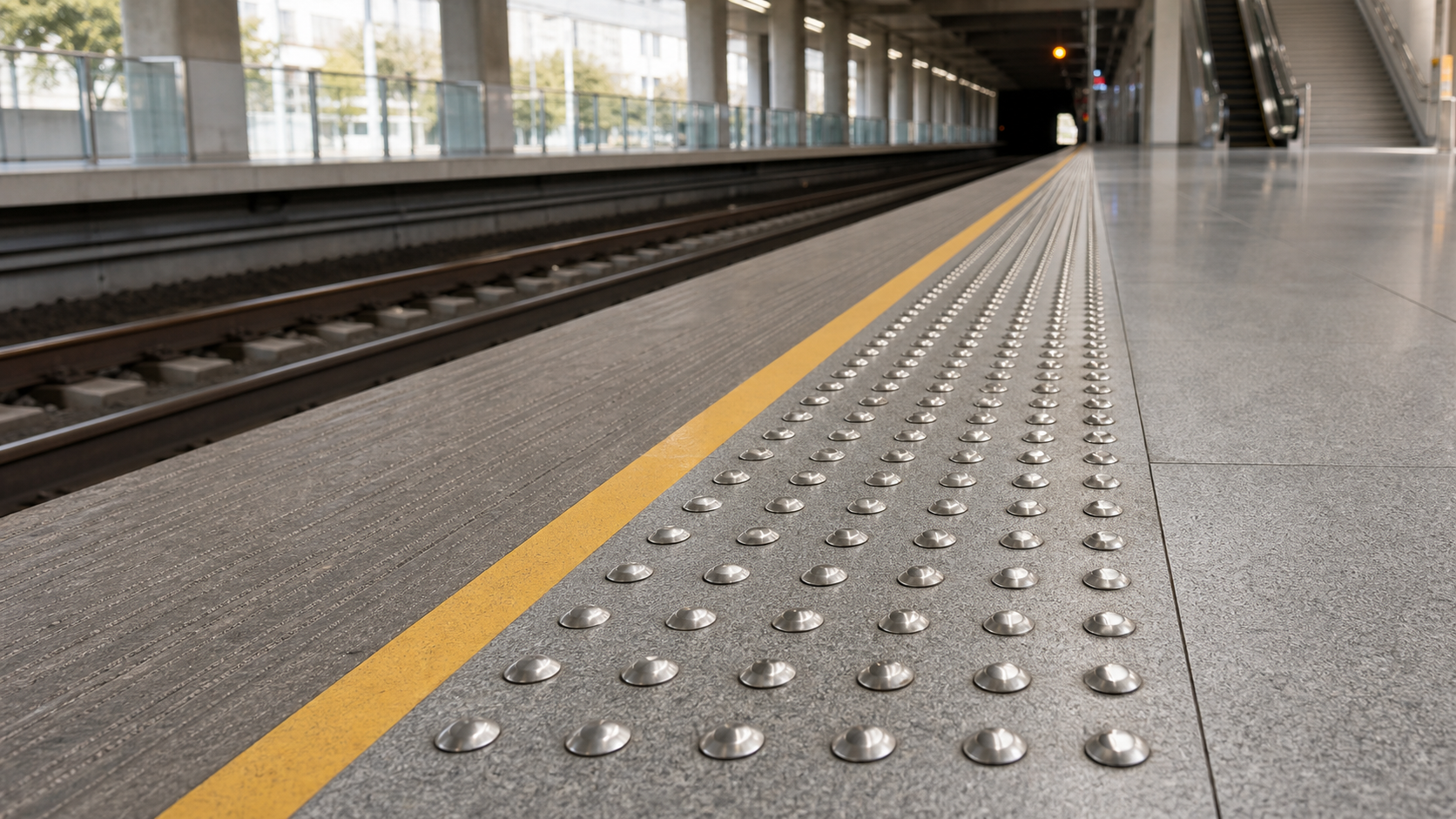
Tactile studs are individual raised domes installed in a regular spacing pattern. They are often used as warning indicators because the dotted surface can be detected underfoot or with a cane. Stainless steel studs may be solid, hollow, cast, machined, or assembled with threaded stems, adhesive bases, or expansion anchors.

Tactile Strips
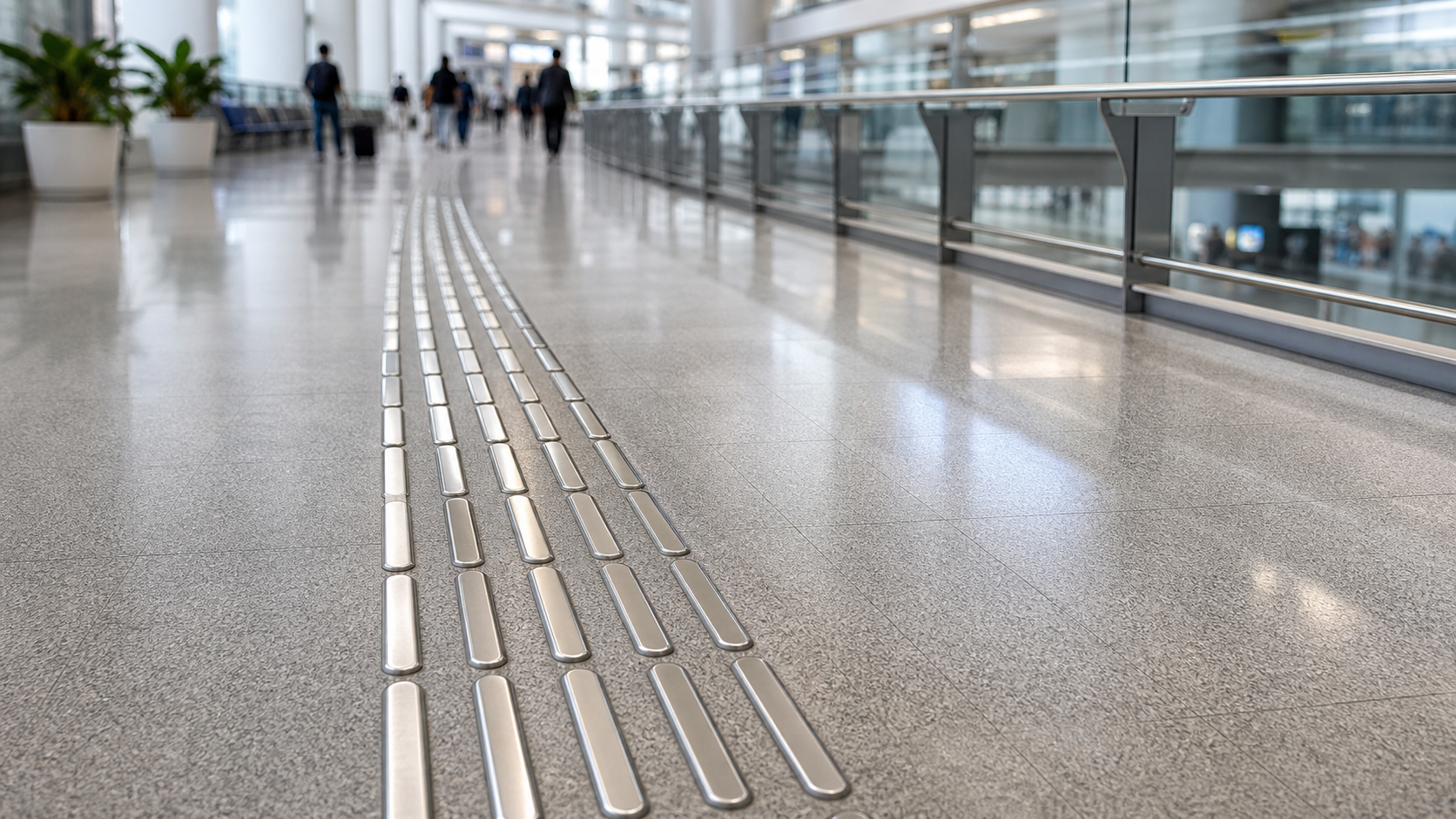
Tactile strips are long raised bars used to provide directional guidance. They can be installed as individual strips, modular sections, or bonded/anchored profiles. The top surface may be brushed, ribbed, grooved, or treated for slip resistance.
Warning Indicators
Warning indicators communicate caution. Their layout, width, offset from hazards, and contrast should follow the applicable accessibility standard or project specification. A common mistake is selecting an attractive product but installing it with incorrect spacing or insufficient contrast.
Directional Indicators
Directional indicators guide users along a route. They should be continuous, logically aligned, and coordinated with entrances, elevators, ticketing areas, public counters, washrooms, and transit connections. For complex public buildings, tactile guidance is most effective when it is planned early in the wayfinding design.
Material Selection
Stainless steel tactile indicators are exposed to foot traffic, cleaning chemicals, moisture, deicing salts, outdoor weather, and sometimes coastal or industrial air. Material grade affects corrosion resistance, surface appearance, cost, and expected service life.
| Material | Strengths | Limitations | Recommended Use |
|---|---|---|---|
| 304 stainless steel | Good general corrosion resistance, strong availability, cost-effective, easy to finish | Less resistant to chloride exposure than 316 | Indoor commercial buildings, universities, office towers, shopping centers |
| 316 stainless steel | Improved chloride and moisture resistance, suitable for demanding public areas | Higher material cost than 304 | Airports, hospitals, coastal cities, exterior walkways, washdown areas |
| Duplex stainless steel | High strength and excellent chloride stress corrosion resistance | Higher cost and more controlled manufacturing requirements | Marine, heavy infrastructure, aggressive outdoor or industrial environments |
For most indoor architectural projects, 304 stainless steel performs well. For exterior, coastal, wet, or high-cleaning-frequency environments, 316 stainless steel is usually the safer specification. Duplex stainless steel is reserved for demanding applications where strength and corrosion resistance justify the added cost.
Manufacturing Process
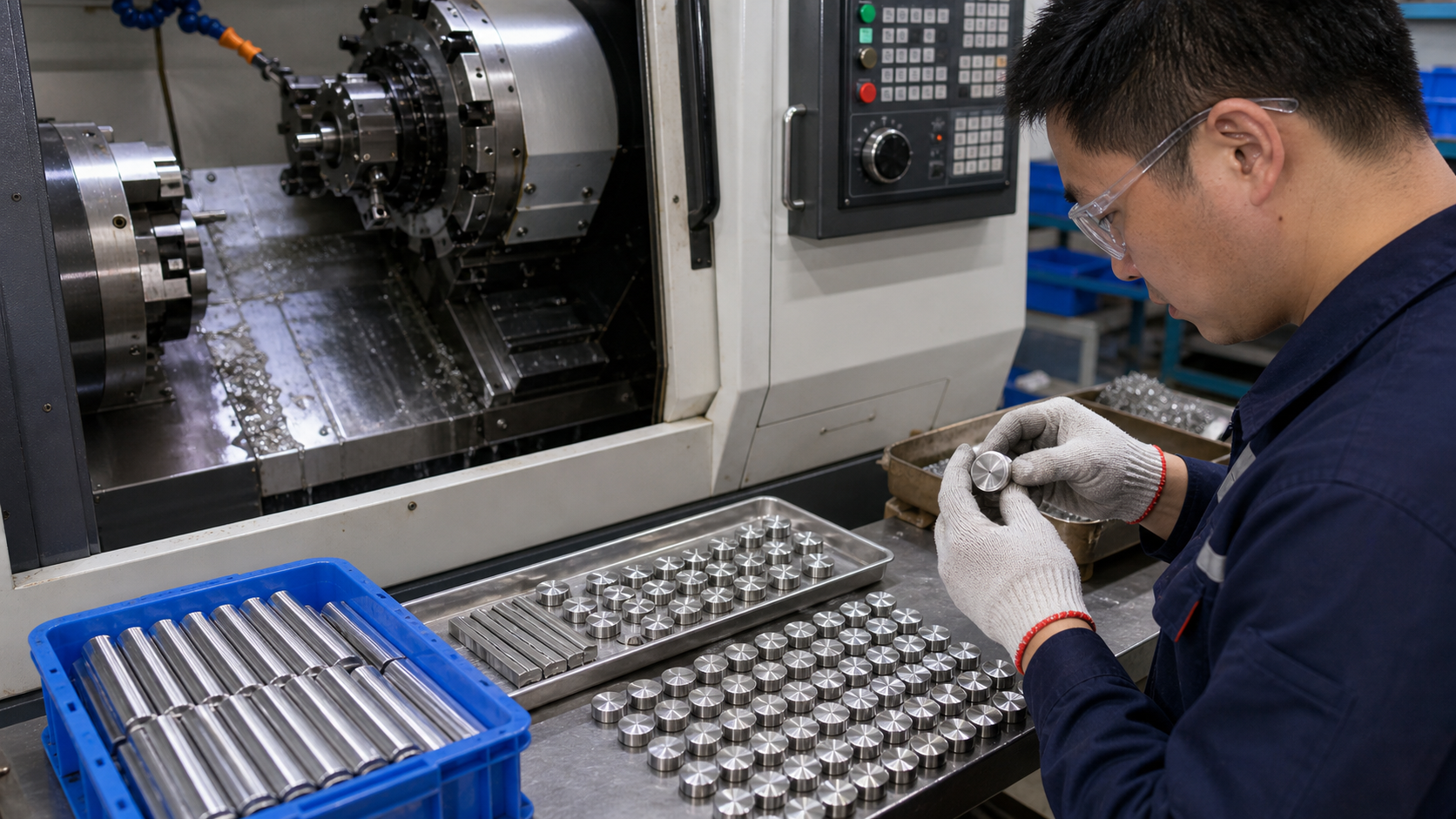
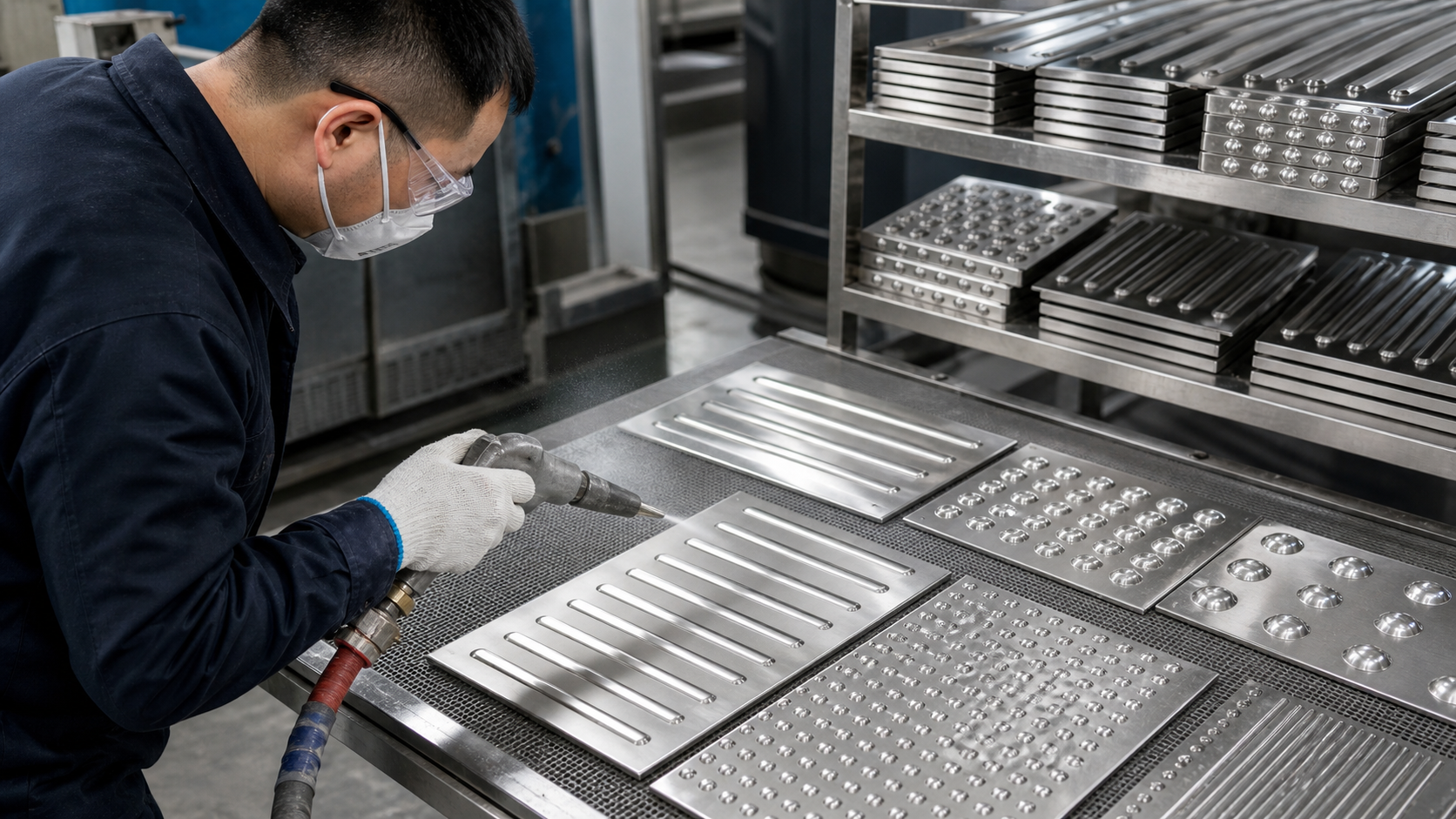
High-quality tactile indicators depend on repeatable geometry, clean edges, stable installation features, surface consistency, and slip-resistant top treatment. AODSON supports precision casting, CNC machining, polishing, brushing, anti-slip treatment, inspection, and packaging for OEM accessibility hardware.
Investment Casting
Investment casting is useful for tactile studs or profiles with complex shapes, underside features, stems, and consistent domed surfaces. It can reduce machining time while allowing durable stainless steel geometry for high-volume OEM orders.

CNC Machining
CNC machining is used to control height, diameter, grooves, countersinks, threaded stems, anchor details, and strip dimensions. Machining is especially important when the product must fit a template, meet tight height tolerance, or use mechanical anchoring.
Surface Finishing
Finishes may include brushed, mirror polished, bead blasted, satin, grooved, or patterned surfaces. The right finish depends on appearance, slip resistance, cleaning method, and contrast with the surrounding floor. In public buildings, the finish should be durable enough to resist wear while still providing detectable contrast.
Anti-Slip Treatment
Anti-slip performance matters because tactile indicators are installed where people walk, turn, stop, and change direction. Raised domes and strips can be grooved, textured, patterned, bead blasted, or combined with anti-slip inserts depending on the application.
Installation Methods
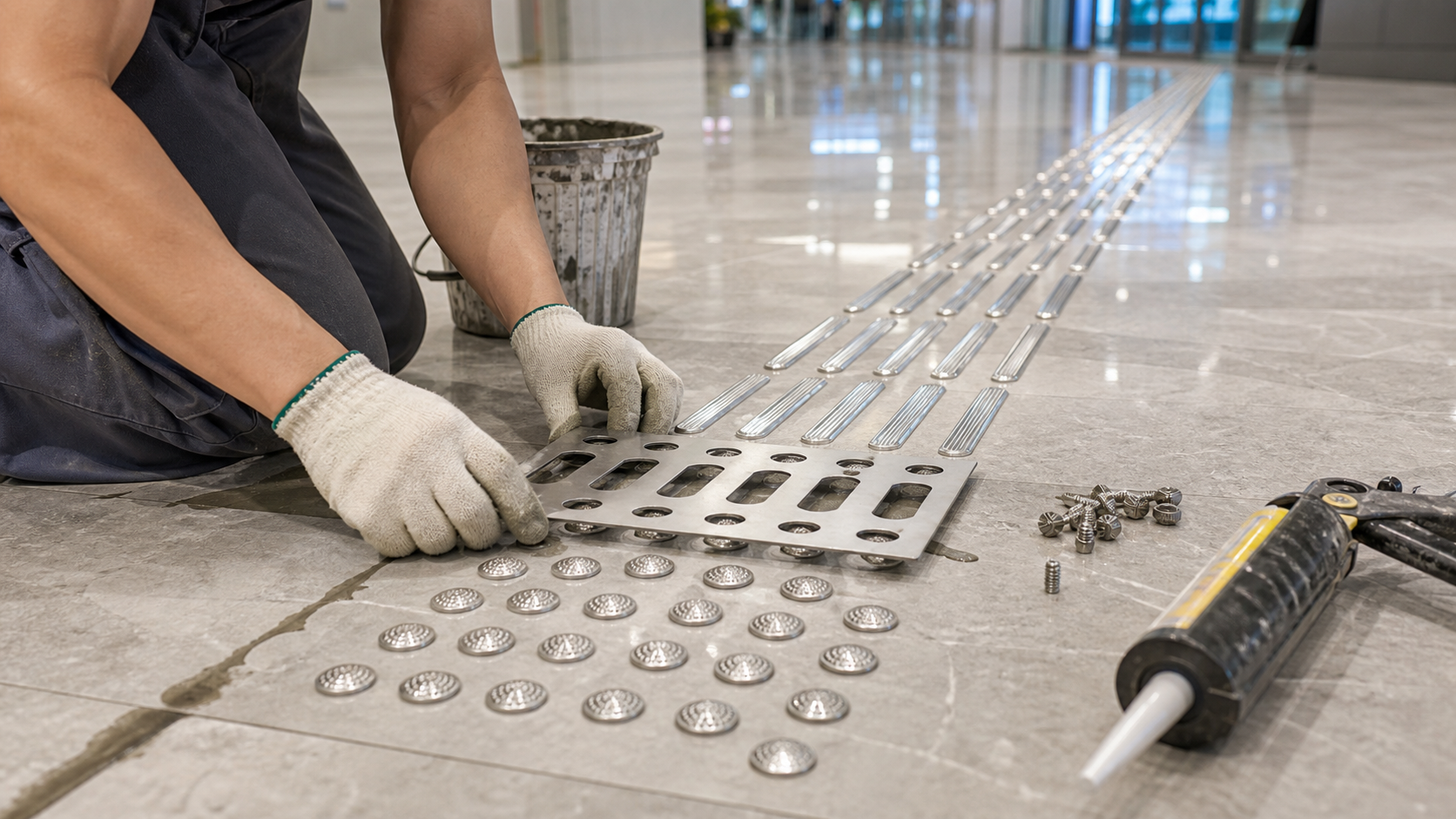
Installation method affects long-term performance as much as product material. A high-quality tactile indicator can fail if the floor surface, adhesive, drilling depth, anchor, or spacing template is wrong.
| Installation Method | Best For | Advantages | Key Checks |
|---|---|---|---|
| Adhesive fixing | Smooth indoor floors, retrofit work | Fast installation, no drilling, clean appearance | Floor cleanliness, adhesive compatibility, curing time |
| Mechanical anchor | High-traffic floors, exterior areas, stone or concrete | Strong retention, suitable for demanding service | Drill depth, anchor diameter, substrate strength, waterproofing |
| Threaded stem | New construction or controlled substrate thickness | Secure fixing and accurate position control | Hole layout, nut/adhesive access, underside clearance |
| Screw fixing | Tactile strips, removable sections, serviceable systems | Easy replacement and strong clamping | Countersink finish, screw grade, loosening prevention |
| Modular plate or tile | Retrofit, temporary route changes, modular flooring | Factory-controlled spacing and quicker installation | Edge trip risk, plate thickness, floor transition |
Accessibility Standards and Design Considerations
Tactile indicator requirements vary by country, region, building type, and project authority. Common references include local accessibility codes, transport authority standards, building regulations, and project specifications. Buyers should confirm the exact required geometry, spacing, contrast, placement, and installation zone before ordering.
Important design considerations include:
- Detectability: Raised height and pattern must be detectable underfoot or by cane.
- Visual contrast: The indicator should contrast with the surrounding floor where required.
- Slip resistance: The surface must remain safe in dry, wet, and cleaned conditions.
- Spacing: Stud and strip layout should follow the applicable standard or approved drawing.
- Durability: Material, fixing method, and finish must match traffic and exposure.
- Maintainability: Damaged indicators should be replaceable without major floor repair.
Because accessibility standards are jurisdiction-specific, the manufacturer should not be asked to guess final compliance from a photo. Provide drawings, code references, spacing requirements, and installation conditions for the most accurate recommendation.
Typical Applications
Stainless steel tactile indicators are widely used in high-traffic public and commercial environments where accessibility, durability, and appearance all matter.
| Application | Typical Product | Material Recommendation | Design Priority |
|---|---|---|---|
| Railway and metro stations | Warning studs and directional strips | 316 stainless steel or project-specified grade | Platform safety, wear resistance, slip resistance |
| Airports | Directional strips, warning studs | 304 or 316 stainless steel | Wayfinding, premium appearance, heavy foot traffic |
| Shopping centers | Studs, strips, modular plates | 304 stainless steel | Architectural finish, clean installation, replacement access |
| Hospitals | Directional strips and warning indicators | 316 stainless steel for wet or cleaning-intensive zones | Hygiene, accessibility, quiet and safe circulation |
| Universities | Directional strips, entrance warning zones | 304 or 316 stainless steel | Durability, wayfinding, campus accessibility |
| Public infrastructure | Warning studs, platform indicators, outdoor strips | 316 or duplex stainless steel | Weather resistance, high traffic, standard compliance |
Quality Control and Material Traceability
For OEM manufacturing and export projects, quality control should cover material, geometry, surface finish, installation features, and packaging. AODSON can support inspection steps based on drawings, samples, standards, and buyer specifications.
| Inspection Item | What to Check | Why It Matters |
|---|---|---|
| Material grade | 304, 316, duplex certificate or PMI when required | Confirms corrosion resistance and specification compliance |
| Stud or strip dimensions | Diameter, height, width, length, edge radius, groove depth | Ensures tactile detectability and installation fit |
| Spacing template | Pattern pitch, row alignment, strip parallelism | Supports code-compliant installation layout |
| Surface finish | Brushing direction, anti-slip texture, polishing quality | Affects appearance, safety, and cleanability |
| Fixing detail | Stem, screw, anchor, adhesive base, countersink | Determines long-term retention and maintenance method |
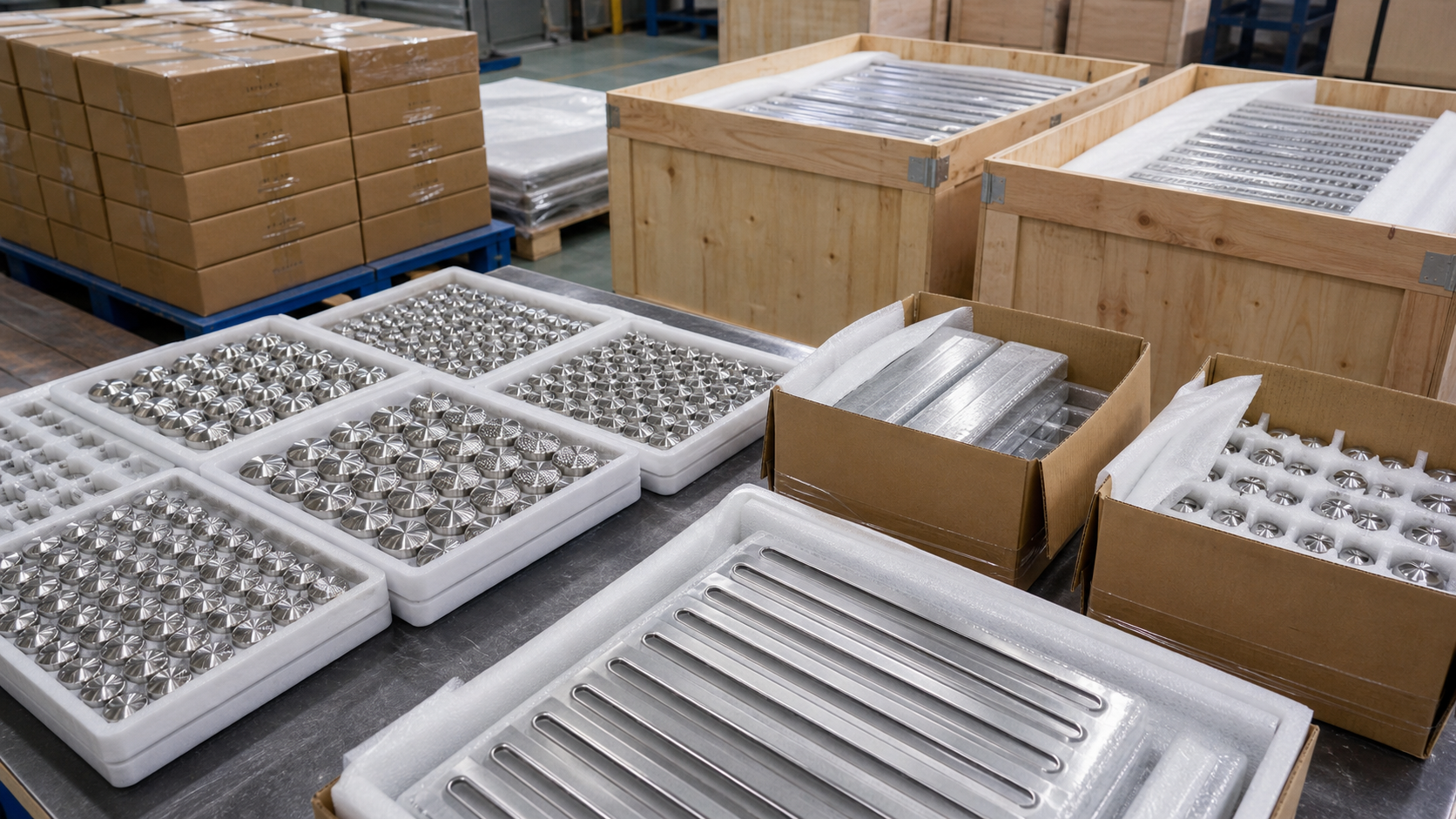
| Packaging | Quantity sorting, foam protection, cartons, labels, crates | Prevents scratches and mixing during export shipment |
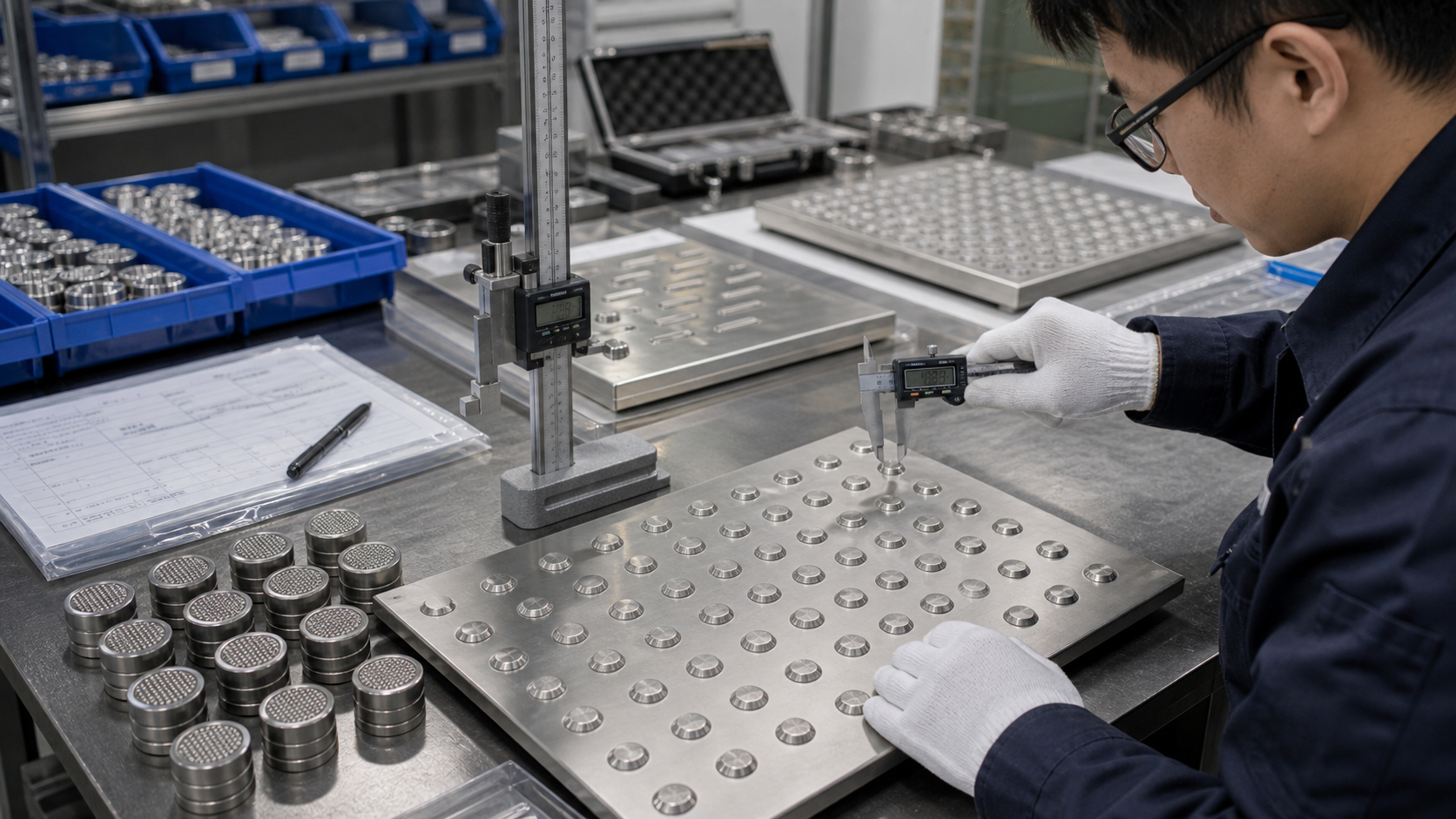
Learn more about AODSON’s inspection process on our quality control page.
Why Choose AODSON for OEM Tactile Indicators?
AODSON supports custom stainless steel tactile indicator programs for buyers who need reliable export manufacturing, project-specific geometry, consistent finishing, and OEM packaging. We work with drawings, samples, specifications, and batch requirements to manufacture tactile studs, strips, anchors, and related stainless steel accessibility hardware.
- OEM manufacturing for stainless steel tactile studs, strips, warning indicators, and directional indicators.
- Material options including 304, 316, and duplex stainless steel.
- Investment casting, CNC machining, surface finishing, and anti-slip treatment support.
- Custom fixing options such as adhesive base, threaded stem, screw fixing, and anchor systems.
- Inspection, material traceability, export packaging, and project communication for global buyers.
If you are developing stainless steel tactile indicators for a public building, transit project, distributor program, or OEM product line, send drawings, material requirements, installation method, quantity, and standard references through Request a Quote or contact AODSON.
Frequently Asked Questions
What are stainless steel tactile indicators used for?
They are used to provide raised tactile and visual cues on walking surfaces. They warn users about hazards, mark decision points, and guide accessible routes in public and commercial spaces.
What is the difference between tactile studs and tactile strips?
Tactile studs are raised dots, often used for warning patterns. Tactile strips are raised linear bars, usually used for directional guidance along accessible routes.
Are 304 stainless steel tactile indicators suitable for outdoor use?
304 can be used in some sheltered outdoor areas, but 316 is generally preferred for wet, coastal, chloride-exposed, or heavily cleaned environments.
How are stainless steel tactile indicators installed?
Common methods include adhesive fixing, mechanical anchors, threaded stems, screw fixing, and modular plates. The best method depends on the floor material, traffic level, exposure, and maintenance plan.
Do tactile indicators need to meet accessibility standards?
Yes. Geometry, spacing, contrast, location, and installation pattern should follow the applicable local accessibility code, transport standard, or project specification.
Can tactile indicators be customized for OEM buyers?
Yes. AODSON can customize dimensions, materials, surface finish, anti-slip texture, fixing method, packaging, and batch inspection requirements based on drawings or samples.
What finish is best for stainless steel tactile indicators?
Brushed, bead blasted, grooved, and anti-slip treated finishes are common. The best choice depends on appearance, slip resistance, cleaning, traffic, and contrast requirements.
Can stainless steel tactile indicators be used in airports and railway stations?
Yes. Stainless steel tactile indicators are widely used in airports, railway stations, metro platforms, and transport hubs because they are durable, clean-looking, and suitable for heavy foot traffic.
What information is needed for a quotation?
Provide drawings, product type, dimensions, material grade, finish, installation method, applicable standard, quantity, packaging requirements, and project environment.
How can buyers avoid installation problems?
Confirm the standard, use accurate spacing templates, prepare the floor correctly, choose a compatible fixing method, allow proper adhesive curing, and inspect the layout before opening the area to traffic.
Conclusion
Stainless steel tactile indicators are essential accessibility components for safe, inclusive, and durable public environments. The best results come from matching the indicator type, material, surface finish, fixing method, and layout to the project standard and service environment. Manufacturing consistency, anti-slip treatment, inspection, and packaging are just as important as product appearance.
For stainless steel tactile studs, tactile strips, warning indicators, directional indicators, and OEM accessibility hardware, AODSON can support material selection, manufacturing, finishing, inspection, and export supply. Request a quote or contact us to discuss your project.
Author
AODSON Engineering Team
AODSON’s engineering and manufacturing team works with stainless steel fabrication, investment casting, CNC machining, surface finishing, quality control, and export manufacturing for custom architectural hardware and accessibility components.