





Marine hardware performance depends on alloy, geometry, finish and verified load requirements.
316 stainless steel is common for marine hardware, while duplex and higher-alloy materials may be appropriate for more severe exposure. The manufacturing route can combine investment casting, CNC machining, forming, welding, polishing and passivation. Load-rated applications require the applicable standards, tests and acceptance criteria to be agreed before production.
- Define saltwater exposure, working load and safety requirements.
- Identify critical interfaces, finish and corrosion-control details.
- Agree material traceability and testing before production approval.
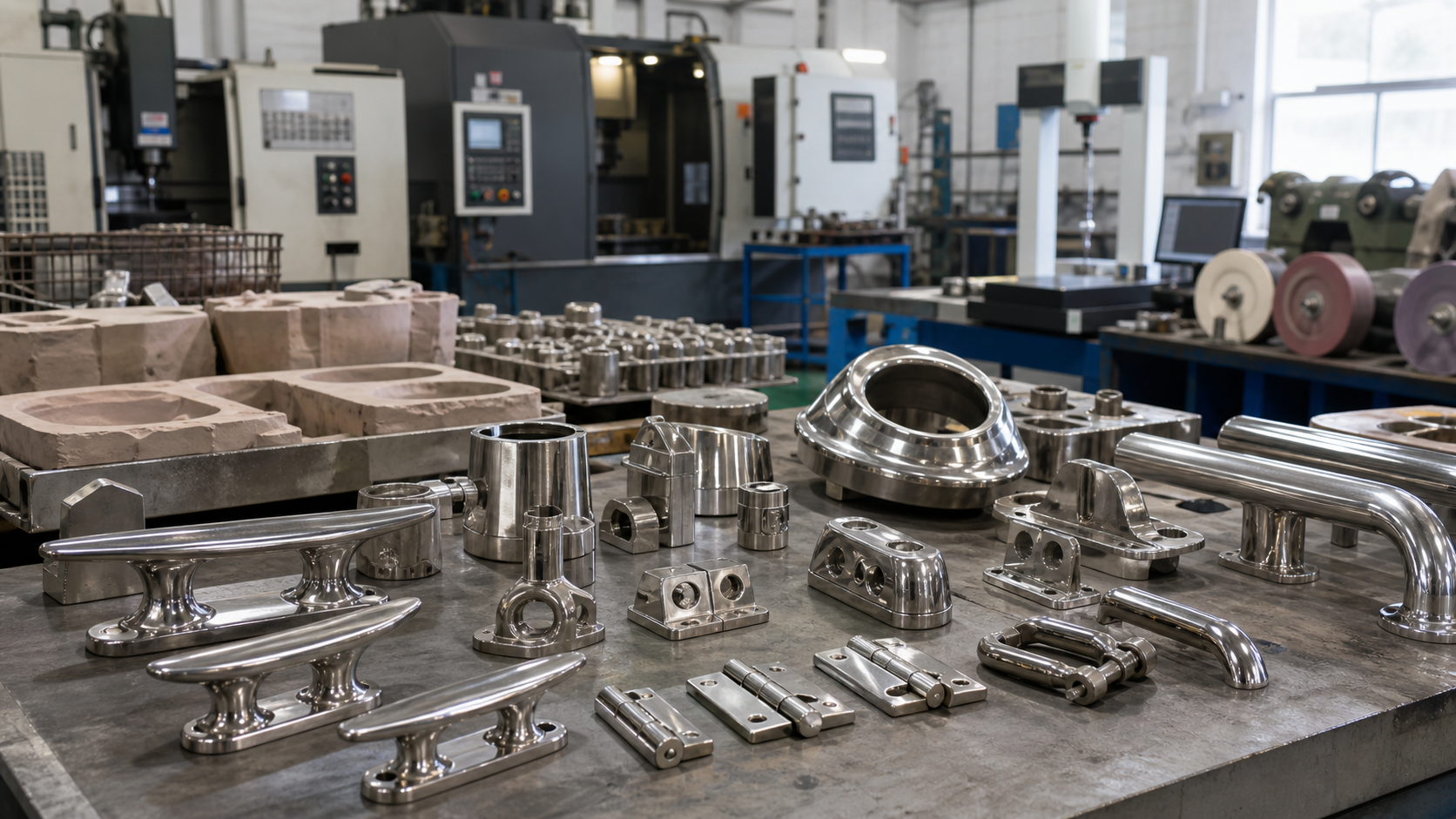
Marine hardware looks simple from the outside. A cleat, hinge, shackle, rail fitting, turnbuckle, deck plate, or custom bracket is often a small part on a boat, but it works in a very difficult environment: salt water, vibration, UV exposure, repeated loading, and tight installation space. For boat builders, hardware brands, distributors, and project contractors, the real challenge is not only buying a finished component. It is finding a manufacturing partner that can turn drawings or samples into stable, repeatable, export-ready parts.
That is why one-stop marine hardware manufacturing services from China have become a practical option for many international buyers. When casting, machining, stamping, polishing, surface treatment, assembly, inspection, and packaging are coordinated under one supply chain, projects move faster and quality problems are easier to trace before shipment.
What One-Stop Manufacturing Means in Marine Hardware
In a real production project, “one-stop” should not mean a factory simply says yes to everything. It should mean there is a controlled process from technical review to final delivery. A reliable supplier will check the drawing, confirm the material, suggest a suitable process, build samples, inspect critical dimensions, manage finishing, and prepare packaging that protects polished or threaded surfaces during transport.
For marine hardware, this is especially important because many parts combine appearance and function. A polished stainless steel deck fitting must look clean on the surface, but it also needs correct hole position, consistent thread quality, suitable strength, and good resistance to corrosion. If these steps are handled by separate suppliers without clear coordination, small errors can become expensive after assembly.
Typical Marine Hardware Products We Can Support
A one-stop manufacturing workflow is suitable for both standard and customized marine components. Common product groups include stainless steel boat cleats, hinges, hasps, hooks, shackles, eye plates, pad eyes, turnbuckles, handrail fittings, deck fittings, rigging hardware, brackets, custom castings, CNC machined parts, and stamped metal accessories.
Some buyers already have a complete 2D or 3D drawing. Others send an existing sample and need reverse engineering support. In both cases, the most important early step is to understand how the part will be used: whether it carries load, whether it is exposed directly to seawater, whether the surface is visible to the end customer, and whether it must fit with existing hardware or installation holes.
Choosing the Right Material for Saltwater Use
Material selection is one of the areas where marine hardware manufacturing cannot be treated like ordinary metal fabrication. Stainless steel is widely used, but the grade and finishing method matter. 304 stainless steel may be acceptable for many general applications, while 316 stainless steel is often preferred for better corrosion resistance in marine environments. For special projects, duplex stainless steel, carbon steel with protective coating, brass, aluminum, or other alloys may also be considered.
A practical supplier should discuss the balance between corrosion resistance, strength, cost, surface finish, and machinability. Over-specifying material can increase cost unnecessarily. Under-specifying it can create rust complaints, warranty issues, or early failure. For custom marine parts, this discussion should happen before tooling or sample production begins.
Matching the Manufacturing Process to the Part
Different marine hardware parts need different processes. Investment casting is often suitable for complex stainless steel shapes such as cleats, hinges, hooks, and irregular fittings. CNC machining is useful for tight tolerances, threaded parts, pins, shafts, and functional surfaces. Stamping can be efficient for flat brackets, plates, washers, clips, and higher-volume sheet metal parts. Welding, polishing, passivation, vibration finishing, and assembly may be required after the main forming process.
The best process is not always the cheapest unit price on paper. A part that is difficult to machine from solid bar may be more economical as a casting plus secondary machining. A simple plate may not need casting at all. A good manufacturing partner should be able to explain the process choice clearly and show where the cost and quality risks are.
Quality Control: More Than a Final Check
Marine hardware quality control should start before production. Drawings need tolerance review. Tooling and fixtures need confirmation. Samples should be checked for dimensions, surface condition, assembly fit, and material requirements. During production, inspection should focus on the features that actually affect installation and service life: hole spacing, thread gauges, flatness, load-bearing geometry, surface defects, weld condition, and finishing consistency.
For export orders, buyers may also require material certificates, dimensional inspection reports, photos before shipment, salt spray testing, or packaging checks. These documents are not just paperwork. They help both sides reduce misunderstanding and keep quality expectations visible throughout the project.
Surface Finish and Packaging Matter
Many marine hardware components are visible on finished boats, docks, or marine equipment. Surface finish is therefore part of the product value. Mirror polishing, satin finishing, passivation, electropolishing, coating, or blasting should be chosen according to the product use and buyer’s market. A beautiful surface can still be damaged if parts rub against each other in cartons, so packaging design is also part of manufacturing quality.
For polished stainless steel fittings, individual wrapping, protective separators, clear labeling, and stable outer cartons can prevent scratches during long-distance shipping. For threaded or precision-machined parts, thread protection and moisture control should be considered.
Why Buyers Work with a China-Based Manufacturing Partner
China’s marine hardware supply chain offers a strong mix of casting, machining, stamping, polishing, tooling, and export experience. For buyers, the advantage is not only competitive cost. It is the ability to combine several production steps in one coordinated project, especially when the order includes both standard hardware and custom-developed parts.
Aodson works with customers who need practical manufacturing support rather than a simple catalog transaction. We can review drawings, discuss materials, recommend production processes, arrange samples, manage finishing, and support batch production with inspection and export packaging. This approach is useful for distributors developing private-label products, boat hardware brands extending a product line, and industrial buyers who need custom stainless steel parts for marine use.
From Drawing to Delivery
A typical project starts with drawings, samples, photos, or a product idea. After technical review, we confirm material, process, tolerance, finish, estimated quantity, and packaging requirements. If tooling is required, the tooling plan is confirmed before sample production. Samples are then inspected and adjusted if necessary. Once approved, the project moves to batch production, finishing, final inspection, packing, and shipment.
This step-by-step method may sound ordinary, but it is what keeps custom marine hardware projects under control. It gives buyers a clear view of cost, lead time, technical risk, and quality checkpoints before the product reaches the market.
Building Reliable Marine Hardware Starts with the Right Supplier
Marine hardware is small only in size. Its performance affects safety, appearance, installation efficiency, and long-term customer confidence. A one-stop manufacturing partner can help reduce supplier management work, improve communication, and keep technical responsibility in one place.
If you are sourcing standard marine fittings or developing custom stainless steel hardware, working with a manufacturer that understands casting, machining, finishing, inspection, and export packaging can make the project smoother from the first drawing to the final carton.