




Choose the stainless steel grade from the actual exposure and product requirements.
316 stainless steel contains molybdenum and generally provides stronger resistance to chlorides than 304, while 304 remains a practical choice for many general industrial and indoor applications. Neither grade is immune to corrosion, so the final choice should consider cleaning, temperature, fabrication, surface condition and the governing product standard.
- Define chloride exposure, cleaning chemicals and operating temperature.
- Confirm the product standard, certificate and fabrication requirements.
- Review welds, crevices and surface finish as part of corrosion control.
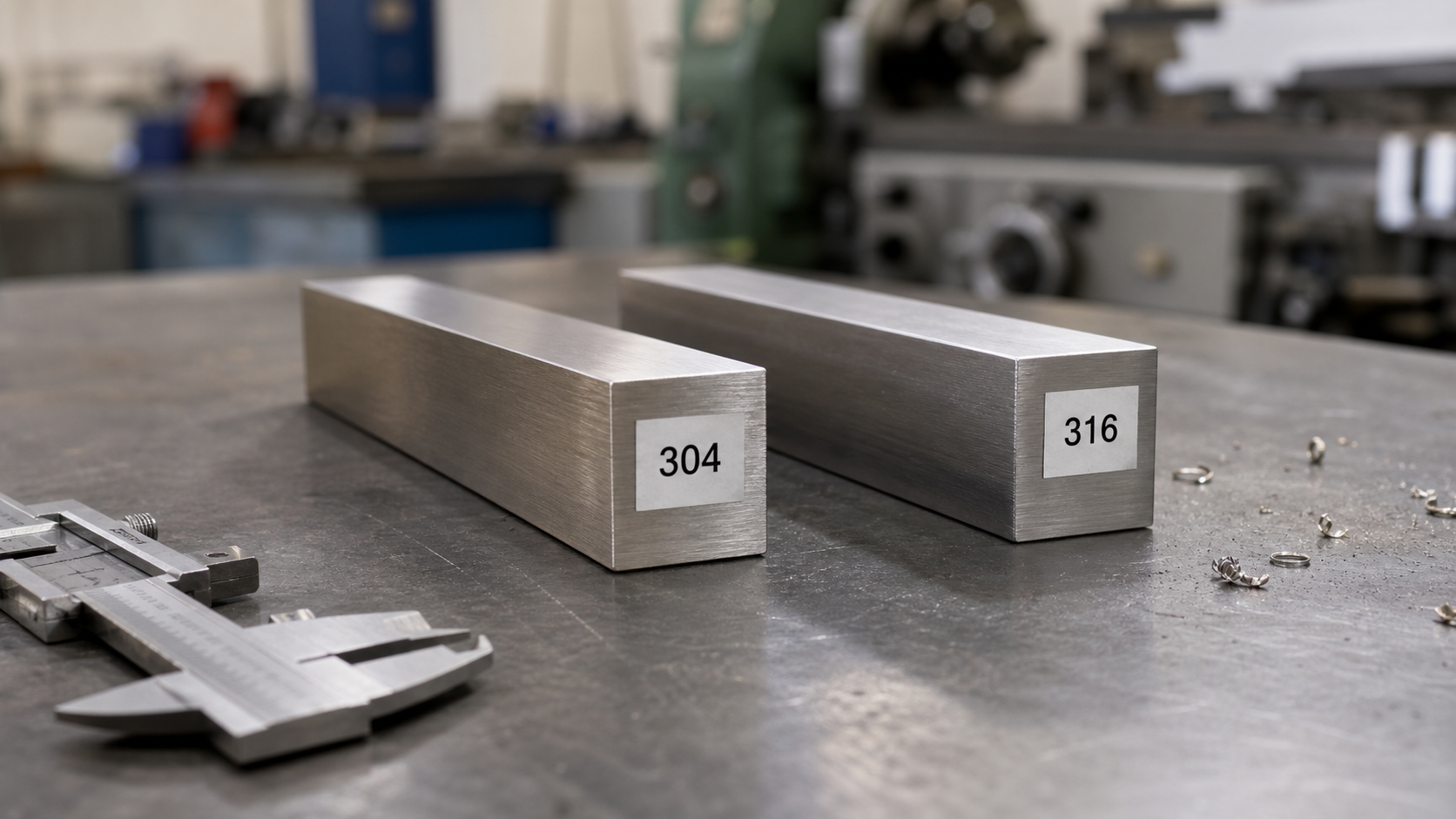
When comparing 304 vs 316 stainless steel for a real component, the right choice depends less on appearance and more on service environment. Both grades look almost identical at first glance, but 304 vs 316 stainless steel performance can differ sharply when the part has to live with chloride, salt spray, cleaning chemicals, higher corrosion risk, or a strict cost target.
In short, 304 stainless steel is a practical, cost-effective choice for general industrial environments. 316 stainless steel adds molybdenum, which gives it stronger resistance to pitting and crevice corrosion, especially in marine, chemical, and chloride-rich conditions.
Specifying 304 or 316 for a Custom Component
For procurement, specify the required material standard and product form as well as the familiar grade name. Describe the fluid or cleaning chemicals, service temperature, finish, critical dimensions and quantity so the manufacturing review addresses the actual part.
Explore stainless steel investment casting, custom marine hardware or architectural hardware manufacturing. Send your drawing for a material and manufacturing review.
What is 304 stainless steel?
304 stainless steel is the most common grade in the 300-series stainless family. It typically contains around 18% chromium and 8% nickel, which is why it is often described as 18/8 stainless steel. This composition gives 304 good corrosion resistance, clean appearance, and reliable performance in many indoor and mildly outdoor applications.
For machined parts, cast components, brackets, housings, food equipment parts, and general hardware, 304 is often the first grade engineers consider. It balances availability, fabrication performance, and cost very well.
What is 316 stainless steel?
316 stainless steel is also an austenitic stainless steel, but it includes molybdenum in addition to chromium and nickel. That molybdenum content is the key reason 316 performs better where chlorides or aggressive chemicals are present.
If the part will be used near seawater, exposed to de-icing salts, cleaned frequently with chemical agents, or installed in a corrosive processing environment, 316 is usually the safer option. It is not “rust-proof,” but it gives the surface more time and resistance before localized corrosion starts.
304 vs 316 stainless steel: main differences
| Factor | 304 stainless steel | 316 stainless steel |
|---|---|---|
| Main alloy difference | Chromium and nickel based | Chromium, nickel, plus molybdenum |
| Corrosion resistance | Good for general environments | Better in chloride, marine, and chemical environments |
| Pitting resistance | Moderate | Higher, especially around salt and chlorides |
| Cost | Usually lower | Usually higher because of molybdenum and nickel content |
| Typical use | General machinery, food equipment, brackets, housings | Marine fittings, chemical equipment, medical parts, coastal hardware |
| Appearance | Very similar to 316 | Very similar to 304 |
Corrosion resistance: where 316 earns its value
The biggest practical difference is corrosion behavior. 304 stainless steel works well in many clean or mildly corrosive environments, but it can suffer pitting when exposed to chlorides. Saltwater, coastal air, road salt, and certain cleaning chemicals can all increase that risk.
316 stainless steel is often chosen because its molybdenum content improves resistance to this type of localized attack. For small precision parts, that difference can matter a lot. A tiny pit on a sealing face, gear profile, threaded section, or mating surface can shorten service life or create assembly problems.
Strength, machining, and fabrication
304 and 316 have broadly similar mechanical behavior. In many applications, the choice is not made because one is dramatically stronger than the other. Instead, the decision usually comes down to environment, certification needs, surface finish requirements, and budget.
From a manufacturing point of view, both grades can be cast, machined, welded, polished, and passivated. 316 may be slightly more demanding in some machining operations, but a capable supplier can control tool wear, surface finish, and dimensional accuracy with the right process settings.
When to choose 304 stainless steel
- The working environment is indoor, dry, or only mildly corrosive.
- The part needs good corrosion resistance without unnecessary material cost.
- The application is general machinery, food handling, structural hardware, or equipment parts.
- The part does not face seawater, chloride cleaning agents, or aggressive chemicals.
When to choose 316 stainless steel
- The part will be used in marine, coastal, or salt-spray conditions.
- The design must resist pitting and crevice corrosion better than 304.
- The component is used in chemical processing, medical, pharmaceutical, or high-cleanliness equipment.
- The cost of corrosion failure is higher than the extra material cost.
Which grade is better?
Neither grade is automatically better. 304 is better when the environment is not severe and cost efficiency matters. 316 is better when corrosion risk is higher and long-term reliability is more important than the lowest material price.
A good rule is simple: choose 304 for general-purpose stainless steel parts, and choose 316 when salt, chlorides, chemicals, or harsh cleaning conditions are part of the service environment.
Final recommendation
If you are developing stainless steel castings, machined components, gears, fittings, or custom hardware, the best material choice should match the real working environment rather than the appearance of the metal. 304 and 316 may look similar on the bench, but their long-term performance can be very different once the part is installed.
For projects where corrosion resistance, precision profiles, and stable surface quality are important, Aodson can help evaluate whether 304 or 316 stainless steel is the better fit for your component design.