




An international grade comparison is a starting point, not an automatic substitution approval.
GB, ASTM, EN and JIS grades may have similar chemistry or mechanical properties without being fully interchangeable. Buyers should confirm the governing product standard, heat treatment, delivery condition, corrosion environment and certification requirements before approving a substitute.
- Compare the full standard designation, not only the grade name.
- Check chemistry, mechanical properties and product form.
- Approve substitutions through engineering and purchasing controls.
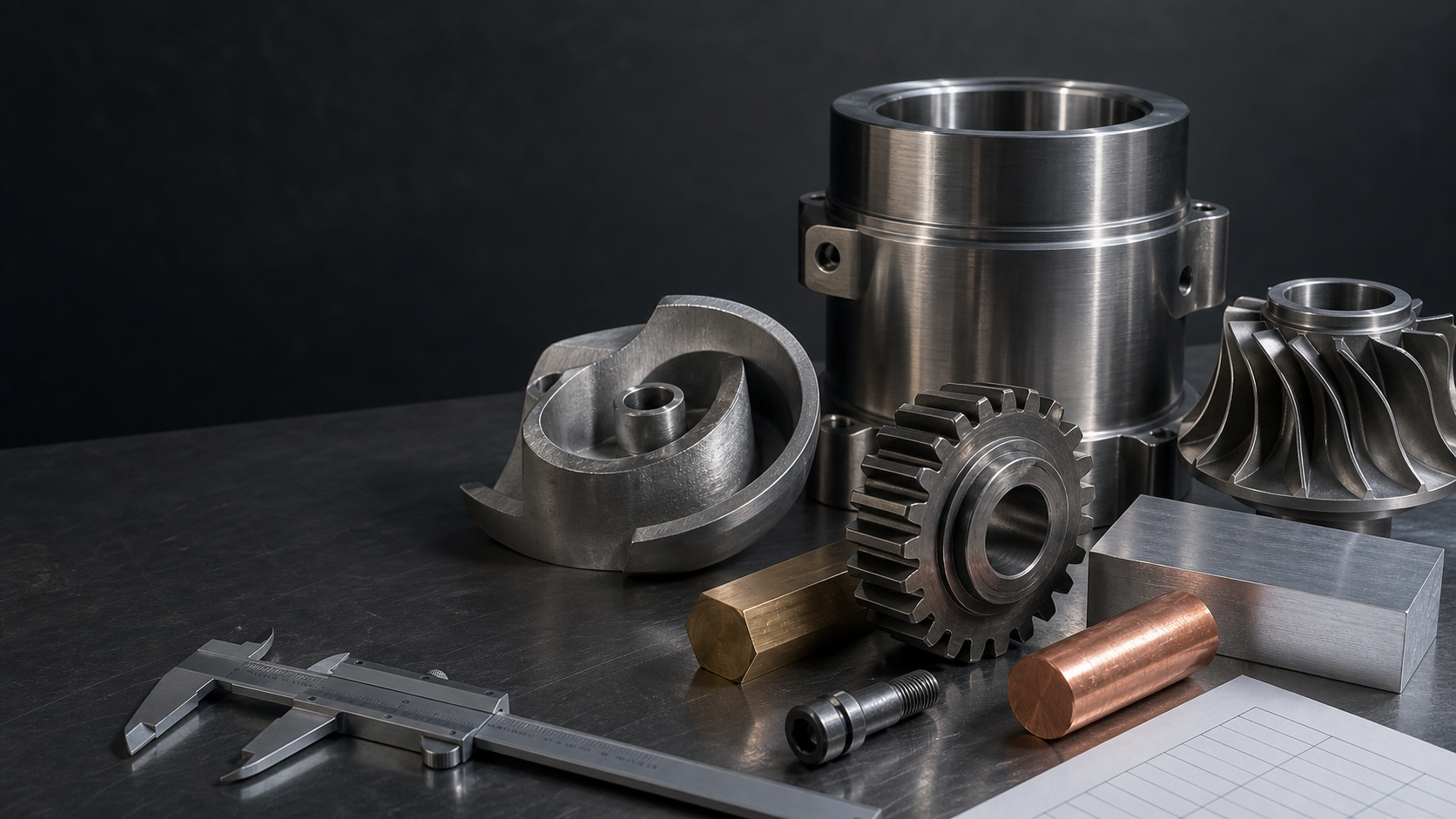
A metal material grade comparison is essential when global sourcing begins with a drawing in one material system and a supplier working in another. A Chinese drawing may specify 06Cr19Ni10, an American buyer may ask for 304, while a European bill of materials lists 1.4301. These grades are commonly treated as counterparts, but good material selection requires more than matching a name.
This guide provides practical cross-reference tables for frequently used ferrous and non-ferrous metals across China GB/T, American ASTM/UNS/SAE-AA, European EN/DIN and Japanese JIS systems. It is intended for early material screening, quotation communication and drawing review in casting, forging, stamping, machining and fastener projects.
Important engineering note: Grades in the same row are commonly compared or near-equivalent grades, not an automatic permission to substitute. Product form standards, chemical limits, mechanical properties, heat treatment, dimensions, corrosion requirements, welding procedure and certification must be checked before approval.
How to Read International Metal Grade Tables
A material grade can be defined in several ways. GB/T and EN grade names often indicate composition; UNS supplies a unified identification number; ASTM commonly specifies product form and test requirements as well as grades; SAE/AISI is widely used for carbon and alloy steel; and AA designations identify wrought aluminum alloys. A grade that looks similar chemically may still be supplied to a different plate, bar, pipe, casting or fastener specification.
| System | Typical role | Examples used in this guide |
|---|---|---|
| China | GB/T grade or alloy designation | 06Cr19Ni10, Q235B, 6061, TA2G |
| United States | ASTM grade, UNS identifier, SAE/AISI or AA alloy | 304 / S30400, A36, 4140, AA 6061 |
| Europe / Germany | EN symbolic grade and material number; legacy DIN terms remain common in trade | X5CrNi18-10 / 1.4301, S235JR, EN AW-6061 |
| Japan | JIS grade | SUS304, SS400, SCM440, A6061 |
1. Stainless Steel Grade Comparison Table
Stainless steel is central to investment casting, pump and valve components, marine hardware, food equipment and corrosion-resistant fasteners. Austenitic grades are highly fabricable, while duplex grades provide higher strength and stronger chloride resistance when properly manufactured.
| China GB/T | ASTM / UNS | EN / DIN | JIS | Typical use direction |
|---|---|---|---|---|
| 06Cr19Ni10 / S30408 | 304 / S30400 | X5CrNi18-10 / 1.4301 | SUS304 | General corrosion-resistant parts, food and architectural hardware |
| 022Cr19Ni10 / S30403 | 304L / S30403 | X2CrNi18-9 / 1.4307 | SUS304L | Welded components requiring low carbon grade |
| 06Cr17Ni12Mo2 / S31608 | 316 / S31600 | X5CrNiMo17-12-2 / 1.4401 | SUS316 | Process equipment and improved chloride pitting resistance |
| 022Cr17Ni12Mo2 / S31603 | 316L / S31603 | X2CrNiMo17-12-2 / 1.4404 | SUS316L | Welded cast or fabricated equipment in corrosive service |
| 06Cr18Ni11Ti | 321 / S32100 | X6CrNiTi18-10 / 1.4541 | SUS321 | Stabilized stainless for elevated-temperature welded parts |
| 06Cr18Ni11Nb | 347 / S34700 | X6CrNiNb18-10 / 1.4550 | SUS347 | Niobium-stabilized heat and weld service |
| 10Cr17 / S11710 | 430 / S43000 | X6Cr17 / 1.4016 | SUS430 | Ferritic sheet components in moderate environments |
| 12Cr13 / S41010 | 410 / S41000 | X12Cr13 / 1.4006 | SUS410 | Martensitic fittings, shafts and hardware needing hardness |
| 20Cr13 / S42020 | 420 / S42000 | X20Cr13 / 1.4021 | SUS420J1 | Hardenable wear-resistant stainless components |
| 022Cr23Ni5Mo3N / S22053 | 2205 / S32205 (S31803 also specified) | X2CrNiMoN22-5-3 / 1.4462 | SUS329J3L | Duplex pumps, valves, chemical and marine equipment |
| 022Cr25Ni7Mo4N / S25073 | 2507 / S32750 | X2CrNiMoN25-7-4 / 1.4410 | SUS327L1 | Super duplex for seawater, desalination and offshore service |
For stainless castings, the cast grade must be checked separately from its wrought counterpart. For example, CF8 is commonly associated with wrought 304 chemistry direction and CF8M with 316 direction, but casting specifications and properties govern the delivered component.
2. Carbon and Structural Steel Grade Comparison Table
Carbon and structural steels are widely used for brackets, welded frames, bases, flanges, general machined components and construction hardware. Yield-strength class, impact testing and delivery condition matter as much as the nominal comparison.
| China GB/T | ASTM / SAE-AISI | EN / DIN | JIS | Practical note |
|---|---|---|---|---|
| Q235B | ASTM A36 (commonly compared) | S235JR / 1.0038 | SS400 | General structural steel; limits are not identical |
| Q355B | ASTM A572 Grade 50 (common strength-level comparison) | S355JR / 1.0045 | SM490A | Higher-strength welded structures |
| 08 / 08Al | SAE 1008 | DC01 family comparison depends on sheet requirement | SPCC family comparison | Cold-forming sheet; specify drawing quality |
| 20 | SAE/AISI 1020 | C22E / 1.1151 | S20C | Low-carbon machined and carburized parts |
| 35 | SAE/AISI 1035 | C35E / 1.1181 | S35C | Medium-carbon shafts and mechanical parts |
| 45 | SAE/AISI 1045 | C45E / 1.1191 | S45C | Common shafts, pins, gears and quenched/tempered parts |
3. Alloy Steel, Bearing Steel and Tool Steel Comparison
Alloy steel choices are closely linked to heat treatment. For bolts, drive components, molds and wear parts, a material certificate alone is not enough; hardness, core properties, case depth where applicable and final inspection should be specified.
| Material group | China GB/T | SAE / AISI / ASTM direction | EN / DIN | JIS |
|---|---|---|---|---|
| Cr-Mo alloy steel | 20CrMo | SAE 4118 / 4120 comparison | 20CrMo5 / 1.7264 comparison | SCM420 |
| Cr-Mo alloy steel | 35CrMo | SAE/AISI 4135 | 34CrMo4 / 1.7220 | SCM435 |
| Cr-Mo alloy steel | 42CrMo | SAE/AISI 4140 | 42CrMo4 / 1.7225 | SCM440 |
| Ni-Cr-Mo high strength steel | 40CrNiMoA | SAE/AISI 4340 | 34CrNiMo6 / 1.6582 | SNCM439 |
| Bearing steel | GCr15 | AISI 52100 | 100Cr6 / 1.3505 | SUJ2 |
| Cold-work tool steel | Cr12Mo1V1 | AISI D2 | X153CrMoV12 / 1.2379 | SKD11 |
| Hot-work tool steel | 4Cr5MoSiV1 | AISI H13 | X40CrMoV5-1 / 1.2344 | SKD61 |
| High-speed tool steel | W6Mo5Cr4V2 | AISI M2 | HS6-5-2 / 1.3343 | SKH51 |
4. Cast Steel and Stainless Casting Comparisons
Investment casting buyers frequently ask whether a casting grade is the same as a wrought bar or plate grade. It is better to state that they are service-related counterparts: cast grades are governed by casting specifications and may have different allowable chemistry, mechanical properties and inspection requirements.
| China casting grade direction | ASTM cast grade | Related wrought grade reference | Typical cast component |
|---|---|---|---|
| ZG250-485 (GB/T 12229 valve casting direction) | A216 WCB direction | Carbon steel service class, not a direct wrought equivalent | Valve bodies, housings, general pressure parts |
| ZG07Cr19Ni10 direction | A351 CF8 | 304 / S30400 direction | Food equipment, general stainless cast hardware |
| ZG03Cr19Ni11 direction | A351 CF3 | 304L / S30403 direction | Welded low-carbon stainless cast assemblies |
| ZG07Cr19Ni11Mo2 direction | A351 CF8M | 316 / S31600 direction | Pumps, impellers, valves and marine hardware |
| ZG03Cr19Ni11Mo2 direction | A351 CF3M | 316L / S31603 direction | Corrosion-resistant welded or chemical components |
| Duplex stainless casting family | A890 / A995 Grade 4A | 2205 / S32205 direction | Duplex valve and pump castings |
| Super duplex casting family | A890 / A995 Grade 5A | 2507 / S32750 direction | Seawater and high-chloride process castings |
5. Aluminum Alloy Grade Comparison Table
Aluminum is commonly used for lightweight machined parts, housings, extrusions, heat-management parts and transportation components. Temper, such as T5, T6 or O, is essential because it significantly changes mechanical behavior.
| Alloy family / use | China GB/T | AA / ASTM designation | EN designation | JIS |
|---|---|---|---|---|
| Commercially pure aluminum | 1060 | AA 1060 | EN AW-1060 (Al99.6) | A1060 |
| Al-Mn general forming | 3003 | AA 3003 | EN AW-3003 | A3003 |
| Al-Mg marine/forming | 5052 | AA 5052 | EN AW-5052 | A5052 |
| Higher Mg marine plate | 5083 | AA 5083 | EN AW-5083 | A5083 |
| Machining/extrusion structural | 6061 | AA 6061 | EN AW-6061 | A6061 |
| Extrusion and architectural | 6063 | AA 6063 | EN AW-6063 | A6063 |
| High-strength aerospace direction | 7075 | AA 7075 | EN AW-7075 | A7075 |
For die-cast aluminum, compare casting alloys within casting standards rather than substituting a wrought alloy name. Examples such as ADC12, A380 and EN AC-AlSi alloy families require product-specific comparison.
6. Copper and Copper Alloy Comparison Table
Copper alloys are chosen for electrical conductivity, thermal transfer, corrosion behavior, machinability, bearing properties or appearance. Brass and bronze names can hide meaningful composition differences, so exact chemistry and lead restrictions should be reviewed.
| Material direction | China GB/T | UNS / US reference | EN reference | JIS |
|---|---|---|---|---|
| High-purity copper | T2 | C11000 electrolytic tough pitch direction | Cu-ETP / CW004A | C1100 |
| Phosphorus-deoxidized copper | TP2 | C12200 | Cu-DHP / CW024A | C1220 |
| Cartridge brass | H70 | C26000 | CuZn30 / CW505L | C2600 |
| Free-cutting brass | HPb62-3 / C36000 | C36000 | CuZn39Pb3 / CW614N direction | C3604 direction |
| Tin bronze | QSn6.5-0.1 direction | C51900 direction | CuSn6 / CW452K direction | C5191 direction |
| Cast aluminum bronze | ZCuAl10Fe3 (GB/T 1176 direction) | C95400 (ASTM B148 direction) | CuAl10Fe3 / CC331G direction | CAC702 direction |
7. Titanium Alloy Grade Comparison Table
Titanium combines low density with corrosion resistance and high specific strength. It is used in marine, chemical, medical and aerospace-related supply chains, where traceability and approved material standards are especially important.
| China GB/T | ASTM / UNS common reference | EN / material direction | JIS | Typical direction |
|---|---|---|---|---|
| TA1G (current industrial-pure grade direction) | Commercially pure titanium Grade 1 / R50250 direction | 3.7025 direction | TP270 direction | Highest formability, corrosion-resistant sheet |
| TA2G (current industrial-pure grade direction) | Commercially pure titanium Grade 2 / R50400 direction | 3.7035 direction | TP340 direction | Common chemical and marine equipment material |
| TA9 (Ti-0.2Pd) | Titanium Grade 7 / R52400 direction | 3.7235 direction | TP340Pd direction | Enhanced corrosion performance in reducing media |
| TC4 | Ti-6Al-4V, Grade 5 / R56400 | 3.7165 | TAP6400 direction | High-strength structural titanium components |
8. Nickel-Based and Heat-Resistant Alloy Comparison Table
Nickel alloys are often specified for chemical corrosion, high-temperature strength, oxidation resistance or severe fastener duty. Trade names are widely used in this sector, but the controlling order document should identify the applicable UNS and product specification.
| China designation direction | UNS / common alloy name | EN material number direction | Typical application direction |
|---|---|---|---|
| NS5200 / H02200 direction | N02200 / Nickel 200 | 2.4060 direction | Chemical handling and conductive nickel components |
| NS3306 direction | N06625 / Alloy 625 | 2.4856 | Corrosive marine, chemical and high-temperature hardware |
| GH4169 direction | N07718 / Alloy 718 | 2.4668 | High-strength elevated-temperature bolts and components |
| GH4145 direction | N07750 / Alloy X-750 | 2.4669 | High-temperature springs and fasteners |
| NS3304 direction | N10276 / Alloy C-276 | 2.4819 | Highly aggressive chemical environments |
Why Equivalent Does Not Always Mean Interchangeable
A cross-reference table is an efficient starting point, but material substitution should be controlled. Before a purchasing or engineering team approves a different international grade, it should examine the following factors:
- Exact product standard: plate, bar, tube, casting, forging and fastener standards may impose different requirements.
- Chemical composition: overlapping ranges can still differ in carbon, nitrogen, molybdenum, residuals or stabilization additions.
- Mechanical properties: yield strength, tensile strength, elongation, hardness and impact requirements may vary by thickness and delivery condition.
- Heat treatment or temper: quenched-and-tempered steel and precipitation-hardened or tempered alloys cannot be compared by chemistry alone.
- Corrosion and temperature duty: chloride exposure, acids, operating temperature, crevices and weld condition can change the correct grade selection.
- Manufacturing route: wrought, cast, forged, welded and additively produced material require route-appropriate specifications.
- Verification: require an EN 10204 3.1 material certificate where appropriate, positive material identification when specified, and relevant mechanical or corrosion testing.
Recommended Material Substitution Workflow for Buyers
- Identify the requested grade, product form, governing standard, size and final service conditions from the drawing or inquiry.
- Use a cross-reference table only to establish one or more candidate counterpart grades.
- Compare current standard requirements for composition, properties, heat treatment, surface condition and inspection.
- Confirm manufacturability for casting, CNC machining, forging, stamping, welding or fastener forming as applicable.
- Submit the proposed grade and any technical deviations for written customer approval before production.
- Maintain heat-number traceability and supply the agreed inspection documentation with the shipment.
Selecting Materials for Precision Cast and Machined Components
For investment casting and CNC-finished parts, the right material balances corrosion resistance, strength, castability, machinability, finishing requirements and cost. Stainless steel such as 304, 316L, duplex 2205 and super duplex 2507 is widely selected for pump components, marine hardware and process parts. Alloy steel can be the stronger economical choice for loaded mechanical hardware after controlled heat treatment. Aluminum and copper alloys address weight, conductivity or appearance, while titanium and nickel alloys serve the most demanding corrosion and temperature requirements.
Aodson supports custom metal components from material evaluation through precision casting, machining, finishing and inspection. When requesting a quotation, provide the drawing, required grade and standard, service environment, quantity, testing requirements and any approved international equivalent grades. That information makes a meaningful technical and commercial comparison possible.
Reference Standards and Further Reading
The tables above are a practical overview compiled for common international sourcing discussions. For production approval, always consult the current revision of the relevant specification, including applicable GB/T standards, ASTM material specifications, EN standards, JIS standards and customer-controlled drawings.
- GB/T 20878-2024: Stainless steels – Designation and chemical composition.
- GB/T 2100-2017: Corrosion-resistant steel castings for general applications.
- GB/T 3620.1-2016: Designation and composition of titanium and titanium alloys.
- GB/T 5231-2022: Designation and chemical composition of wrought copper and copper alloys; GB/T 1176 for cast copper alloys.
- GB/T 15007-2017: Designations of corrosion-resistant alloy.
- ASTM International: Standards and Publications
- worldstainless: Stainless Steel Information Resources
- The Aluminum Association: Industry Standards
- Copper Development Association: Alloy Database
- Nickel Institute: Technical Knowledge
Disclaimer: This article is for material identification and preliminary selection support. Final material approval must be based on project specifications, current standards, engineering review and agreed inspection documentation.