




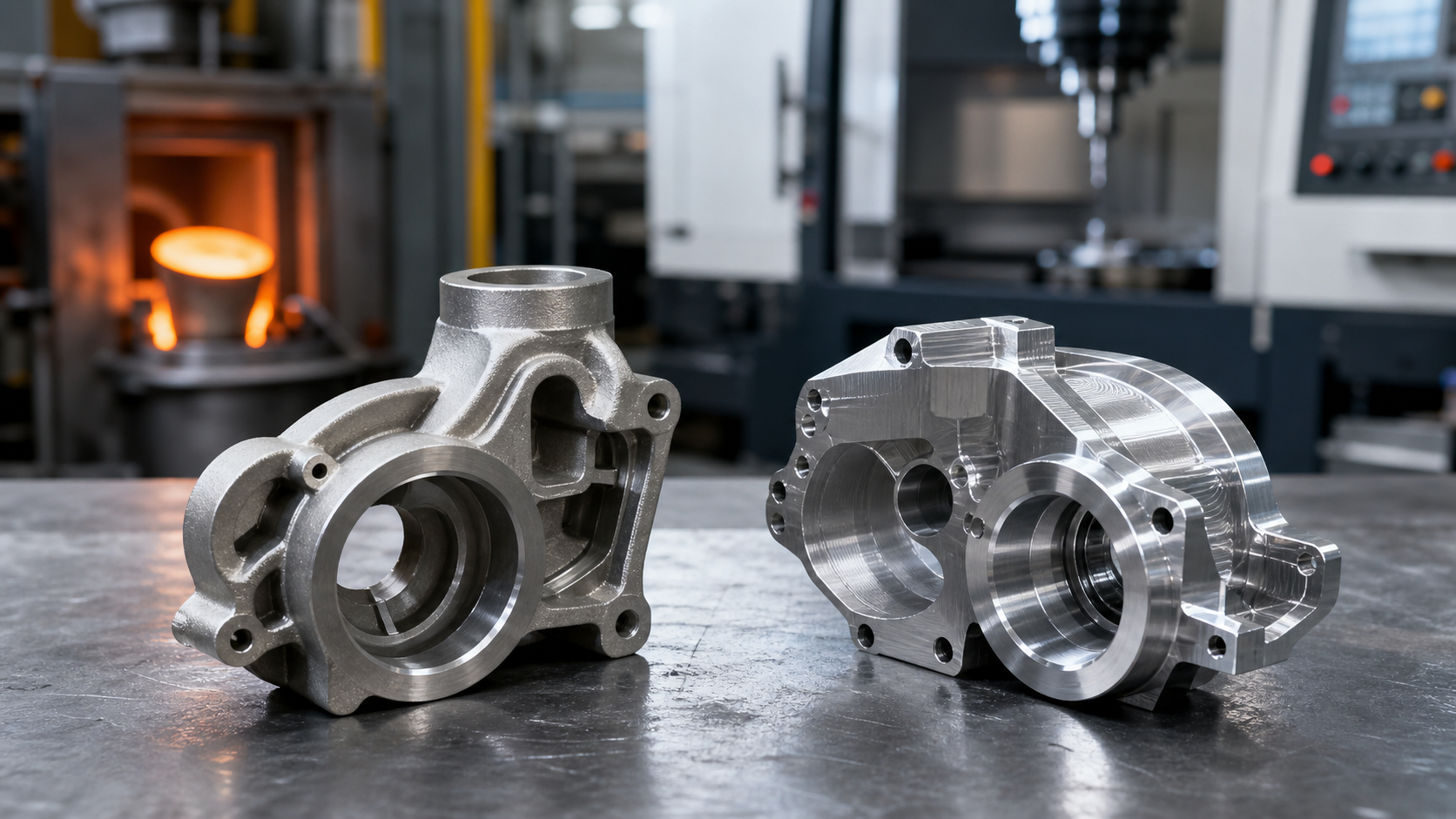
When a metal part becomes difficult to make, the manufacturing decision usually narrows to two strong options: investment casting and CNC machining. Both can produce reliable, high-performance components. Both are used for stainless steel, carbon steel, alloy steel, aluminum, brass, and specialty alloys. And both can support demanding applications in pumps, valves, marine hardware, construction hardware, machinery, and custom industrial assemblies.
The better choice depends less on which process is “more advanced” and more on the shape of the part, annual quantity, tolerance requirements, surface finish, material, and how much post-processing the design can tolerate.
This guide compares investment casting vs CNC machining from a practical engineering and sourcing point of view, especially for complex metal parts where cost, repeatability, and design freedom all matter.
What Is Investment Casting?
Investment casting, also called lost wax casting, is a precision casting process used to produce metal parts with complex geometry. A wax pattern is made, assembled into a tree, coated with ceramic shell, melted out, and then filled with molten metal. After solidification, the ceramic shell is removed and the castings are cut, cleaned, heat treated, machined where needed, and inspected.
The biggest strength of investment casting is shape freedom. It can create internal contours, curved surfaces, ribs, bosses, thin walls, and blended transitions that would be expensive or impossible to machine from solid bar stock. For complex parts, it often produces a near-net-shape blank, leaving only critical surfaces for secondary CNC machining.
What Is CNC Machining?
CNC machining removes material from a solid block, bar, forging, casting, or extrusion using computer-controlled cutting tools. Common CNC processes include milling, turning, drilling, tapping, grinding, and multi-axis machining.
The biggest strength of CNC machining is dimensional control. It is excellent for tight tolerances, flatness, concentricity, threads, precision holes, sealing surfaces, and parts that need clean, repeatable edges. For prototypes and low-volume production, CNC can also be faster because it does not require wax tooling or casting development.
The Core Difference: Forming vs Removing Metal
Investment casting forms the part close to its final shape. CNC machining cuts away unwanted material until the final shape remains. That difference affects almost every decision: material waste, tooling cost, tolerance, lead time, scalability, and design flexibility.
If the part is a simple bracket, shaft, plate, or block with a few holes, CNC machining is often the straightforward answer. If the part has organic surfaces, changing wall thickness, internal passages, or many features on different faces, investment casting may reduce material waste and machining time dramatically.
Investment Casting vs CNC Machining: Quick Comparison
FactorInvestment CastingCNC MachiningBest forComplex shapes, near-net parts, repeat productionTight tolerances, prototypes, simple-to-medium geometryToolingRequires wax pattern toolingNo casting tooling neededUnit costLower when volume and complexity increaseLower for prototypes and simple partsMaterial wasteUsually lower for complex partsCan be high when machining from solid stockToleranceGood, with machining for critical areasExcellent, especially for precision featuresSurface finishGood cast surface, can be polished or machinedVery controlled machined surfaceLead timeLonger at first because tooling is requiredOften faster for first samplesDesign freedomVery highLimited by tool access and cutting strategy
When Investment Casting Is the Better Choice
- The Part Has Complex Geometry
Investment casting is often the better process when a part has shapes that are not friendly to cutting tools. Examples include impellers, pump bodies, valve components, marine fittings, brackets with blended ribs, hardware with curved profiles, and machinery parts with multiple bosses and pockets.With CNC machining, every pocket, slot, undercut, radius, and angled face needs tool access. If the cutter cannot reach the feature directly, the part may require multiple setups, custom fixtures, long cycle times, or design compromises. Casting can form many of those features in one operation. - Material Waste Is a Serious Cost
Machining a complex part from a solid billet can remove a large percentage of the starting material. For stainless steel, duplex stainless steel, nickel alloys, and other expensive metals, that waste becomes real money. Investment casting starts closer to the final shape, which can reduce scrap and shorten machining time. - The Part Will Be Produced Repeatedly
Investment casting has an upfront tooling cost, but that cost is spread across production. Once the process is stable, it can be very competitive for medium and higher quantities. The more complex the part, the sooner casting can become cost-effective compared with machining everything from solid stock. - The Design Needs Smooth Transitions and Functional Curves
Casting allows engineers to design with smoother transitions, generous fillets, and weight-saving geometry. These features can improve strength, reduce stress concentration, and remove unnecessary mass. CNC can create curves too, but complex 3D machining increases programming time, cutting time, and tool wear.
When CNC Machining Is the Better Choice
- The Part Requires Very Tight Tolerances
CNC machining is the stronger choice when the whole part depends on very tight dimensional control. Bearing seats, precision shafts, threaded holes, sealing faces, sliding surfaces, and high-accuracy assemblies usually need machining. Investment castings can be accurate, but cast metal still moves during solidification, cooling, heat treatment, and finishing.In many real projects, the best solution is not casting or machining alone. It is investment casting for the near-net shape, followed by CNC machining on the critical dimensions. - The Quantity Is Low or the Design Is Still Changing
If the design is not finalized, CNC machining is usually more flexible. A programmer can adjust tool paths quickly when a hole moves or a pocket changes. With investment casting, design changes may require tooling modification or new tooling, which adds time and cost. - The Geometry Is Simple
For flat plates, turned shafts, simple bushings, spacers, blocks, and parts made from standard bar stock, CNC machining is often cheaper and cleaner. Casting a simple part can add unnecessary process steps. - The Surface Must Be Precisely Machined Everywhere
If most surfaces require a machined finish anyway, the value of casting is reduced. In that case, starting from bar stock, plate, or forging may be more efficient.
Tolerances: What Buyers Should Understand
A common mistake is comparing investment casting and CNC machining as if both are meant to deliver the same tolerances on every surface. They are not. Investment casting is designed to create accurate near-net shapes, while CNC machining is designed to create precise final dimensions.For complex cast parts, the smart approach is to separate the drawing into two groups:- As-cast features: surfaces where normal casting tolerance is acceptable.
- Machined features: holes, threads, flat sealing faces, bearing positions, and other dimensions that need tighter control.
This keeps cost under control. Over-specifying every surface forces unnecessary machining and can erase the economic advantage of casting.
Surface Finish and Appearance
CNC machining produces visible tool marks unless the part is polished, blasted, or finished afterward. Investment casting produces a fine cast surface that can be bead blasted, pickled, passivated, polished, electropolished, or locally machined.For decorative stainless steel hardware, marine hardware, food equipment parts, and exposed mechanical components, the final finishing route matters as much as the base manufacturing process. A good supplier should review both the drawing and the expected appearance standard before production starts.
Cost: The Real Decision Is Total Cost, Not Piece Price Alone
The cheapest-looking quote is not always the lowest total cost. For complex metal parts, buyers should compare tooling, raw material, machining time, fixture cost, scrap risk, inspection requirements, finishing, and repeat-order stability.CNC machining may win the first sample because there is no casting tooling. Investment casting may win production because it reduces material removal and cycle time. The break-even point depends on part size, alloy, complexity, tolerance, and annual demand.
Material Considerations
Both processes support a wide range of metals, but not every alloy behaves the same in casting and machining. Stainless steels, carbon steels, alloy steels, heat-resistant steels, and corrosion-resistant alloys each have different shrinkage, flow, heat treatment, and machinability characteristics.For stainless steel parts, investment casting is widely used for 304, 316, 17-4PH, duplex stainless steel, and other grades when corrosion resistance and complex geometry are both important. CNC machining is still used afterward for threads, holes, and surfaces that require higher precision.
A Practical Rule of Thumb
Choose investment casting when the part is complex, the quantity is repeatable, the material is expensive, and many surfaces do not require ultra-tight tolerances. Choose CNC machining when the part is simple, urgent, low-volume, still changing, or needs tight tolerances across most features.For many complex metal parts, the best answer is a hybrid process: investment casting creates the shape efficiently, and CNC machining finishes the functional surfaces accurately.
Final Recommendation
Investment casting is not automatically better than CNC machining, and CNC machining is not automatically more precise in the ways that matter for every project. The right process depends on the part’s geometry, tolerance map, material, volume, and performance requirements.If your part has complex curves, ribs, bosses, internal contours, or a high buy-to-fly ratio when machined from solid stock, investment casting deserves serious consideration. If your part is simple, tolerance-heavy, or still in development, CNC machining may be the more practical starting point.For the strongest result, involve your manufacturing partner early. A small adjustment to wall thickness, radius, machining allowance, or datum strategy can make the difference between a part that is merely possible and a part that is stable, cost-effective, and ready for repeat production.