




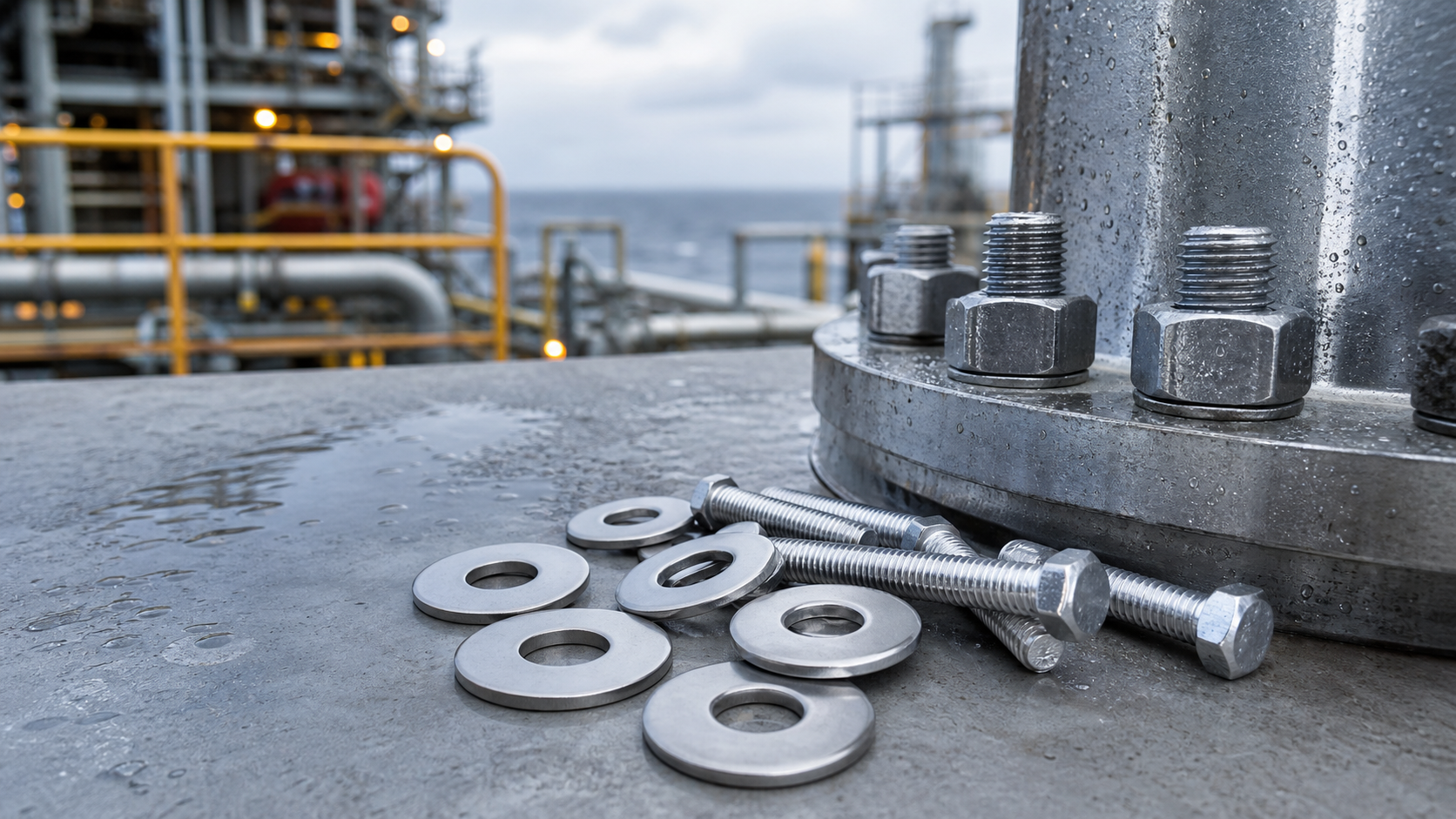
In harsh industrial environments, a washer is never just a thin ring of metal. It is a load-distribution surface, a spacing element, a seal-support component, and often the small part that protects a much more expensive bolted assembly from premature failure. When equipment is exposed to salt spray, chemicals, heat, vibration, moisture, and constant maintenance cycles, stainless steel washers become essential because they help keep fastening systems stable, clean, and corrosion resistant over time.
For manufacturers, EPC contractors, maintenance teams, and OEM buyers, the value of stainless steel washers is not only in their material strength. Their real value is in reliability: fewer seized fasteners, more predictable clamp load, better resistance to environmental attack, and lower risk of unplanned downtime.
Harsh environments attack the whole fastening system
Industrial fasteners rarely fail because of one simple cause. Failure usually comes from a combination of corrosion, surface damage, vibration, thermal cycling, and poor load distribution. A carbon steel washer may look acceptable at installation, but in wet, marine, chemical, or high-temperature service it can become the weak point in the joint. Rust expansion, pitting, and surface roughness can reduce contact quality and make later disassembly difficult.
Stainless steel washers are designed to resist these conditions. Grades such as 304 stainless steel provide good general corrosion resistance, while 316 stainless steel adds molybdenum for improved resistance to chlorides and marine atmospheres. In more aggressive environments, duplex stainless steels or higher alloy grades may be selected for increased strength and pitting resistance.
They distribute load and protect mating surfaces
The most immediate function of a washer is to spread the load from the bolt head or nut over a larger area. In industrial machinery, pumps, valves, structural brackets, marine hardware, and flange connections, this helps prevent localized indentation, galling, or deformation of the mating surface.
This matters especially when the connected component is softer than the fastener, coated for corrosion protection, machined to tight tolerances, or exposed to repeated assembly and maintenance. A properly selected stainless steel flat washer helps preserve the contact surface and supports more consistent tightening performance.
Corrosion resistance supports long-term joint integrity
Corrosion is not only a visual problem. Once corrosion starts around a washer, it can change the friction conditions in the joint, reduce effective clamping force, contaminate nearby components, and accelerate crevice corrosion at the interface between washer, bolt, nut, and base material.
Stainless steel washers help reduce these risks because their chromium-rich passive layer protects the surface from oxidation. In environments where moisture, cleaning chemicals, salt, acidic vapors, or process fluids are present, this passive layer is one reason stainless steel washers are preferred over plated carbon steel washers.
They perform better under vibration and maintenance cycles
Vibration is common in compressors, conveyors, pumps, engines, marine equipment, mining machinery, and process lines. While a flat washer alone is not a locking device, it creates a cleaner bearing surface and can work together with suitable locking washers, prevailing torque nuts, thread-locking compounds, or engineered bolting procedures.
In maintenance-heavy environments, stainless steel washers also offer a practical advantage: they are less likely to rust onto the assembly. This can reduce labor time during inspection, repair, and replacement, especially in outdoor installations or equipment that must be serviced quickly.
Temperature, chemicals, and hygiene also matter
Stainless steel washers are widely used in food processing, chemical plants, wastewater treatment, marine systems, pharmaceutical equipment, and energy infrastructure because they combine mechanical performance with a clean, stable surface. Their resistance to staining and chemical attack helps keep assemblies easier to inspect and less likely to introduce contamination.
For elevated-temperature applications, material grade and operating conditions must be reviewed carefully. Thermal expansion, oxidation resistance, and strength retention should all be considered. The washer material should be compatible with the bolt, nut, base material, and any process medium present in the application.
Material selection is critical
Choosing the right stainless steel washer is not simply a matter of selecting “stainless steel” on a purchase order. Buyers should consider:
- Operating environment: marine, chemical, outdoor, high humidity, high temperature, or washdown service.
- Stainless steel grade: 304 for general use, 316 for chloride exposure, and duplex or specialty alloys for severe corrosion or high strength requirements.
- Dimensional standard: DIN, ISO, ASTM, ASME, or custom specifications depending on the assembly.
- Washer type: flat washers, spring washers, fender washers, structural washers, or custom stamped washers.
- Surface finish: passivation, polishing, deburring, or special finishing for cleanliness and corrosion resistance.
- Compatibility: avoid galvanic corrosion by considering contact with aluminum, carbon steel, copper alloys, and other metals.
Where stainless steel washers are commonly used
Stainless steel washers are found in a wide range of demanding applications, including offshore platforms, shipbuilding, marine hardware, chemical processing equipment, food machinery, wastewater systems, power generation, HVAC systems, outdoor structures, pumps, valves, and precision machinery. In each case, their role is small but essential: protect the joint, stabilize the load, and extend service life.
Procurement checklist for industrial buyers
Before ordering stainless steel washers for harsh environments, confirm the washer grade, size, thickness, standard, tolerance, finish, packaging, and traceability requirements. For critical applications, request material certificates and verify whether passivation, salt spray resistance, hardness, or special inspection reports are needed.
A reliable supplier should be able to support both standard washers and custom washer production, including stamping, machining, deburring, surface treatment, and quality inspection. This is especially important when washers are part of a larger stainless steel fastener or precision metal parts package.
Conclusion
Stainless steel washers may be small components, but in harsh industrial environments they have an outsized effect on performance. They help distribute load, protect surfaces, resist corrosion, support maintenance efficiency, and improve the reliability of bolted joints. For any project exposed to moisture, chemicals, salt, temperature changes, or vibration, specifying the right stainless steel washer is a practical investment in long-term equipment safety and service life.