




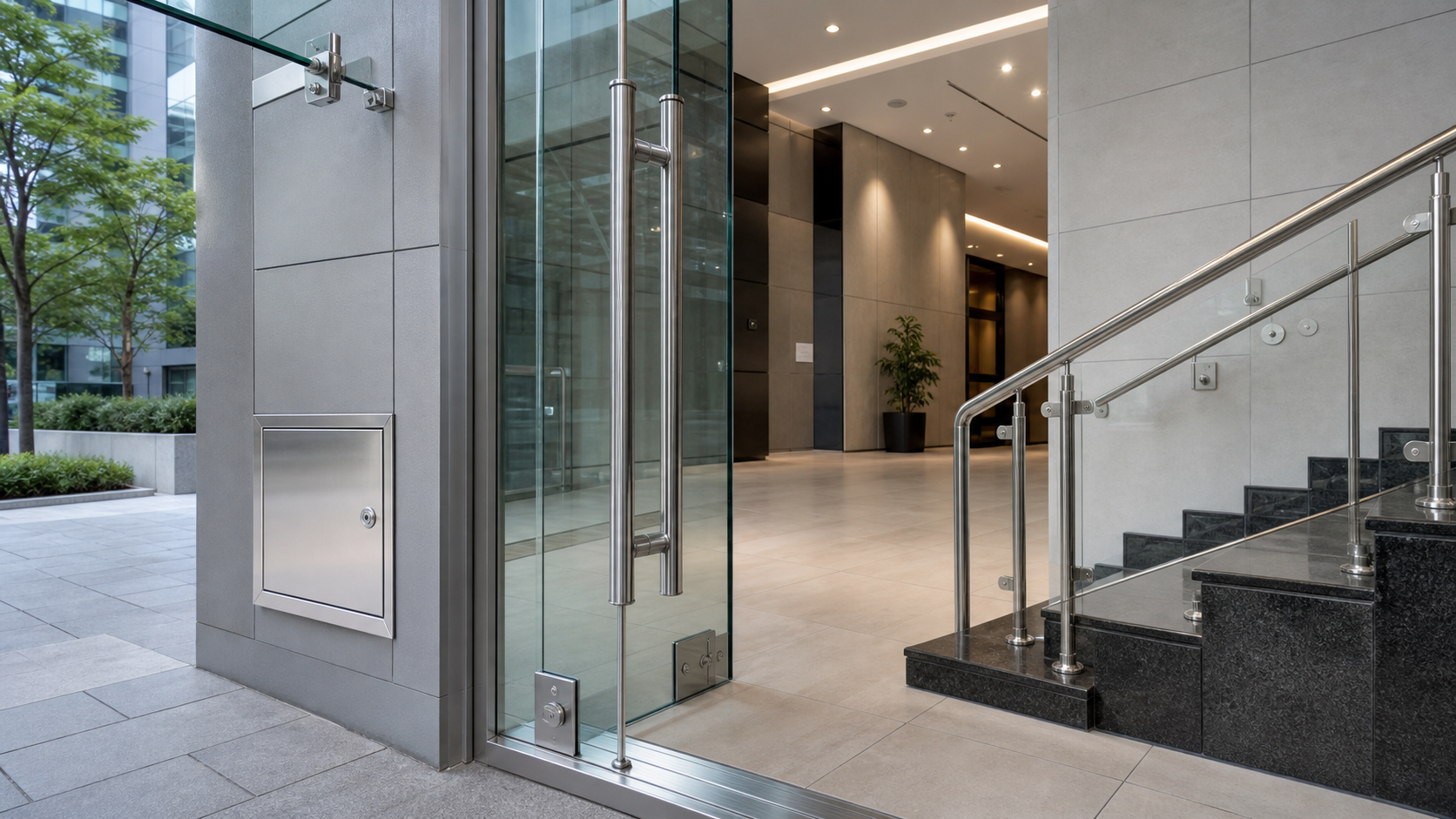
Commercial buildings ask more from architectural hardware than a private residence ever will. A door handle in an office tower may be touched thousands of times a week. A railing bracket in a shopping mall has to look clean while quietly resisting impact, cleaning chemicals, humidity, and daily wear. In hotels, hospitals, schools, airports, factories, and public buildings, hardware is not just a finishing detail. It is part of the building’s safety, accessibility, maintenance cost, and long-term appearance.
That is why stainless steel remains one of the most widely specified materials for commercial architectural hardware. It offers a practical balance of corrosion resistance, strength, hygiene, fire performance, and design flexibility. The best product choice still depends on the building environment. Indoor dry areas may use 304 stainless steel successfully for many years, while coastal sites, swimming pool areas, food facilities, and chemical-exposed environments often require 316, duplex stainless steel, or carefully selected surface treatments.
Below are ten stainless steel architectural hardware products commonly used in commercial buildings, with practical notes on where they are used and what buyers, contractors, and designers should check before specifying them.
1. Stainless Steel Door Pull Handles
Door pull handles are among the most visible pieces of architectural hardware in any commercial entrance. They are used on glass doors, timber doors, aluminum-framed doors, and stainless steel doors in offices, hotels, retail stores, schools, and public buildings.
For commercial use, the handle should be judged by more than shape. Tube wall thickness, welded joint quality, mounting method, grip clearance, and finish consistency all affect performance. Back-to-back pull handles on glass doors need reliable fixing kits and properly sized gaskets to prevent glass stress. For high-traffic entrances, brushed satin stainless steel is often more forgiving than mirror polish because small scratches are less obvious.
2. Stainless Steel Hinges
Hinges carry the weight of the door and absorb repeated opening cycles, so under-specifying them is one of the fastest ways to create maintenance problems. Stainless steel butt hinges, ball bearing hinges, lift-off hinges, and concealed hinges are all common in commercial buildings.
Ball bearing hinges are often preferred for heavy or frequently used doors because they reduce friction and improve cycle life. Fire-rated doors, escape routes, and security doors may require certified hinges with specific load and fire performance. In damp or exterior environments, stainless steel pins and fasteners matter just as much as the hinge leaves. A good hinge assembly should resist sagging, corrosion around the knuckle, and loose screws over time.
3. Stainless Steel Door Locks, Latches, and Strike Plates
Locks and latches sit at the meeting point of security, usability, and code compliance. In commercial buildings, stainless steel lock bodies, lever handles, latch bolts, deadbolts, and strike plates are widely used because they resist wear and maintain a clean appearance.
Selection should consider door type, access control requirements, fire rating, egress rules, and the level of abuse the opening may receive. Strike plates are sometimes treated as minor accessories, but they are critical for alignment and long-term security. Where electronic access control is used, stainless steel faceplates and keepers help maintain a consistent finish around card readers, electric strikes, and maglock systems.
4. Stainless Steel Panic Exit Hardware
Panic exit devices are essential for many commercial and public buildings. They allow people to exit quickly in an emergency while maintaining controlled access from the outside. Stainless steel touch bars, push pads, end caps, exterior trims, and mounting hardware are used in schools, hospitals, theaters, shopping centers, factories, and transportation facilities.
The most important point is compatibility with local life-safety codes and door ratings. Hardware must be selected for single doors, double doors, rim exit devices, vertical rod systems, or mortise applications. Stainless steel is valued here because panic hardware is frequently touched, cleaned, and exposed to impact. A robust finish reduces visible wear on the bar and helps the device remain serviceable over many cycles.
5. Stainless Steel Door Closers and Floor Springs
Door closers and floor springs control movement. They protect the door, reduce noise, improve fire compartment performance, and help maintain climate control inside the building. Stainless steel cover plates, arms, fasteners, and floor spring top plates are common where appearance and corrosion resistance are both important.
For glass doors and lobby entrances, floor springs are often chosen for a clean appearance. For service doors and fire doors, overhead closers are usually more practical. The key specification points are door weight, door width, opening angle, hold-open requirements, backcheck, closing speed adjustment, and site exposure. A closer that is too weak will not latch reliably; one that is too strong can make the door uncomfortable or non-compliant for accessibility.
6. Stainless Steel Handrails and Railing Brackets
Staircases, ramps, corridors, balconies, and atriums all rely on handrails for safety. Stainless steel handrails and brackets are popular because they combine strength with a clean architectural look. They are also relatively easy to clean, which matters in hospitals, schools, transport hubs, and office buildings.
Designers should check bracket spacing, wall substrate strength, tube diameter, weld quality, edge finishing, and local accessibility requirements. Exterior railings should use materials and finishes that match the environment. In coastal cities or exposed public areas, 316 stainless steel is often a better long-term choice than 304. For heavy public use, welded brackets and concealed fixing details can reduce tampering and improve durability.
7. Stainless Steel Glass Railing Hardware
Glass balustrades are common in commercial interiors, hotels, malls, airports, and modern office buildings. Stainless steel glass clamps, standoffs, spigots, base shoes, handrail adapters, and end caps provide the structural connection while keeping the system visually light.
Glass railing hardware must be selected as part of a system, not as isolated fittings. Glass thickness, laminated glass type, wind load, crowd load, fixing substrate, edge protection, and drainage all affect safety. The stainless steel surface should be free of sharp edges and designed to avoid water traps. For exterior projects, hidden crevices and poor drainage can cause staining even when the visible parts look well polished.
8. Stainless Steel Access Panels and Inspection Covers
Access panels are not glamorous, but commercial buildings depend on them. They provide access to valves, electrical services, plumbing, HVAC controls, and inspection points. Stainless steel access panels are used in corridors, kitchens, clean rooms, laboratories, public washrooms, and service areas.
The value of stainless steel is especially clear where panels are cleaned often or exposed to moisture. Flush designs reduce dirt traps and keep walls or floors tidy. Depending on the project, panels may require locks, concealed hinges, fire rating, gasket seals, or anti-slip floor finishes. Good fabrication keeps the door flat, the frame square, and the opening easy to service after installation.
9. Stainless Steel Kick Plates, Push Plates, and Protection Plates
Commercial doors often suffer damage from carts, luggage, cleaning equipment, and constant foot traffic. Stainless steel kick plates, push plates, armor plates, and mop plates protect the door surface and extend service life.
These products are simple, but details matter. Edges should be deburred, corners should be radiused where required, and fixing holes should be clean and consistent. Plate thickness should match the traffic level. In hospitality and office environments, a brushed finish usually hides daily marks better than a mirror finish. In healthcare and food service areas, smooth stainless steel plates also support easier cleaning and better hygiene.
10. Stainless Steel Fasteners, Anchors, and Custom Brackets
Many hardware failures start with the small parts. Screws, bolts, anchors, washers, spacers, and custom brackets hold the visible hardware in place. If these parts corrode, loosen, or react with surrounding materials, the entire installation can lose strength or appearance.
For commercial projects, stainless steel fasteners should be selected to match the hardware material and site conditions. Mixing incompatible metals can cause galvanic corrosion, especially outdoors or near salt. Custom brackets may be needed for unusual substrates, heavy glass systems, facade connections, or retrofit work. Precision casting, CNC machining, stamping, and welding can all be used to produce stainless steel hardware components when standard catalog parts are not enough.
How to Choose the Right Stainless Steel Grade
There is no single stainless steel grade that suits every building. 304 stainless steel is widely used for general indoor architectural hardware because it offers good corrosion resistance and cost efficiency. 316 stainless steel adds molybdenum, improving resistance to chlorides and making it better for coastal, humid, or more aggressive environments. Duplex stainless steels can provide higher strength and stronger corrosion resistance for demanding applications, though availability and fabrication requirements should be checked early.
Finish also matters. Satin brushed finishes are practical for high-touch areas. Mirror finishes can look impressive but show fingerprints and scratches more easily. Electropolishing, passivation, and careful weld cleaning can improve corrosion performance, especially for exterior or hygiene-sensitive hardware.
Installation and Maintenance Notes
Even high-quality stainless steel hardware can perform poorly if it is installed incorrectly. Doors must be aligned before hinges, closers, and locks are adjusted. Glass hardware must be paired with the correct glass thickness and gasket system. Railings and brackets must be fixed into suitable structural substrates, not just decorative wall finishes.
Maintenance should be simple but regular. Use non-abrasive cleaning methods, remove construction dust after installation, avoid chloride-heavy cleaners where possible, and inspect fasteners in high-traffic areas. Rust-like staining on stainless steel is often caused by contamination from carbon steel tools, grinding dust, or aggressive chemicals rather than the stainless steel itself. Early cleaning and proper passivation can prevent small stains from becoming a bigger problem.
Final Thoughts
Stainless steel architectural hardware is popular in commercial buildings because it combines function, durability, and a professional appearance. The best results come from matching the product, grade, finish, and fixing method to the actual building environment. A lobby door handle, a stair handrail, a glass railing clamp, and a service access panel each face different loads and maintenance realities.
For contractors, distributors, and project owners, the practical question is not simply which hardware looks good in a catalog. It is which hardware will still work, still look acceptable, and still be easy to maintain after years of daily use. That is where well-made stainless steel hardware earns its place in commercial architecture.