




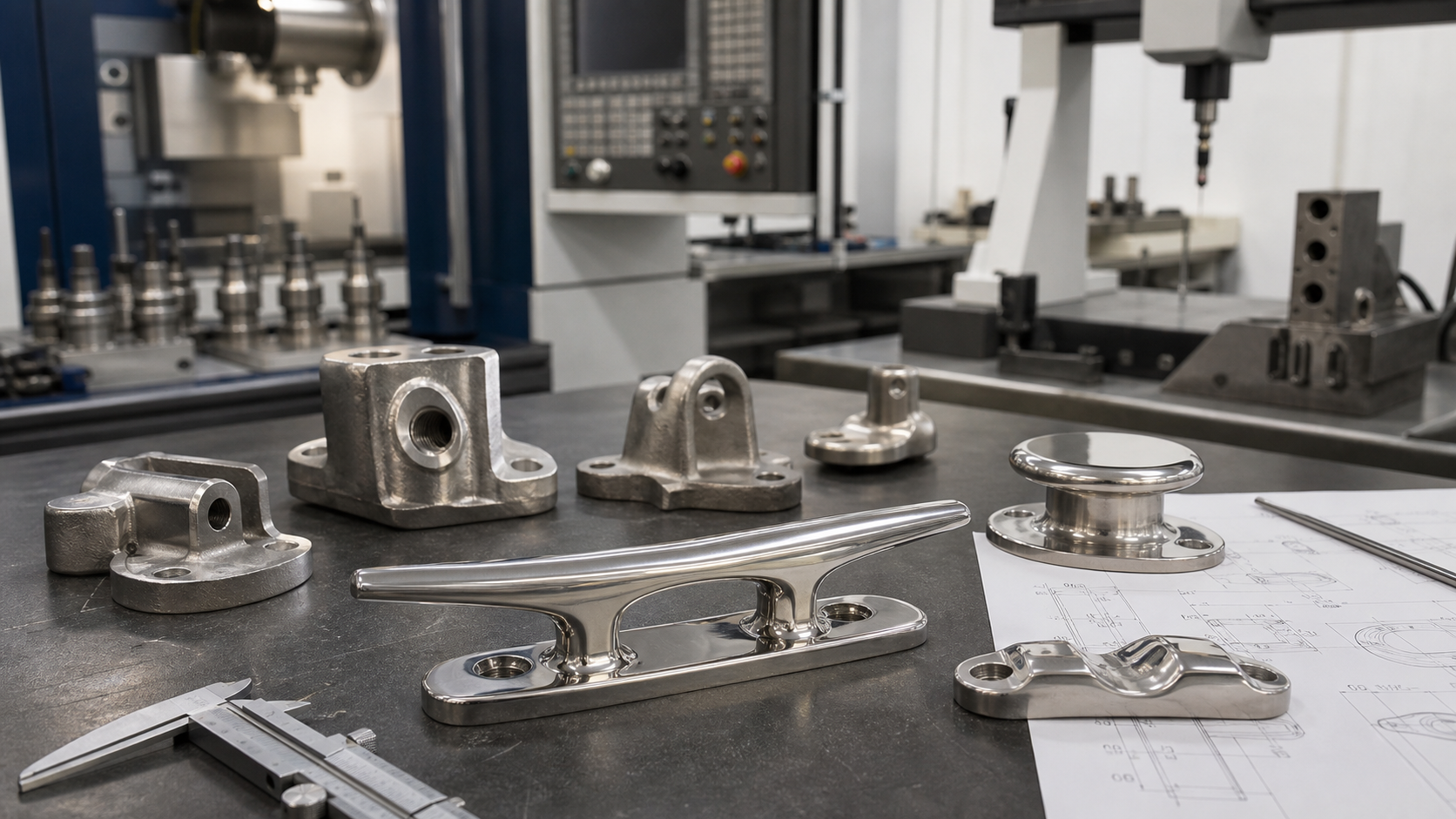
Custom marine hardware manufacturing looks simple from a distance. A cleat, hinge, deck fitting, latch, rail base, or lifting point may only be a small part of a boat, but it works in one of the most unforgiving environments in manufacturing: saltwater, vibration, load cycles, UV exposure, and constant handling. For boat builders and marine equipment suppliers, the real value is not only in getting a part that looks polished. It is in controlling the whole route from alloy selection and precision casting to machining, surface finishing, inspection, and repeatable delivery.
At Aodson, custom marine hardware manufacturing usually starts with a practical question: what does the part need to do on the boat? A decorative fitting, a load-bearing cleat, and a hinge used near the waterline do not have the same risk profile. The drawing matters, but the working conditions matter just as much. The manufacturer has to understand the expected load, assembly method, corrosion exposure, surface requirement, and the customer’s target cost before deciding the best process route.
Why Custom Marine Hardware Manufacturing Often Starts with Precision Casting
Many marine hardware parts have shapes that are difficult or wasteful to machine from solid bar. Curved profiles, recessed mounting areas, rounded edges, internal transitions, and organic load paths are common. Precision investment casting gives the designer more freedom while keeping material use under control. It is especially suitable for stainless steel fittings where strength, corrosion resistance, and a clean finished appearance must work together.
The casting stage is not simply about pouring metal into a mold. A reliable casting process includes wax pattern control, shell building, burnout, pouring temperature control, gate and riser design, and post-casting cleaning. Small decisions at this stage can affect shrinkage, surface quality, dimensional stability, and the amount of machining needed later. For custom marine parts, this is where experience shows: a good casting plan reduces rework before it ever reaches the CNC machine.
Material Choice: Stainless Steel Is Not One Single Answer
Marine customers often ask for stainless steel, but the grade still has to match the use case. For many deck and exterior applications, 316 stainless steel is preferred because of its better resistance to chloride corrosion compared with 304. In less exposed applications, 304 may be acceptable when cost and availability are important. For parts with higher mechanical demands, the conversation may include heat treatment, section thickness, and whether the casting geometry can support the required strength without creating unnecessary weight.
A serious manufacturing review should also consider galvanic corrosion. Marine hardware rarely works alone; it is fastened to aluminum, fiberglass, wood, or other metal assemblies. The wrong combination of materials, coatings, and fasteners can shorten service life even when the part itself is made from good stainless steel. This is why custom hardware manufacturing should include application review, not only quotation against a drawing.
From Casting Blank to Functional Component
After casting, the part is still a blank. Gates must be removed, surfaces need to be cleaned, and critical features usually require machining. CNC machining is used for mounting holes, threaded sections, flat contact faces, bearing surfaces, slots, and any area where the tolerance must be tighter than casting alone can provide. This combination of near-net-shape casting and targeted machining is often the most efficient route for custom stainless marine hardware.
Dimensional control should be planned from the beginning. If a drawing includes tight tolerances on every surface, the part may become unnecessarily expensive. A better approach is to define which features are truly functional: hole position, mating surfaces, thread depth, pin fit, or installation flatness. Non-critical surfaces can keep a practical casting tolerance and then be finished for appearance. This keeps the part manufacturable while protecting the areas that affect assembly and service.
Surface Finishing: Appearance and Corrosion Resistance
Marine hardware is judged by touch and sight. Edges should feel smooth, mounting areas should be clean, and polished surfaces should not expose deep sanding marks or casting defects. Depending on the part, finishing may include shot blasting, grinding, belt sanding, vibratory finishing, brushing, mirror polishing, passivation, or electropolishing. The right sequence depends on the part geometry and the final visual standard.
Passivation is especially important for stainless parts used in marine environments. Machining and polishing can leave free iron or contamination on the surface. A controlled passivation process helps restore the protective chromium oxide layer and improves corrosion resistance. For parts sold into demanding applications, salt spray testing or customer-specific inspection criteria may be used to verify the finish.
Quality Control Is Built Into the Process
Quality control in marine hardware manufacturing should not wait until final packing. Incoming material checks, wax pattern inspection, casting visual review, dimensional inspection after machining, thread checks, surface finish review, and final assembly checks all reduce the chance of a problem reaching the customer. For custom projects, first article inspection is often the most important milestone. It confirms whether the drawing, casting method, machining plan, and finishing requirement are aligned before batch production begins.
For functional parts, inspection may include calipers, gauges, CMM measurement, hardness checks, material certificates, or corrosion-related testing depending on the contract requirement. The goal is not to add paperwork for its own sake. The goal is to make sure each batch can be trusted when installed on real boats and marine equipment.
How a Custom Project Usually Moves Forward
- Drawing or sample review: The manufacturer checks geometry, material, tolerance, finish, and expected application.
- Process proposal: Casting method, machining operations, surface finishing, and inspection points are defined.
- Tooling and sample production: Wax tooling or mold preparation is completed, then sample castings are produced and machined.
- First article confirmation: Dimensions, surface quality, assembly fit, and packaging expectations are reviewed before mass production.
- Batch manufacturing: Production follows the approved route with inspection records and stable finishing standards.
- Final packing and shipment: Finished parts are cleaned, protected, labeled, and packed to reduce scratches during transport.
What Buyers Should Look for in a Marine Hardware Manufacturer
A capable supplier should be able to discuss both production and application. If a part is only quoted by weight, the hidden risks may appear later in machining, polishing, or assembly. Buyers should look for a manufacturer that can review drawings, suggest realistic tolerances, choose the right stainless steel grade, control casting defects, machine critical features accurately, and finish the surface to a consistent marine standard.
The best custom marine hardware projects are collaborative. The customer brings the application knowledge; the manufacturer brings process knowledge. When both sides discuss function, material, tolerance, finish, and inspection early, the final product is more reliable and usually more economical.
From Precision Casting to Finished Products
Custom marine hardware manufacturing is not a single operation. It is a chain of decisions. Precision casting gives the part its basic shape, CNC machining gives it functional accuracy, finishing gives it the corrosion resistance and appearance the market expects, and inspection gives the customer confidence that the batch can be repeated. For stainless steel marine fittings, every step has to respect the reality of the sea.
For companies developing custom cleats, hinges, deck fittings, brackets, rail bases, or other stainless steel marine hardware, working with an experienced casting and machining partner can shorten development time and reduce avoidable production problems. A well-made part is not only polished on the outside. It is engineered through the whole manufacturing process.