




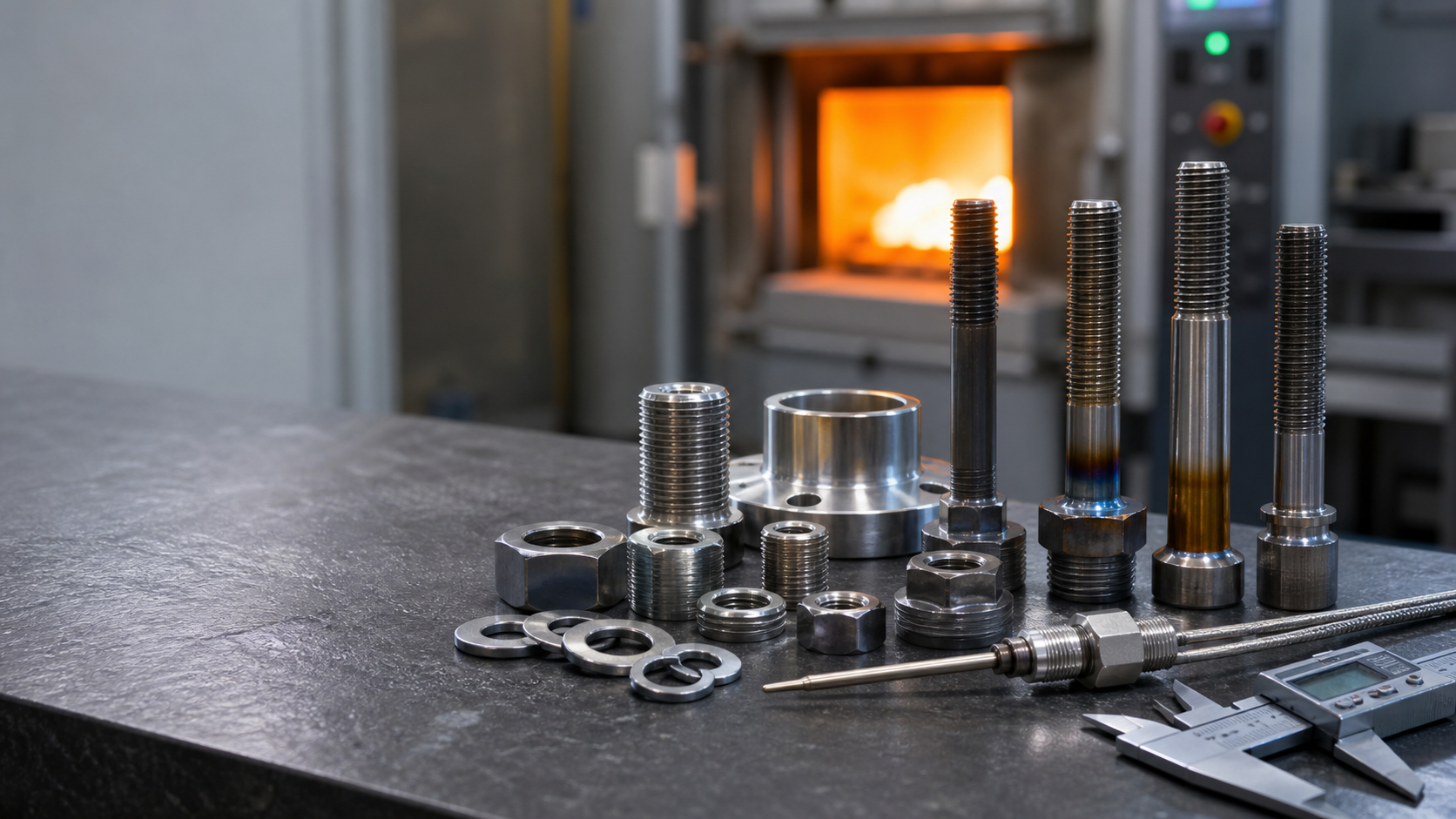
High-temperature service is hard on fasteners and mechanical components because heat changes almost everything that makes a metal reliable. Tensile strength drops, creep becomes more important than short-term yield strength, oxidation accelerates, and a bolt that looked oversized at room temperature can relax after repeated thermal cycles.
For this reason, choosing a material for high-temperature applications should never be based on a single maximum temperature number. A better question is: what load, atmosphere, thermal cycle, mating material, and inspection schedule will the part actually see?
What makes a fastener material suitable for high-temperature service?
In practical engineering work, a heat-resistant fastener or machined component is expected to hold geometry and clamping force while exposed to elevated temperature for long periods. The most important properties are high-temperature strength, creep resistance, oxidation resistance, thermal fatigue resistance, corrosion behavior in the service environment, and dimensional stability after heat treatment.
Short-term tensile strength is still useful, but it can be misleading. In furnace hardware, exhaust systems, petrochemical equipment, turbines, heat exchangers, and power generation assemblies, failures often come from creep, stress relaxation, scaling, galling, or thermal fatigue rather than a simple one-time overload.
Common material families used in high-temperature fasteners and components
1. Austenitic stainless steels: practical and widely available
Grades such as 304, 316, 321, 347, and 310 stainless steel are often used where moderate heat resistance, corrosion resistance, and availability matter. 304 and 316 are easy to source and machine, but they are not the best choice for sustained high load at high temperature. Stabilized grades such as 321 and 347 can offer better resistance to intergranular corrosion after heating because titanium or niobium helps tie up carbon.
310 stainless steel is frequently considered for oxidizing environments because of its higher chromium and nickel content. It is a sensible option for furnace fixtures, heat shields, burner parts, and non-critical high-temperature hardware, but designers should still check creep strength if the fastener is carrying serious preload.
2. Precipitation-hardened stainless steels: strength with limits
17-4 PH and similar precipitation-hardened stainless steels are attractive when high strength and corrosion resistance are needed. However, their useful temperature range is limited by the aging condition and by the loss of strength at elevated temperature. They can be excellent for warm mechanical service, but they should not be treated as universal high-temperature alloys.
A286 is a more specialized iron-nickel-chromium alloy and is widely used for high-strength fasteners in hot sections, including aerospace and turbine-related applications. It offers better elevated-temperature strength than common stainless steels, while still being more economical than many nickel superalloys.
3. Alloy steels for high-temperature bolting
Chromium-molybdenum alloy steels such as B7, B16, and related pressure-vessel bolting grades are common in power plants, refineries, valves, flanges, and high-pressure piping. They are selected for strength, toughness, and established specification coverage. Their weakness is oxidation and corrosion resistance compared with stainless or nickel alloys, so coatings, environment, and maintenance practices matter.
For bolting in pressure equipment, the material specification, heat treatment, hardness limits, and compatible nuts are just as important as the alloy name. A strong stud that is paired with the wrong nut or used outside its temperature range can still lose preload or seize during service.
4. Nickel-based alloys: the standard choice for severe heat
When the combination of temperature, load, oxidation, and corrosion becomes severe, nickel-based alloys usually move to the top of the list. Inconel 600, 601, 625, 718, X-750, and similar grades are common choices for high-temperature fasteners, springs, furnace parts, gas turbine hardware, and chemical processing components.
Inconel 600 and 601 are often selected for oxidation resistance and thermal stability. Inconel 625 is valued for corrosion resistance and good strength without relying on precipitation hardening. Inconel 718 and X-750 are used when high strength at elevated temperature is required, but heat treatment control becomes critical. These alloys are more expensive and harder to machine, yet they often reduce total cost when downtime or failure risk is high.
5. Cobalt-based and refractory alloys for extreme cases
Cobalt-based alloys and refractory metals such as molybdenum, tungsten, niobium, and tantalum are used only when the service conditions justify them. They may offer outstanding hot strength or wear resistance, but oxidation behavior, brittleness, cost, and fabrication difficulty can be serious limitations. For most industrial fastener projects, they are not the starting point; they are the answer when conventional stainless, alloy steel, and nickel alloys have been ruled out.
Material selection by service temperature
| Service condition | Typical material options | Engineering notes |
|---|---|---|
| Up to about 400 C | 304, 316, 17-4 PH, alloy steels | Good availability; confirm corrosion, preload loss, and coating behavior. |
| 400-650 C | 321, 347, 310, A286, B16, selected nickel alloys | Creep, thermal cycling, and oxidation become key design checks. |
| 650-900 C | 310, Inconel 600/601/625/718/X-750 depending on load | Nickel alloys are often preferred for loaded fasteners and hot mechanical parts. |
| Above 900 C | Special nickel alloys, cobalt alloys, refractory alloys | Requires detailed engineering review; atmosphere and load history dominate. |
These ranges are only a starting point. A lightly loaded furnace bracket in clean air and a highly preloaded stud in a sulfur-bearing process stream can require completely different choices even at the same temperature.
Failure modes that should guide your material choice
Creep and stress relaxation
Creep is slow permanent deformation under load at high temperature. In fasteners, stress relaxation is often the more visible problem: the bolt may remain intact, but the clamping force drops. This can lead to leakage, vibration, joint movement, or fatigue failure. If preload retention matters, use creep data and long-term service experience, not only room-temperature tensile strength.
Oxidation and scaling
At high temperature, some metals form protective oxide films while others scale rapidly. Chromium and aluminum help many alloys resist oxidation, which is why stainless steels and nickel-chromium alloys are common in furnace and exhaust environments. However, protective films can break during thermal cycling or abrasion.
Galling and seizure
Stainless and nickel alloy fasteners can gall during tightening, especially under high load or poor lubrication. Thread finish, lubricant selection, nut material, and installation speed matter. In hot service, anti-seize compounds must also be compatible with the operating temperature and process environment.
Thermal expansion mismatch
A fastener does not work alone. If the bolt, nut, washer, and clamped components expand at different rates, preload can increase or decrease during heating. This is one reason material pairing and joint design are just as important as the fastener grade.
How to specify high-temperature fasteners correctly
A useful purchase specification should include the alloy grade, applicable standard, heat treatment condition, mechanical property requirements, thread standard, surface finish, inspection requirements, and any coating or passivation requirement. For critical applications, ask for material certificates and confirm whether testing is performed at room temperature only or includes elevated-temperature data.
It is also worth specifying the complete assembly rather than only the bolt. Matching nuts, washers, and mating parts help avoid hardness mismatch, galvanic issues, thread stripping, or unexpected seizure. For custom mechanical components, machining allowance, grain direction, heat treatment distortion, and post-machining stress relief may also need to be reviewed.
Practical recommendations
- Use common stainless steel only when the temperature, load, and corrosion risk are moderate.
- Consider 321, 347, or 310 stainless steel when oxidation resistance and thermal stability are more important than maximum strength.
- Use alloy steel bolting grades when pressure equipment standards and high strength are the main drivers, but protect against corrosion.
- Move to A286 or nickel-based alloys when preload retention, creep resistance, and hot strength are critical.
- Do not ignore installation details. Lubrication, tightening method, thread quality, and washer selection can decide whether the joint survives.
Conclusion
The best material for high-temperature fasteners and mechanical components is not the one with the highest advertised temperature rating. It is the material that keeps enough strength, resists oxidation or corrosion, holds preload, and remains manufacturable within the real cost and lead-time limits of the project.
For many applications, stainless steels and alloy steels provide an economical solution. For more demanding heat, load, and corrosion combinations, A286 and nickel-based alloys are often the safer choice. The final decision should always be based on actual service temperature, load duration, atmosphere, joint design, and the inspection standard required by the equipment.
Aodson supports custom stainless steel, alloy steel, and nickel alloy fasteners and machined mechanical components for demanding industrial applications. If your project involves high-temperature service, share the working temperature, load condition, drawing, and material preference so the part can be reviewed before production.