




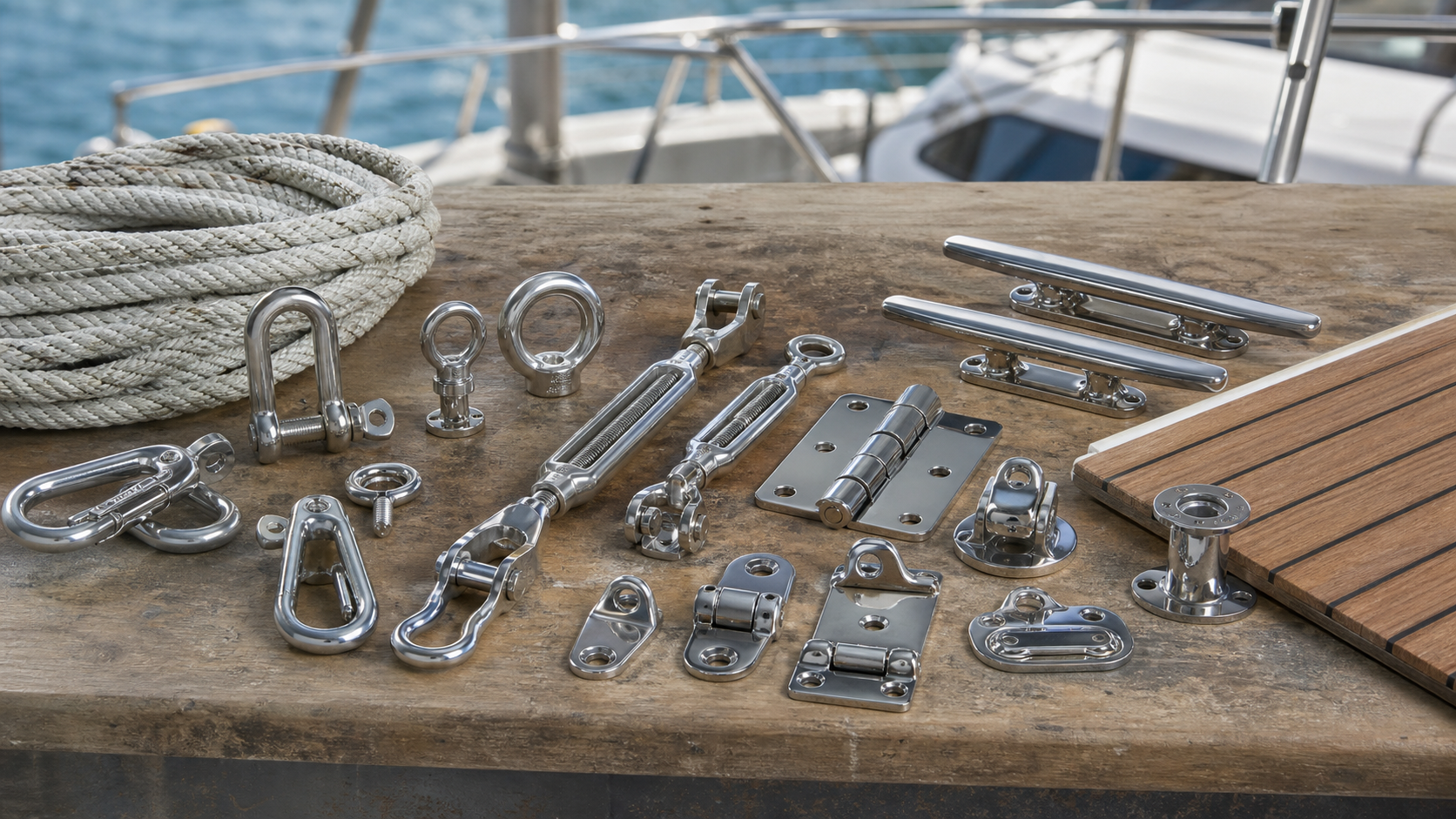
Marine hardware looks simple from a distance. A cleat holds a line, a hinge opens a hatch, a shackle connects two parts, and a turnbuckle adjusts tension. But anyone who has worked around saltwater knows the details matter. A small fitting can decide whether a deck installation stays reliable for years or starts staining, seizing, loosening, or failing after one hard season.
This guide is written for boat builders, marine equipment buyers, repair yards, chandlers, and engineers who need to choose hardware that is practical, durable, and cost-effective. Instead of treating “marine grade” as a vague label, we will look at the materials, common applications, and real selection points that should be checked before ordering.
What Counts as Marine Hardware?
Marine hardware refers to metal fittings and components used on boats, docks, yachts, marine structures, and coastal equipment. It includes visible deck fittings as well as small functional parts hidden inside assemblies.
Common examples include cleats, hinges, hasps, shackles, snap hooks, eye bolts, eye nuts, turnbuckles, wire rope terminals, deck plates, rail fittings, fairleads, latches, brackets, rings, hooks, and custom cast or machined parts. Some pieces mainly handle convenience and access. Others carry real load, absorb vibration, or protect the vessel from impact and corrosion. That difference should shape the material and manufacturing process you choose.
Why the Marine Environment Is So Demanding
Saltwater is aggressive because chloride ions attack passive films on many metals. Add UV exposure, humidity, temperature changes, galvanic contact between different metals, and repeated loading from waves or vibration, and ordinary hardware quickly shows its limits.
Even stainless steel is not automatically safe. It needs the right alloy, surface finish, design drainage, and maintenance. A 316 stainless fitting with a poor surface, trapped salt deposits, or sharp crevices can still develop tea staining or pitting. A well-made part, installed correctly and washed regularly, will usually perform far better than the same alloy used carelessly.
Main Materials Used in Marine Hardware
316 Stainless Steel
316 stainless steel is the most common choice for quality marine hardware. Its molybdenum content improves resistance to chloride corrosion compared with 304 stainless steel. For deck fittings, boat rail hardware, shackles, hinges, turnbuckles, and many custom components, 316 offers a strong balance of corrosion resistance, mechanical strength, appearance, and availability.
It is a good default for above-water and splash-zone applications, especially on yachts, sailboats, leisure craft, and general marine equipment. However, buyers should still check finish quality, passivation, weld condition, and whether the part design avoids moisture traps.
304 Stainless Steel
304 stainless steel is widely used in industrial and architectural hardware, but it is less suitable for continuous saltwater exposure. It can be acceptable for indoor, freshwater, or low-corrosion environments, and sometimes for cost-sensitive components away from direct spray. For serious marine use, especially coastal or offshore, 316 is usually the safer specification.
Duplex Stainless Steel
Duplex stainless steels, such as 2205 and super duplex grades, provide higher strength and better resistance to stress corrosion cracking than standard austenitic stainless steels. They are used where higher load capacity, seawater exposure, or more severe service conditions are expected.
Duplex materials can be valuable for heavy-duty fasteners, structural fittings, pump components, offshore equipment, and custom marine parts. The trade-off is higher cost, more careful fabrication requirements, and less universal availability in some hardware shapes.
Bronze and Brass
Bronze has a long history in marine use because it performs well in seawater and is compatible with many traditional boatbuilding applications. It is common in propeller hardware, seacocks, bushings, and some deck fittings. Brass is easier to machine and visually attractive, but standard brass is not always ideal in seawater because dezincification can weaken it over time.
If copper alloys are specified, confirm the exact grade and intended exposure. “Brass” should not be treated as a single material category for marine service.
Aluminum Alloys
Marine-grade aluminum alloys are valued for low weight, especially on smaller craft, aluminum boats, and certain structural or accessory parts. They can perform well when properly anodized or coated, but galvanic corrosion becomes a major issue if aluminum is connected directly to stainless steel or copper alloys without isolation.
Galvanized Steel
Hot-dip galvanized steel is often used for dock hardware, trailers, anchors, and some heavy-duty coastal structures. It is strong and economical, but the zinc coating is sacrificial and will eventually wear or corrode. It is usually chosen where appearance is less critical and where replacement or inspection is easy.
Common Applications and What to Watch For
Deck Hardware
Cleats, fairleads, deck plates, pad eyes, and rail bases are exposed to sun, spray, footwear, rope abrasion, and mechanical load. For these parts, smooth surfaces, rounded edges, secure mounting holes, and proper backing plates are important. A shiny casting is not enough if the base geometry is weak or the screw holes are poorly placed.
Rigging and Lifting Connections
Shackles, turnbuckles, eye bolts, wire rope clips, hooks, and rings must be selected by load rating, working load limit, and the direction of applied force. A fitting that looks strong may not be designed for side loading, shock loading, or constant vibration. For rigging parts, always match the component to the system load and use safety factors appropriate to the application.
Hinges, Latches and Access Hardware
Marine hinges and latches need more than corrosion resistance. They also need good alignment, consistent movement, and resistance to rattle. For hatches, lockers, engine covers, and doors, look at pin construction, thickness, bearing surface, fastener position, and whether the hardware can be serviced after installation.
Dock and Coastal Infrastructure
Dock hardware often faces impact, abrasion, standing water, and long service intervals. Galvanized steel, 316 stainless, and heavy cast components are common choices depending on budget and exposure. In this category, ease of inspection and replacement matters as much as initial appearance.
Custom Cast and Machined Marine Parts
When standard catalog parts do not fit, investment casting, CNC machining, forging, stamping, and welded fabrication can produce custom marine hardware. The right process depends on geometry, quantity, strength requirements, surface finish, tolerance, and cost target. For complex stainless parts with smooth shapes and moderate to high volume, investment casting is often an efficient route.
How to Select Marine Hardware
1. Start with the Actual Environment
Ask where the part will be used: freshwater, coastal air, splash zone, bilge, deck, dock, or direct seawater immersion. A component used inside a cabin has different needs from one mounted on a bow rail. The more chloride exposure and water retention involved, the more carefully you should specify alloy and finish.
2. Confirm the Load Case
Separate decorative or positioning hardware from load-bearing hardware. If a part carries rigging tension, mooring force, lifting load, or structural load, choose based on working load limit, proof testing, material strength, and geometry. Do not rely on weight or appearance as a substitute for engineering data.
3. Check the Manufacturing Process
Marine hardware may be cast, forged, machined, stamped, welded, or assembled from multiple pieces. Each process has advantages. Cast parts can create smooth and complex forms. Forged parts are often preferred for high-load items. CNC machining gives tight tolerance and clean detail. Stamping works well for thin brackets and plates. The best choice depends on function, not just price.
4. Look Closely at Surface Finish
A good finish improves both appearance and corrosion performance. Rough surfaces hold salt and dirt. Sharp corners can start corrosion or damage rope. For stainless steel, polishing, pickling, passivation, and electropolishing may all be relevant depending on the part. For aluminum, anodizing or coating quality is critical.
5. Avoid Galvanic Corrosion
When dissimilar metals touch in the presence of an electrolyte such as seawater, galvanic corrosion can occur. Stainless steel fasteners in aluminum structures are a common example. Use isolation washers, sealants, compatible fasteners, coatings, and proper drainage to reduce risk.
6. Think About Installation and Maintenance
Even the right hardware can fail early if installed poorly. Use suitable fasteners, bedding compounds, backing plates, and torque practices. Make sure water can drain and that the part can be inspected. Regular freshwater rinsing is simple, but it can significantly reduce salt build-up and staining.
7. Work with a Supplier Who Understands Marine Use
For B2B buyers, supplier capability matters. Ask about material certificates, dimensional control, surface treatment, salt spray testing when relevant, packaging protection, and whether the supplier can support custom drawings. Consistency is especially important when hardware is part of a larger assembly or sold under your own product line.
Quick Selection Checklist
- Environment: freshwater, coastal, splash zone, submerged, or offshore?
- Material: 316 stainless, duplex stainless, bronze, aluminum, or galvanized steel?
- Load: decorative, positioning, mooring, rigging, lifting, or structural?
- Finish: polished, passivated, electropolished, anodized, coated, or galvanized?
- Design: smooth edges, drainage, no unnecessary crevices, proper hole placement?
- Compatibility: will it contact aluminum, carbon steel, copper alloys, or treated wood?
- Documentation: drawings, material certificates, inspection reports, or load data?
- Maintenance: can it be rinsed, inspected, tightened, and replaced?
Common Mistakes to Avoid
One common mistake is buying by appearance alone. Highly polished hardware can still be made from the wrong alloy or have weak geometry. Another mistake is assuming all stainless steel is the same. 304 and 316 may look similar when new, but they can behave very differently in saltwater.
Buyers also sometimes overlook installation details. A good fitting mounted with the wrong fastener, no backing plate, or poor sealing can create leaks, movement, and corrosion. Finally, do not ignore packaging and storage. Stainless parts can be contaminated by carbon steel dust or scratched during transport, which affects both appearance and service performance.
Final Thoughts
Choosing marine hardware is a balance of material, design, process, finish, and real operating conditions. For many applications, 316 stainless steel remains the practical standard. For higher strength or more severe environments, duplex stainless, bronze, galvanized steel, or coated aluminum may be better choices.
The best results come from matching the hardware to the job instead of relying on a broad label like “marine grade.” If you are sourcing standard fittings or developing custom stainless steel marine hardware, define the environment, load, finish, and inspection requirements early. That small amount of discipline can prevent corrosion problems, reduce warranty risk, and give the final product a longer service life at sea.