




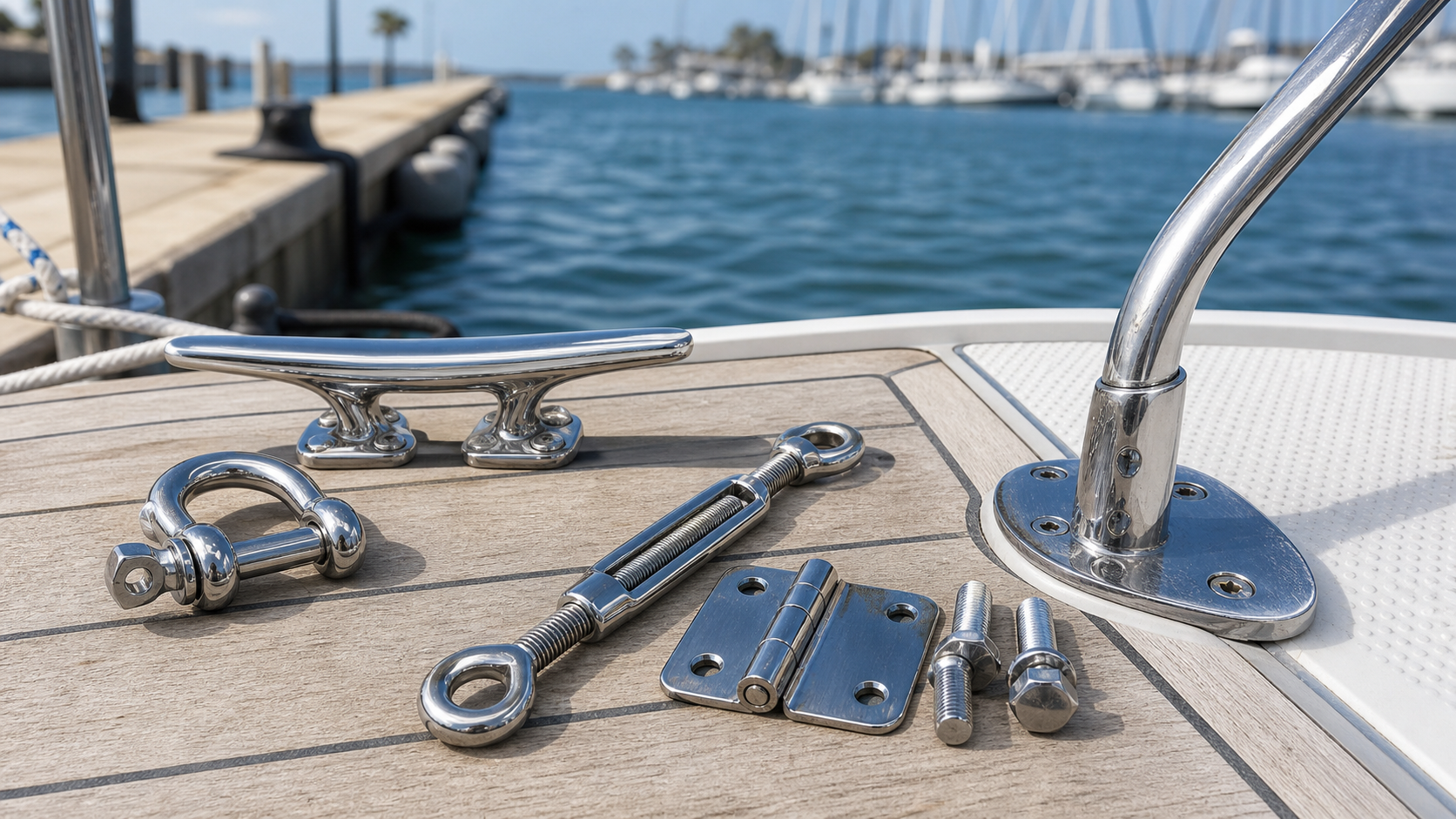
Stainless steel marine hardware has to survive one of the most demanding environments for metal components: saltwater. A fitting that looks perfectly acceptable in a warehouse can begin staining, seizing, or pitting after a few months on a dock, workboat, yacht, or coastal structure. The problem is not simply water. It is the combination of chlorides, oxygen, heat, crevices, wet-dry cycling, and mechanical load.
Choosing stainless steel marine hardware therefore requires more than picking a shiny part from a catalog. The right decision depends on the grade of stainless steel, the design of the fitting, the surface finish, the fasteners used with it, and how the part will be installed and maintained. This guide explains the practical details buyers, engineers, boat builders, and marine contractors should consider before selecting hardware for saltwater service.
Start with the Real Exposure Conditions
“Marine grade” can mean very different things depending on where the part is used. A handrail inside a cabin has a much easier life than a deck cleat exposed to spray every day. Before comparing grades, define the actual environment:
- Is the part fully exposed to seawater, splash, or only coastal air?
- Will it be submerged, intermittently wet, or mostly dry?
- Is the location warm, tropical, or high-UV?
- Will salt deposits sit on the surface between washdowns?
- Are there tight joints, gaskets, washers, or blind holes that can trap water?
- Will the hardware carry static load, shock load, or moving load?
This first step matters because stainless steel does not fail in saltwater in one simple way. Exposed smooth surfaces may remain clean for years, while the same alloy can pit under a washer or inside a threaded connection where oxygen is limited and chlorides concentrate.
Understand What Stainless Steel Actually Does in Saltwater
Stainless steel resists corrosion because chromium in the alloy forms a thin passive oxide layer on the surface. When the surface is clean and oxygen is available, this passive layer repairs itself. Saltwater challenges that protection because chloride ions attack weak points in the film, especially in stagnant or crevice areas.
The most common saltwater problems include:
- Tea staining: brown surface discoloration that is often cosmetic but signals salt deposits and surface contamination.
- Pitting corrosion: small, deep holes that can reduce strength and are more serious than general staining.
- Crevice corrosion: attack under washers, fittings, gaskets, lap joints, or threads where water sits without oxygen.
- Galling: thread seizure when stainless fasteners are tightened without lubrication, especially stainless-on-stainless.
- Galvanic corrosion: accelerated attack when stainless is coupled with a less noble metal such as aluminum in an electrolyte.
A good marine hardware choice reduces these risks through alloy selection, smooth design, proper drainage, compatible fasteners, and realistic maintenance.
304 vs 316 Stainless Steel: Why 316 Is Usually the Baseline
For general industrial use, 304 stainless steel is common and economical. In saltwater service, however, 304 is usually not the best baseline. It contains chromium and nickel, but it does not contain the molybdenum level that gives 316 stainless steel better resistance to chloride pitting.
316 stainless steel, often called marine grade stainless steel, includes molybdenum and is the normal starting point for cleats, hinges, shackles, rail fittings, brackets, deck hardware, and many coastal construction components. It is not immune to corrosion, but it gives a much better safety margin than 304 in salty air and spray zones.
Use 304 only when exposure is mild, the part is easy to inspect, and corrosion staining would not create a functional or reputational problem. For exposed deck hardware, dock hardware, and customer-facing marine fittings, 316 is usually the minimum practical choice.
When to Consider Duplex Stainless Steel
Some applications demand more than 316. Duplex stainless steels, such as 2205 and super duplex grades, offer higher strength and improved chloride stress corrosion cracking resistance. They can be valuable for heavy-load brackets, mooring-related components, offshore structures, and areas where weight reduction or higher mechanical performance matters.
Duplex materials are not automatically better for every small fitting. They may cost more, require tighter control during casting or fabrication, and need appropriate welding and heat-treatment practices. But for high-load saltwater hardware, duplex stainless steel can provide a stronger and more corrosion-resistant option than standard austenitic grades.
Do Not Ignore Surface Finish
Two fittings made from the same stainless grade can perform differently if their surface finish is different. Rough surfaces hold salt, dirt, polishing compound, and iron contamination. A smoother finish is easier to wash and gives the passive layer a better chance to remain stable.
For marine hardware, look for:
- Clean machining with no sharp burrs or torn metal
- Uniform polishing, especially on visible and exposed faces
- Passivation or pickling after fabrication where appropriate
- No embedded carbon steel particles from tools, blasting media, or handling
- Rounded transitions instead of deep corners that trap salt
Mirror polish may look attractive, but the best finish is the one that matches the application. A polished rail fitting may need a bright decorative finish, while a load-bearing bracket may need a controlled, clean, functional finish with excellent edge quality.
Check the Design, Not Just the Material
Material grade is important, but design often decides how long marine hardware lasts. Saltwater hardware should avoid features that trap water or concentrate stress. Drainage, accessibility, and contact surfaces matter.
Before buying, examine whether the part has:
- Open geometry that allows rinsing and drying
- Generous radii instead of sharp inside corners
- Sufficient wall thickness around holes and pins
- Proper bearing area for bolts, washers, and mating surfaces
- Smooth threads and accurately aligned holes
- No hidden voids, shrinkage, or casting defects in critical load paths
For investment cast stainless steel marine hardware, the foundry’s process control is especially important. Good casting quality reduces internal defects and helps maintain consistent strength after machining and finishing.
Match Hardware Strength to the Actual Load
Marine hardware is often exposed to dynamic load. A cleat, shackle, eye plate, or hinge may experience vibration, shock, wave movement, and repeated tightening. Selection should be based on working load, safety factor, and installation conditions rather than appearance alone.
Ask for relevant mechanical information when the part is load-bearing. Depending on the component, that may include tensile strength, yield strength, proof load, working load limit, or test data. For custom hardware, confirm the load direction and the real mounting surface. A strong fitting can still fail if mounted with undersized bolts or installed on a weak substrate.
Choose Compatible Fasteners and Accessories
A marine fitting is only as reliable as the fasteners used with it. Mixing grades, using low-quality bolts, or installing stainless directly against aluminum without isolation can create problems. For exposed saltwater service, use fasteners that match the corrosion performance of the hardware and the expected load.
Practical rules include:
- Use 316 stainless fasteners with 316 marine hardware in exposed saltwater areas.
- Use anti-seize compound on stainless threads to reduce galling.
- Use isolation washers, sealants, or coatings when stainless contacts aluminum or carbon steel.
- Avoid creating tight, wet crevices under oversized washers or poorly sealed joints.
- Torque fasteners correctly instead of overtightening stainless threads.
Fastener details are easy to overlook, but they are often where corrosion starts first.
Look for Manufacturing Traceability
For professional marine projects, supplier reliability matters as much as alloy names. A part marked “316” is only useful if the manufacturer can control the material, casting, machining, polishing, and inspection steps consistently.
When sourcing stainless steel marine hardware, consider whether the supplier can provide:
- Material grade confirmation or mill certificate when required
- Dimensional inspection for critical holes, threads, and mating surfaces
- Surface finish and passivation control
- Custom casting or machining support for non-standard designs
- Clear communication about load, tolerance, and finish requirements
This is especially important for OEM hardware, replacement marine fittings, and parts that must fit into an existing assembly.
Plan for Maintenance from the Beginning
Even good stainless steel needs care in saltwater. Regular freshwater rinsing removes chloride deposits before they concentrate. Periodic inspection catches staining, pitting, loose fasteners, and damaged sealant early. For boats and coastal structures, simple maintenance often decides whether hardware looks clean after one season or becomes difficult to restore.
A practical maintenance routine includes rinsing exposed hardware, avoiding harsh chloride cleaners, cleaning tea staining before it develops into pitting, checking hidden contact points, and reapplying anti-seize or protective compounds where needed. Maintenance should be treated as part of the specification, not an afterthought.
A Practical Selection Checklist
Before confirming a stainless steel marine hardware order, review the following checklist:
- Define the exposure: coastal air, splash zone, deck use, or immersion.
- Use 316 stainless steel as the normal baseline for saltwater exposure.
- Consider duplex stainless steel for high-load or severe chloride environments.
- Check whether the design allows water to drain and surfaces to dry.
- Confirm the surface finish is smooth, clean, and suitable for passivation.
- Match fasteners, washers, pins, and mating materials to the same environment.
- Ask for mechanical data when the part carries load.
- Verify supplier capability for casting quality, machining accuracy, and inspection.
- Plan cleaning and inspection intervals before the hardware goes into service.
Conclusion
The right stainless steel marine hardware is not chosen by grade alone. 316 stainless steel is a strong starting point for most saltwater applications, but the best result comes from matching alloy, design, finish, fasteners, load requirements, and maintenance to the real environment. When the hardware is exposed to severe salt spray, heavy load, or long service intervals, higher-performance stainless grades and stronger manufacturing controls may be worth the added cost.
For marine buyers and engineers, the goal is simple: choose hardware that keeps its strength, appearance, and fit after years of exposure, not just after the first installation. A careful specification today can prevent corrosion, downtime, replacement cost, and safety risk later.