




Instrument fitting performance depends on threads, sealing faces and bore alignment.
CNC turning and milling can produce stainless steel instrument fittings consistently when workholding, tool wear, burr control and inspection are planned around the functional surfaces. Material certificates and cleanliness requirements should be defined before production.
- Identify thread standard and inspection gauge.
- Control concentricity between bores, seats and threads.
- Define deburring, finish, cleaning and traceability.
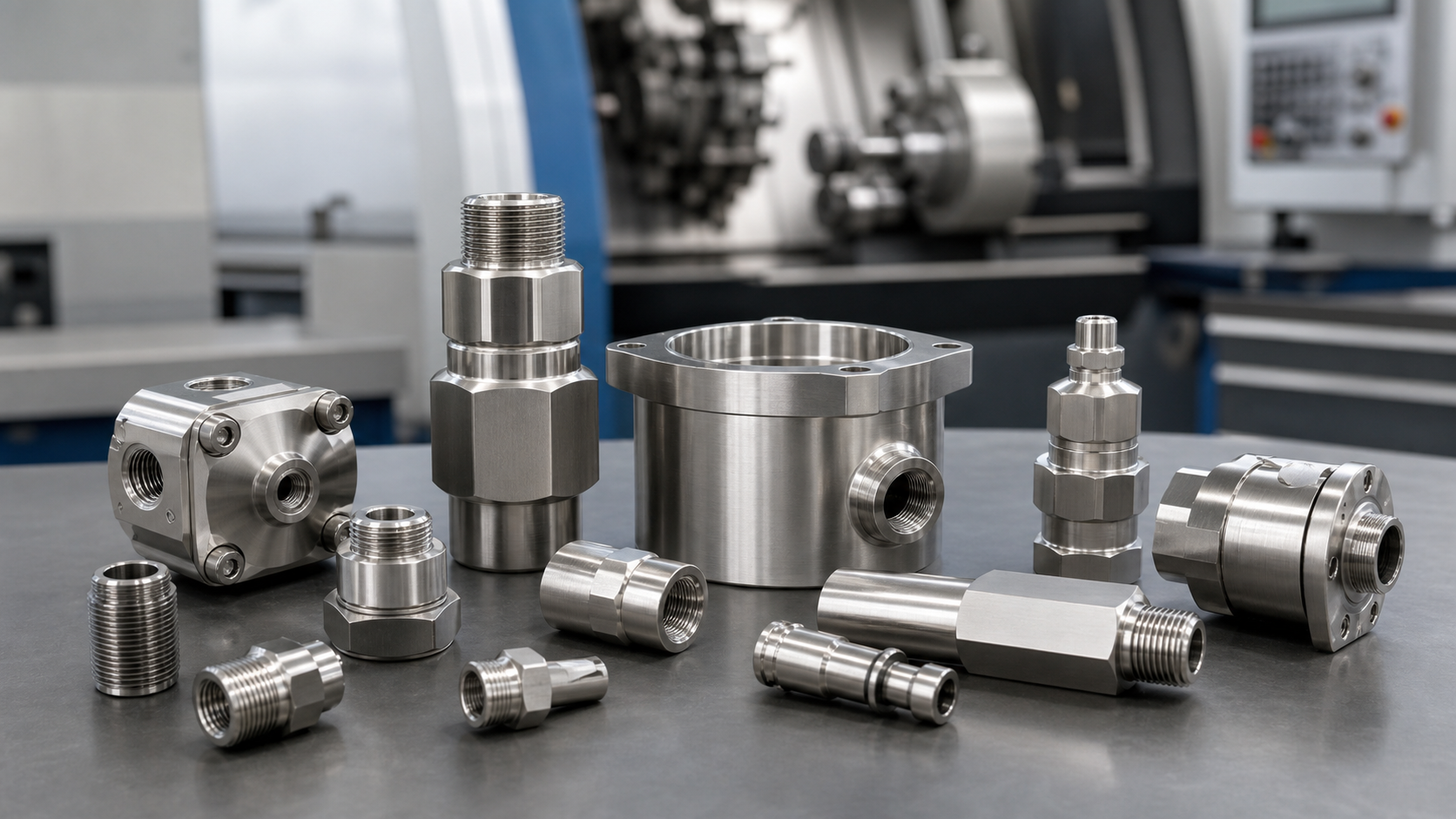
In industries where measurement, control and reliability matter, small metal components often carry a large share of system performance. Stainless steel instrument fittings are a good example. They may look simple from the outside, but the threads, sealing faces, bores and shoulders all need to be produced with consistent accuracy so the finished assembly can perform safely in demanding environments.
Why stainless steel is widely used for instrument fittings
Stainless steel offers an excellent balance of corrosion resistance, strength and long service life. For instrumentation systems used in fluid control, pressure monitoring, analytical equipment, marine hardware or industrial automation, these properties help fittings maintain dimensional stability and surface integrity over time.
Common stainless steel grades such as 304 and 316 are often selected according to the working environment. 304 stainless steel is suitable for many general industrial applications, while 316 stainless steel provides stronger resistance in chloride-rich or more corrosive conditions. Choosing the right grade at the design stage can reduce maintenance issues and improve product reliability.
The role of CNC machining in precision fitting production
CNC turning and milling make it possible to manufacture stainless steel instrument fittings with tight tolerances and repeatable quality. Features such as internal and external threads, tapered seats, small holes, grooves and flat sealing surfaces can be produced in one controlled workflow when the process is planned correctly.
For stainless steel parts, machining stability is especially important. Stainless steel has toughness and work-hardening characteristics, so tool selection, cutting parameters, coolant strategy and fixture design all affect the final result. A stable CNC process helps control burrs, preserve thread quality and maintain a clean surface finish.
Key details buyers should pay attention to
When sourcing CNC machined stainless steel instrument fittings, the drawing is only the starting point. Buyers should also consider the functional surfaces of the part. Thread accuracy, concentricity, edge treatment, surface roughness and cleanliness may all influence assembly performance.
If the fitting will be used with pressure, fluid or gas systems, communication between the buyer and manufacturer becomes even more important. Confirming the material grade, tolerance requirements, inspection method and finishing standard before production helps avoid costly rework later.
Aodson Metal’s manufacturing approach
Aodson Metal supplies precision stainless steel parts and custom CNC machined components for industrial customers. For instrument fittings, the focus is on stable processing, clear drawing review and practical quality control from raw material to finished part.
Whether the requirement is a small batch for development or repeat production for an assembled product, CNC machining gives engineers flexibility to refine dimensions, improve assembly fit and keep part quality consistent. With the right material and process control, stainless steel instrument fittings can support reliable performance across many industrial applications.
Looking for custom stainless steel instrument fittings? Send your drawing, sample or specification to Aodson Metal for a practical machining review and manufacturing suggestion.