




CNC machining converts digital toolpaths into repeatable metal components.
A computer numerical control system coordinates machine axes, spindle speed, tools and programmed movements. Milling, turning, drilling and EDM are selected according to geometry, material, tolerance, surface finish and production volume.
- Milling is suited to prismatic faces, pockets and complex profiles.
- Turning is efficient for shafts, threads and rotational parts.
- DFM review reduces setups, tooling risk and unnecessary cost.
In the modern manufacturing landscape, Computer Numerical Control (CNC) machining stands as a cornerstone technology, revolutionizing how precision parts and components are designed and produced. From aerospace components to everyday consumer goods, CNC machining has become an indispensable tool, blending computer programming, mechanical engineering, and automation to deliver consistent, high-quality results. This article explores the fundamentals of CNC machining, including its definition, core processes, key components, applications, advantages, and future trends.
1. What is CNC Machining?
CNC machining refers to the automated control of machine tools using computer programs encoded with numerical data. Unlike traditional manual machining, which relies on human operators to manipulate tools and guide the machining process, CNC machining uses pre-programmed instructions to control the movement of cutting tools, workpieces, and other machine components with unparalleled precision. The core principle is to translate design specifications—typically created using Computer-Aided Design (CAD) software—into a set of commands (often in G-code or M-code) that the CNC machine interprets and executes automatically. Below are practical G-code examples for common CNC operations, making the programming concept more tangible:
The evolution of CNC machining traces back to the 1950s, when the first numerically controlled (NC) machines were developed using punched cards for programming. As computing technology advanced, NC machines evolved into CNC systems, which offer greater flexibility, easier programming, and real-time adjustments—eventually replacing manual machining in most high-precision and high-volume manufacturing applications. Today, CNC machining is used across industries to produce parts with tight tolerances (often as small as ±0.0005 inches) and complex geometries that would be impossible or impractical to achieve manually.
2. Core CNC Machining Processes
CNC machining encompasses a range of subtractive manufacturing processes, where material is removed from a workpiece to achieve the desired shape. The most common processes include:
2.1 CNC Milling
CNC milling is one of the most versatile CNC processes, using rotating multi-point cutting tools to remove material from the workpiece. The workpiece is clamped to a worktable, which moves along multiple axes (typically X, Y, and Z) to position the material relative to the tool. Milling can produce flat surfaces, slots, holes, and complex 3D shapes, making it ideal for parts like engine components, brackets, and mold cavities. Advanced milling machines, such as 5-axis models, can move the tool along additional rotary axes (A, B, C), enabling the machining of complex curved surfaces in a single setup.
2.2 CNC Turning
CNC turning is used to produce cylindrical or conical parts, such as shafts, pins, and bushings. In this process, the workpiece rotates at high speed while a stationary cutting tool moves linearly to remove material from the outer or inner surface of the workpiece. CNC lathes (the machines used for turning) can also perform additional operations like facing, boring, grooving, and threading, eliminating the need for multiple machine setups. This process is widely used in the automotive and aerospace industries for mass-producing precision rotational parts.
2.3 CNC Drilling
CNC drilling involves using computer-controlled drill bits to create precise holes in a workpiece. The process can produce holes of various depths and diameters, and may include specialized techniques like peck drilling (for deep holes) and spot drilling (to guide the drill bit). CNC drilling is essential for parts like fixture plates, mechanical housings, and engine blocks, where accurate hole positioning is critical.
2.4 Advanced CNC Processes
Beyond the core processes, modern CNC machining includes advanced techniques to meet specialized needs: – 5-Axis Machining: Combines linear and rotary axes to machine complex parts from multiple angles, reducing setup time and improving precision—ideal for aerospace components like turbine blades. – High-Speed Machining (HSM): Uses spindle speeds of 20,000–50,000 RPM and ultra-hard tools to increase material removal rates by 30% or more, while achieving surface roughness as low as Ra 0.8μm. – EDM (Electrical Discharge Machining): A non-contact process that uses electrical sparks to erode material, suitable for hard metals and complex shapes that cannot be cut with traditional tools.
3. Key Components of a CNC Machine
A CNC machine is a complex system of interconnected components, each playing a critical role in ensuring precision and efficiency. The seven major components are as follows:
3.1 Machine Frame/Bed
The structural base of the CNC machine, supporting all other components (spindle, axes, worktable). It is typically made of cast iron, steel, or granite for high rigidity and stability, reducing vibrations during machining to ensure accuracy. The frame also holds linear guides for smooth movement of the worktable.
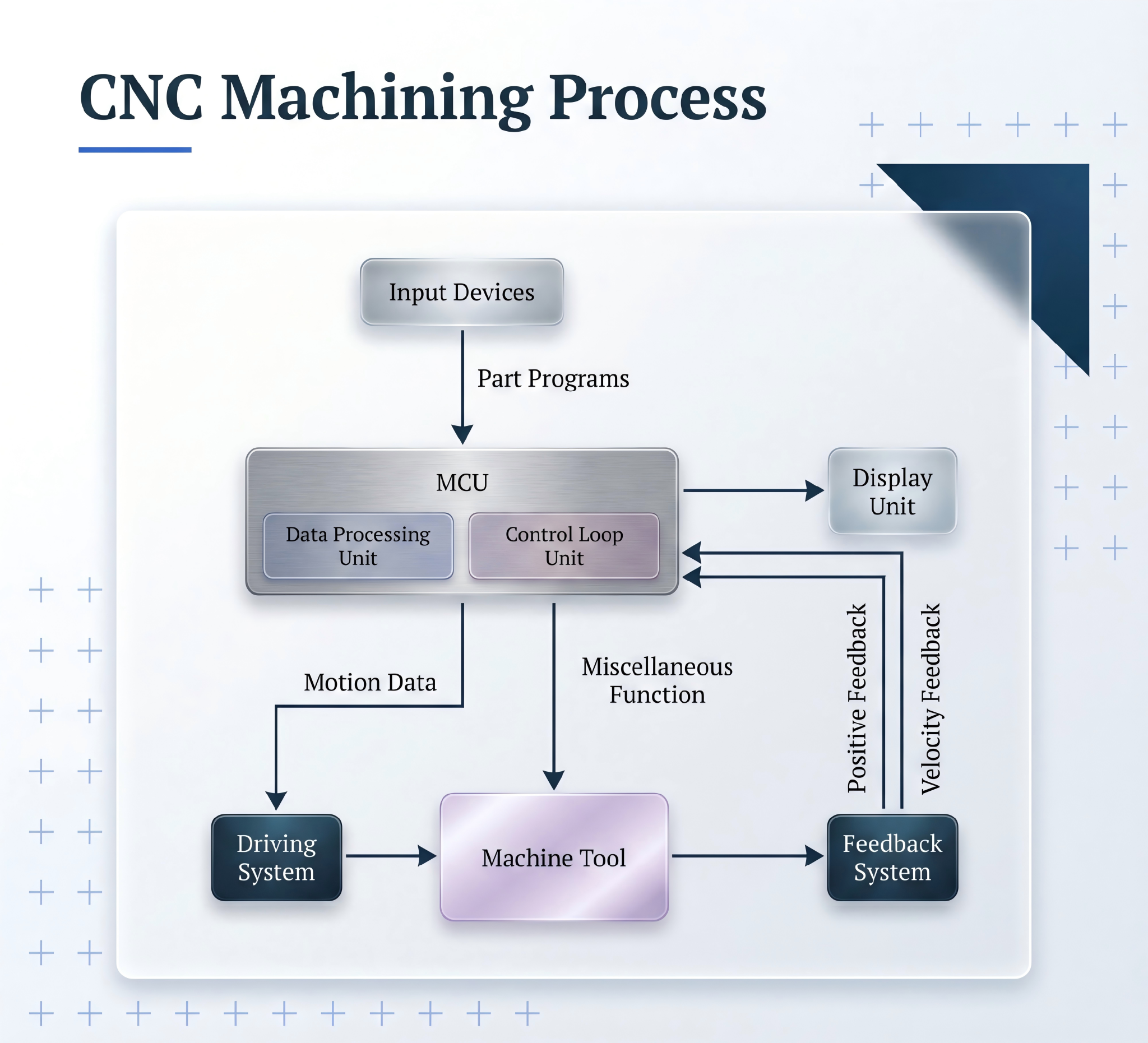
3.2 CNC Controller (Machine Control Unit, MCU)
The “brain” of the CNC machine, responsible for interpreting the G-code or M-code program, sending commands to the drive system, and monitoring feedback from sensors. It features an operator interface (control panel) for program input, editing, and monitoring. Popular controllers include Fanuc, Siemens, and Haas models.
3.3 Spindle & Tool Holder
The spindle is the rotating component that holds the cutting tool (in milling) or the workpiece (in turning). It provides rotational motion at precise speeds (RPM) and transfers torque to the tool or workpiece. The tool holder secures the cutting tool, ensuring rigidity and precision during cutting. Spindles can be belt-driven, gear-driven, or electric (integrated motor and spindle for high-speed applications).
3.4 Axis System
CNC machines move the tool or workpiece along controlled axes, which can be linear (X, Y, Z) or rotary (A, B, C). The number of axes determines the machine’s capability: 3-axis machines are common for basic parts, while 5-axis machines handle complex geometries. Linear guides and ball screws ensure precise positioning and repeatability.
3.5 Drive System
Converts electrical signals from the controller into mechanical motion, driving the axes and spindle. It includes servo motors and ball screws, which determine the machine’s positioning accuracy and speed. Closed-loop drive systems (with feedback sensors) are used for high-precision applications, while open-loop systems are simpler and more cost-effective for basic tasks.
3.6 Worktable & Work Holding Device
The worktable is where the workpiece is clamped or secured during machining. It moves along the X and Y axes (in milling) or rotates (in turning) to position the material relative to the tool. Work holding devices—such as vices, chucks, and fixtures—ensure the workpiece remains stable and aligned, preventing movement that could compromise precision.
3.7 Feedback System (Sensors)
Monitors the position, speed, and temperature of the machine’s components in real time, sending data back to the controller. This allows the controller to make adjustments and correct errors, ensuring tight tolerances. Common feedback devices include encoders, resolvers, and linear scales. Machines with a feedback system are called closed-loop systems, while those without are open-loop systems.
4. Applications of CNC Machining
CNC machining is used across virtually every manufacturing industry, thanks to its versatility, precision, and efficiency. Those seeking professional support can access specialized CNC machining services, and the top industries relying on CNC machining (by market size) include:
- Aerospace & Defense: Produces precision parts like turbine blades, airframe structures, and landing gear using high-strength materials (titanium, Inconel). The global aerospace parts market reached $913 billion in 2023.
- Automotive: Manufactures engine blocks, transmission housings, and chassis components. The global automotive CNC equipment market is projected to reach $32 billion in 2025.
- Medical & Dental: Creates surgical tools, implants, and prosthetics with high precision and biocompatibility, using materials like medical-grade stainless steel and titanium.
- Electronics & Semiconductor: Produces enclosures, molds, and fixtures for semiconductor equipment and consumer electronics, requiring tight tolerances for small, delicate parts.
- Tool & Die/Mold Making: Manufactures injection molds, dies, and fixtures with complex geometries, essential for mass production in various industries.
- Oil, Gas & Energy: Produces valve bodies, pumps, and turbine components that operate in extreme conditions, requiring high durability and precision.
5. Advantages & Limitations of CNC Machining
5.1 Advantages
- Precision & Consistency: Delivers parts with tight tolerances and consistent quality, even for high-volume production. Human error is minimized, ensuring every part matches the design specifications.
- Efficiency: Automates the machining process, reducing cycle times and increasing productivity. CNC machines can operate 24/7 with minimal human supervision.
- Versatility: Can machine a wide range of materials (metals, plastics, wood, composites) and complex geometries that are impossible with manual machining.
- Flexibility: Changing production runs is simple—just update the program, no need to reconfigure the machine extensively. This makes it ideal for small-batch and custom production.
- Safety: Reduces human exposure to hazardous cutting operations, as operators are not required to manually guide tools.
5.2 Limitations
- High Initial Cost: CNC machines and related software (CAD/CAM) require significant upfront investment, making them less accessible for small businesses.
- Skilled Labor Requirement: Operators and programmers need specialized training to operate CNC machines and write effective G-code programs.
- Setup Time: Complex parts may require lengthy setup times for programming, tooling, and fixturing, which can reduce efficiency for very small production runs.
- Material Limitations: While versatile, CNC machining is less effective for extremely hard or brittle materials, which may require specialized processes like EDM.
6. Future Trends in CNC Machining
The future of CNC machining is shaped by technological advancements that enhance precision, efficiency, and connectivity. Key trends include:
- Industry 4.0 Integration: CNC machines are becoming part of smart factories, connected to IoT (Internet of Things) devices for real-time monitoring, predictive maintenance, and data-driven optimization. This reduces downtime and improves overall productivity.
- AI & Machine Learning: AI-powered CNC systems can optimize tool paths, predict tool wear, and adjust parameters in real time, improving efficiency and reducing waste. Machine learning algorithms can also learn from past production runs to refine future processes.
- Additive-Subtractive Hybrid Machining: Combining 3D printing (additive manufacturing) with CNC machining (subtractive manufacturing) to produce complex parts with both speed and precision. This hybrid approach leverages the strengths of both technologies.
- Miniaturization: The demand for micro-CNC machining is growing, particularly in the electronics and medical industries, to produce tiny, high-precision parts like micro-implants and electronic components.
- Sustainability: CNC manufacturers are adopting eco-friendly practices, such as using biodegradable coolants, optimizing energy use, and reducing material waste through precise tool paths.
7. Conclusion
CNC machining has transformed modern manufacturing, offering unparalleled precision, efficiency, and versatility. From its humble beginnings as a replacement for manual machining to its current role as a cornerstone of smart manufacturing, CNC technology continues to evolve, driving innovation across industries. Understanding its definition, processes, components, and applications is essential for anyone involved in manufacturing, engineering, or product design.
As technology advances, CNC machining will become even more accessible, efficient, and integrated into global supply chains, ensuring it remains a critical tool for producing the parts that power our world—from aerospace engines to medical devices and beyond.