Local Service, Global Capabilities.
Local Service, Global Capabilities.
2026-05-28
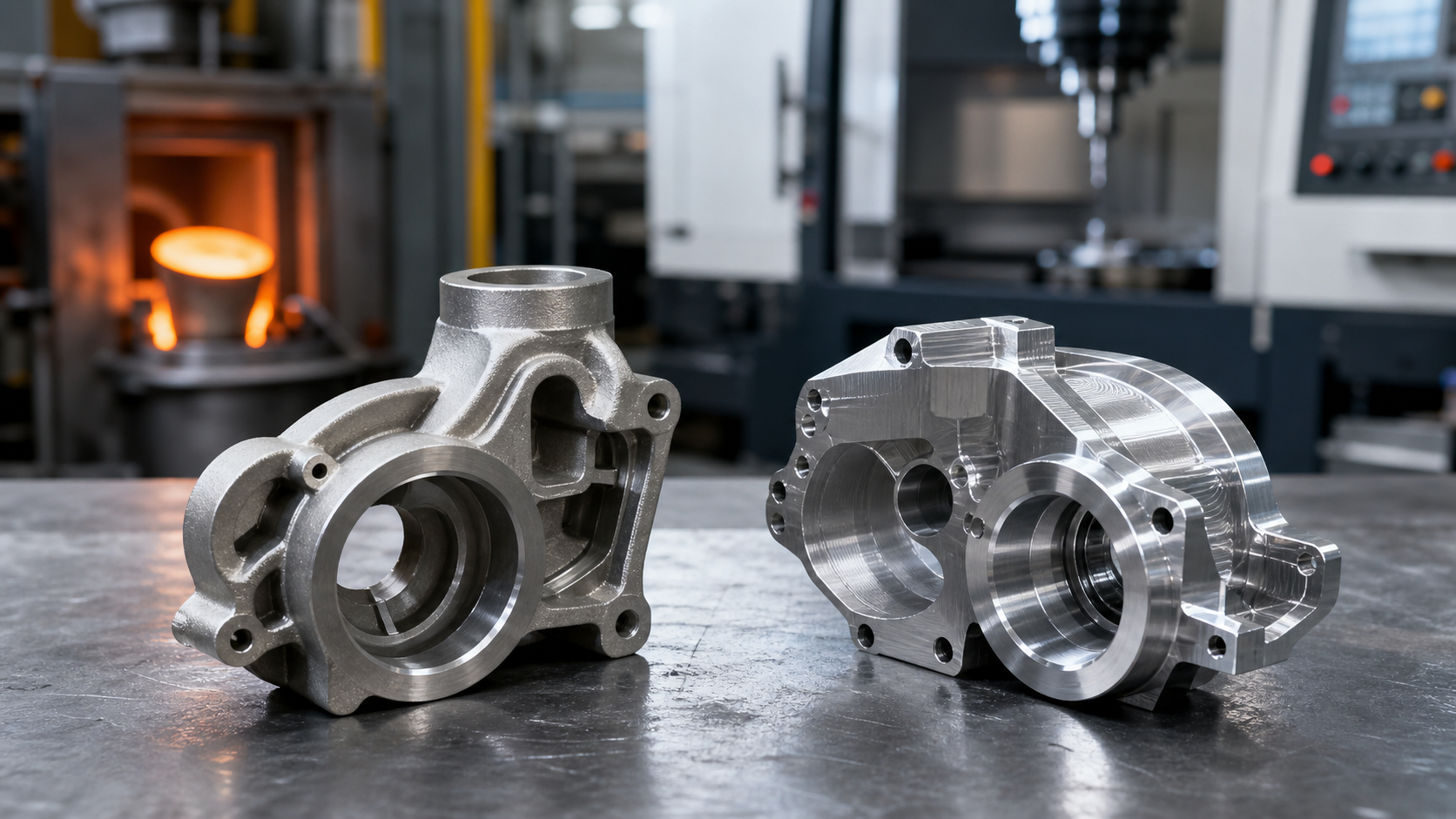
When a metal part becomes difficult to make, the manufacturing decision usually narrows to two strong options: investment casting and CNC machining. Both can produce reliable, high-performance components. Both are used for stainless steel, carbon steel, alloy steel, aluminum, brass, and specialty alloys. And both can support demanding applications in pumps, valves, marine hardware, construction hardware, machinery, and custom industrial assemblies.The better choice depends less on which process is “more advanced” and more on the shape of the part, annual quantity, tolerance requirements, surface finish, material, and how much post-processing the design can tolerate.This guide compares investment casting vs CNC machining from a practical engineering and sourcing point of view, especially for complex metal parts where cost, repeatability, and design freedom all matter. What Is Investment Casting? Investment casting, also called lost wax casting, is a precision casting process used to produce metal parts with complex geometry. A wax pattern is made, assembled into a tree, coated with ceramic shell, melted out, and then filled with molten metal. After solidification, the ceramic shell is removed and the castings are cut, cleaned, heat treated, machined where needed, and inspected.The biggest strength of investment casting is shape freedom. It can create internal contours, curved surfaces, ribs, bosses, thin walls, and blended transitions that would be expensive or impossible to machine from solid bar stock. For complex parts, it often produces a near-net-shape blank, leaving only critical surfaces for secondary CNC machining. What Is CNC Machining? CNC machining removes material from a solid block, bar, forging, casting, or extrusion using computer-controlled cutting tools. Common CNC processes include milling, turning, drilling, tapping, grinding, and multi-axis machining.The biggest strength of CNC machining is dimensional control. It is excellent for tight tolerances, flatness, concentricity, threads, precision holes, sealing surfaces, and parts that need clean, repeatable edges….