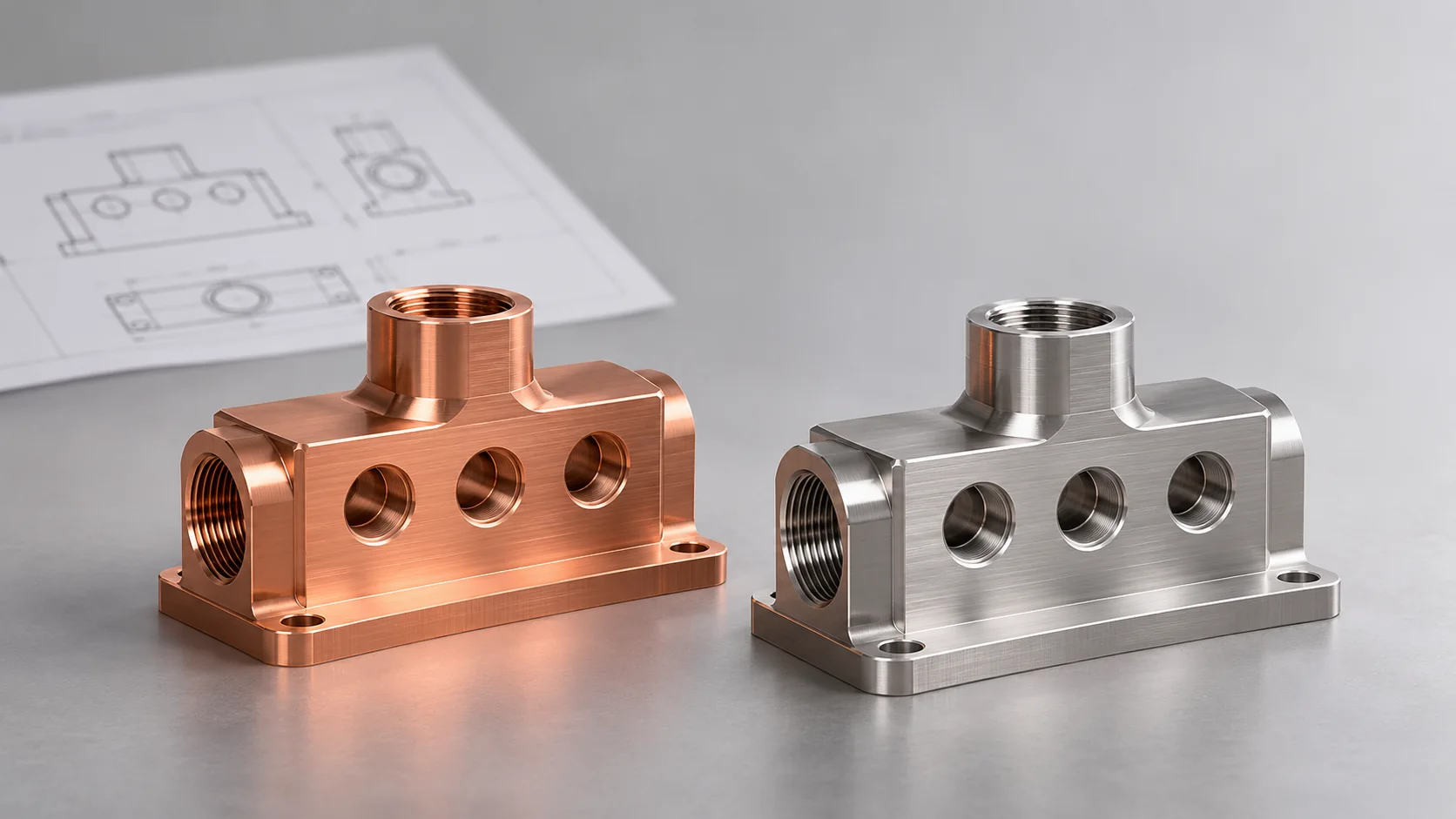
Engineering answer: Stainless steel can replace a copper component when the part’s primary job is to contain a fluid, carry a mechanical load, survive cleaning, or resist a specified environment and the complete assembly is redesigned and qualified. It is usually not a direct substitute where copper’s high electrical or thermal conductivity is the reason the part works. The decision must start with the actual copper alloy, product form, operating environment and governing standard.
This article compares wrought C11000 electrolytic tough pitch (ETP) copper with common austenitic 304 and 316L stainless steels. “Copper” also includes brass, bronze and copper-nickel alloys; their strength, conductivity and corrosion behavior differ greatly. Do not apply the numbers below to those alloys or to cast parts without checking the relevant data sheet.
Material properties at a glance
The following are representative published values near room temperature, not guaranteed values for a particular batch. Stainless steel properties are grade and product-form dependent; strength values are deliberately kept out of this physical-property table because temper, cold work and specification can change them substantially.
| Property | C11000 copper | 304 stainless | 316L stainless | Engineering consequence |
|---|---|---|---|---|
| Density, g/cm³ | 8.91 | 7.9 | 8.0 | Same-volume stainless part is roughly 10–11% lighter; redesign may change total mass. |
| Thermal conductivity at about 20 °C, W/(m·K) | 391 | 15 | 14–15 | Copper conducts heat roughly 26–28 times faster through equal geometry. |
| Electrical resistivity at about 20 °C, Ω·mm²/m | about 0.0171* | about 0.73 | about 0.75 | For equal length and cross-section, stainless has about 43–44 times the DC resistance. |
| Electrical conductivity, % IACS | about 101 | about 2.4* | about 2.3* | Do not assume a stainless conductor can replace a copper conductor. |
| Elastic modulus at about 20 °C, GPa | about 117 | about 200 | about 200 | Stainless is stiffer, but joint loads and deflection still require calculation. |
| Mean linear thermal expansion, 20–100 °C, ×10⁻⁶/K | about 16.9 | about 16–17 | about 16–17 | Values are similar in this range; constrained joints still need thermal-stress review. |
*Calculated from the Copper Development Association’s C11000 value of 101% IACS and the IACS reference conductivity of 58.0 MS/m; stainless % IACS values are calculated from the listed resistivities. The copper conductivity is a typical figure in the cited CDA tables, while C11000 annealed material has a stated minimum of 100% IACS. BSSA and World Stainless list 304/316-family physical properties; exact figures vary by source and grade. Figures are for screening, not a certified purchase specification.
Where substitution is technically feasible
Valve bodies, manifolds, fittings and housings: If the copper component primarily provides a pressure boundary or mechanical interface, 304 or 316L may be considered. Recalculate wall thickness, thread engagement, pressure rating, fatigue, sealing surfaces and joint loads. Evaluate fluid chemistry, temperature, cleaning agents and the effect of any copper-containing mating parts. A drawing and pressure test for the copper version do not automatically qualify the stainless version.
Hardware and brackets: Stainless may improve stiffness, wear resistance or cleaning durability in some applications. The geometry and grade must still meet the specified load, corrosion and surface-finish requirements. For custom components, CNC machining, forming or precision casting may be possible routes; select the process after reviewing tolerances and volume, not from alloy name alone.
Piping and wetted assemblies: Stainless pipe and fittings are established products, but the substitution is a system change. Confirm applicable piping and drinking-water/product-contact approvals, pipe schedule, flow velocity, welding procedure, surface condition, cleaning, fittings, supports and code requirements. The suitability of 304 or 316L depends on chloride concentration, temperature, stagnation and crevices. Do not treat 316L as universally resistant to seawater or hot chloride service.
Where stainless must not be a drop-in replacement
| Original copper duty | Why direct replacement fails | What would be required |
|---|---|---|
| Busbars, power terminals, grounding straps, motor windings | Much greater resistance causes voltage drop and I²R heating; contact behavior and fault performance change. | Electrical, temperature-rise and fault-current redesign. In many cases, retain copper at the current path. |
| Heat spreaders, cold plates, heat-exchanger tubes or fins | Far lower bulk thermal conductivity increases conduction resistance for equal geometry. | Full thermal and hydraulic redesign, potentially with different area, wall, flow and joining method; a stainless shell with a copper thermal path may be more appropriate. |
| Touch surfaces chosen for copper’s antimicrobial performance | A bare stainless surface must not be assumed to deliver the same antimicrobial effect. | Retain the specified copper alloy or independently validate a different surface system against the required protocol. |
| Copper plumbing connections or code-listed parts | Tube dimensions, joining method and approvals may differ even if nominal size matches. | Review the complete fitting and installation standard; obtain required potable-water or other product approvals. |
| Parts relying on copper’s solderability, brazing behavior or soft-seal deformation | Joint metallurgy, process temperature and sealing behavior change. | Qualify the new joint, compatible filler or mechanical connection and its leak/fatigue performance. |
These are application-level screening rules, not a ban on stainless in electrical or thermal equipment. Stainless may still be used for a housing, pressure shell, fastener or support while copper remains in the conductor or heat-transfer path.
Two simple calculations that expose the trade-off
For a uniform electrical path, R = ρL/A. At the same temperature, length and area, replacing C11000 copper (approximately 0.0171 Ω·mm²/m) with 304 stainless (approximately 0.73 Ω·mm²/m) increases calculated DC resistance by approximately 43×. For a 1 m path with 100 mm² cross-section, that is about 0.000171 Ω versus 0.0073 Ω. At 100 A, idealized I²R loss is about 1.7 W versus 73 W. These figures exclude joints, skin effect and temperature rise; they demonstrate why an identical stainless busbar is not an acceptable assumption.
For one-dimensional steady conduction through a uniform solid, Q = kAΔT/L. At identical area, length and temperature difference, 304 stainless at 15 W/(m·K) transfers only about 1/26 as much heat through the material as C11000 copper at 391 W/(m·K). A real heat exchanger also has convection, fouling and contact resistances, so this ratio is not a prediction of its total duty. It is a strong warning against changing only the material on the drawing.
Mechanical strength and manufacturability need their own comparison
It is often true that an annealed 304 or 316L stainless product has higher specified yield strength than annealed C11000 copper, but “stainless is stronger” is not a universal specification. Cold-worked copper can be much stronger than annealed copper, and stainless plate, bar, tube and castings have different minimums. Compare the exact material standard, temper/condition, temperature and design allowable. Also review ductility, forming radius, galling at stainless threads, machining time, weldability and surface finish. Replaceable seals and dissimilar-metal joints may become the limiting details.
The following published examples show why the condition matters. CDA figures are typical C11000 values for the listed tempers; the Alleima figures are for its annealed bar stock at 20 °C. These are different product forms and value types, so the rows are not design-code equivalences.
| Published material example | 0.2% proof/yield, MPa | Tensile strength, MPa | Elongation, % |
|---|---|---|---|
| C11000 copper, OS025 annealed (CDA typical) | 76 | 235 | 45 |
| C11000 copper, H02 half-hard (CDA typical) | 255 | 283 | 14 |
| Sanmac 304/304L annealed bar (Alleima data sheet) | ≥205 | 515–680 | ≥45 |
| Sanmac 316/316L annealed bar (Alleima data sheet) | ≥205 | 515–690 | ≥40 |
For a pressure-containing part, use the applicable design code and material allowable rather than substituting published room-temperature tensile strength into a pressure calculation. Verify wall thickness, proof/leak testing, weld procedure and inspection plan through the project’s qualified engineer.
Corrosion is an environment-specific decision
Stainless corrosion resistance comes from a chromium-rich passive film. It can be damaged locally by chlorides, crevices, deposits or unsuitable cleaning chemistry. 316L generally has better pitting and crevice resistance than 304 because of molybdenum, but neither grade is a blanket seawater solution. Temperature, chloride content, oxygen, flow, crevice geometry and weld condition matter. Mixed copper/stainless assemblies also need review for galvanic effects in the actual electrolyte and geometry; metal pairing alone does not determine failure.
Conversely, copper is not universally corrosion-proof: its performance depends on water chemistry, fluid velocity, contaminants and the chosen copper alloy. A material change should be evaluated against actual service records or representative corrosion testing, rather than a generic ranking of “copper versus stainless.” See AODSON’s quality-control overview for general inspection capabilities; project-specific corrosion testing and acceptance criteria must be agreed separately.
A practical substitution decision sequence
- Identify the existing alloy and condition (for example C11000, brass or copper-nickel), product standard and critical function.
- Record the operating envelope: fluid, pressure, temperature, chloride and cleaning exposure, electrical current, thermal duty, loads and lifetime.
- Mark every interface: threads, welds, soldered/brazed joints, seals, dissimilar metals, supports and regulatory approvals.
- Screen physical-property differences, then recalculate electrical, heat-transfer, pressure, fatigue and corrosion performance as relevant.
- Prototype the revised geometry and qualify it with the required dimensional, pressure/leak, thermal, electrical or corrosion tests.
- Compare total material, machining, joining, inspection, maintenance and replacement cost. Commodity price alone is not the decision.
If you are considering a copper-to-stainless redesign for a manifold, fitting, housing or finished industrial component, send the existing drawing, copper grade, duty conditions, required standard and annual quantity through the AODSON quotation page. We can review manufacturability and the inspection information needed for a realistic quotation; final material approval remains with the responsible design authority.
Frequently asked questions
Is 316L always a better substitute than 304?
No. 316L is often preferred when chloride-related pitting or crevice corrosion is a concern, but it is not immune, and its higher alloy content does not solve electrical or thermal conductivity limits. Match the grade to the actual environment and code.
Will a stainless copy of a copper manifold weigh less?
For exactly the same solid volume, 304/316L would weigh about 10–11% less using the representative densities above. Required wall thickness, added fittings or changed geometry can remove that advantage.
Can stainless replace copper in a heat exchanger?
Sometimes, after a complete design and material review. Stainless heat exchangers exist, but lower wall conductivity, fluid-side corrosion, fouling, pressure drop, wall thickness and joining must be calculated. It is not a same-drawing material swap.
Can stainless replace a copper busbar?
Usually not at identical dimensions. Its much higher resistivity changes voltage drop, temperature rise and fault behavior. Any alternative conductor design requires an electrical engineer’s calculations and testing.
Technical references and scope
- Copper Development Association, C11000 alloy profile — composition, density, conductivity and temper-dependent mechanical properties.
- Copper Development Association, architectural copper-alloy property table — C11000 thermal conductivity, expansion and modulus.
- British Stainless Steel Association, ambient physical properties — 304/316 density, modulus, expansion, thermal conductivity and resistivity.
- Alleima, Sanmac 316/316L data sheet — grade-specific physical and corrosion information for bar.
- Alleima, Sanmac 304/304L data sheet — mechanical properties of annealed bar.
- World Stainless, corrosion properties — passive film, pitting, crevice and galvanic corrosion considerations.
Values are approximate screening data at the stated temperature and for the named grades. Confirm the current material specification and certificate for the actual product form, and use the applicable design code and qualified test plan before approving a substitution.