



PVD-coated stainless steel architectural hardware should be specified as a complete finish system: stainless substrate, surface texture, approved color sample, coating process, wear exposure, fabrication sequence and inspection criteria. Ordering “gold PVD” or “black PVD” without these details can lead to color variation, visible defects and unsuitable performance.
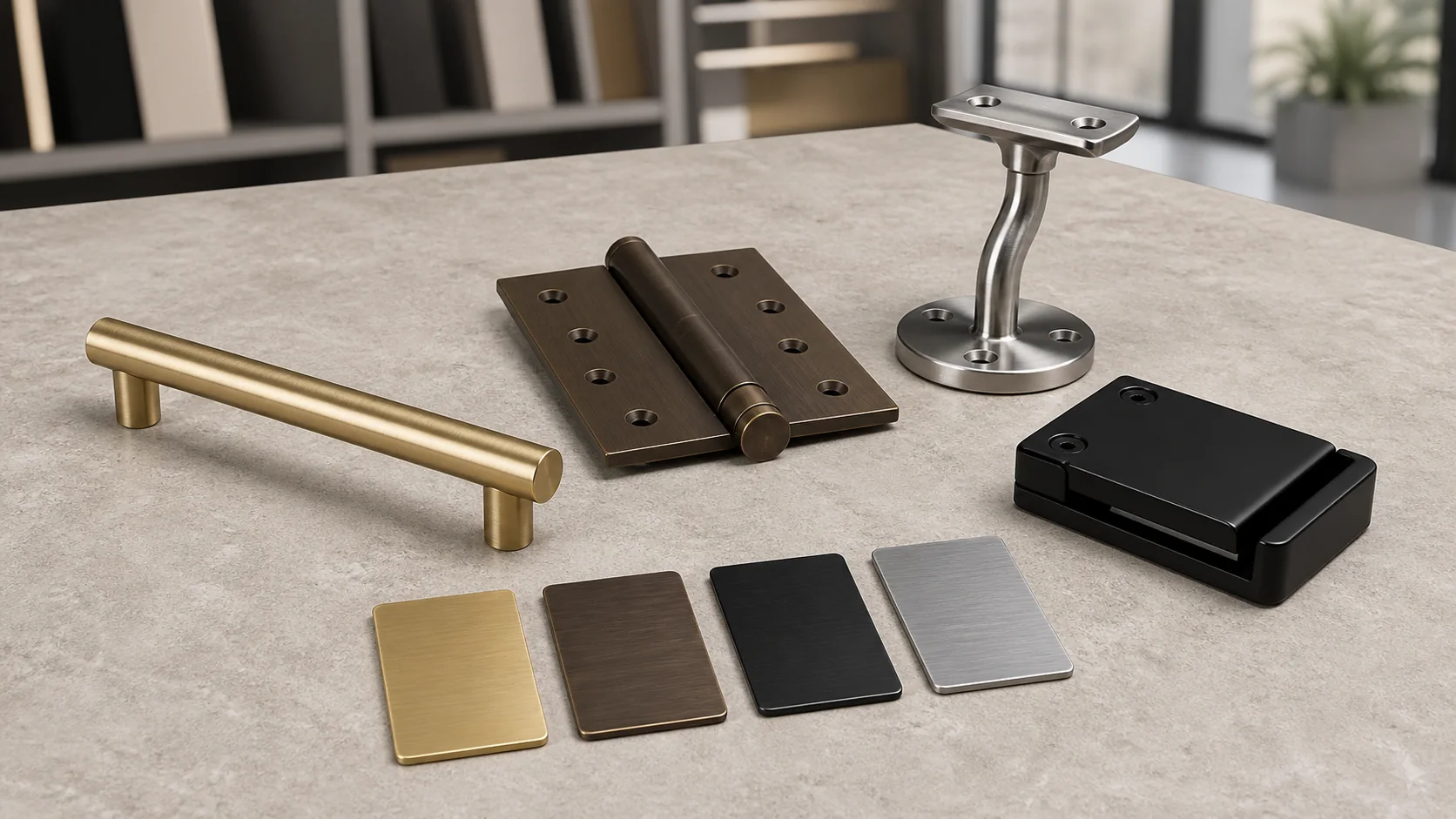
Colored stainless steel is now common in hotels, retail interiors, offices, residential towers and premium public buildings. Champagne-gold door pulls, bronze handrail brackets and black glass clamps give designers a warmer or more dramatic alternative to natural silver stainless steel.
The finish is often described simply as PVD. For architects, hardware brands, distributors and OEM buyers, that label is only the beginning. The final appearance depends heavily on the stainless steel beneath the coating and on how the component is manufactured before it enters the coating chamber.
What is PVD coating on stainless steel?
Physical vapor deposition (PVD) is a vacuum coating process in which material is vaporized and deposited as a thin, adherent layer on a prepared component. Different coating materials and process conditions can create colors such as champagne, gold, rose gold, bronze, copper, black, gray and blue.
PVD changes the surface color and can improve selected surface properties, but it does not turn a poor substrate into a premium component. Scratches, pits, polishing waves, weld defects and casting marks usually remain visible after coating. Surface preparation is therefore part of the color specification.
Where PVD architectural hardware is used
Typical applications include door pull handles, lever handles, handrail supports, glass clamps, shower fittings, elevator trim, signage details, decorative fasteners, wall brackets and selected facade components. PVD is particularly attractive when several metal elements must share a coordinated finish across an interior design.
Not every surface is equally suitable. A decorative handrail bracket sees different wear from a door latch, floor fitting or moving hinge. Contact frequency, abrasion, cleaning chemicals, outdoor exposure and replacement access should be considered before the finish is approved.
1. Select the stainless steel substrate first
For many dry interior products, 304 stainless steel offers a practical balance of formability, finish quality and cost. Exterior, humid, poolside and coastal applications commonly require 316 or 316L stainless steel for improved chloride resistance.
The PVD layer should not be treated as a substitute for an appropriate base alloy. Edges, threads, holes, damaged areas and hidden interfaces may experience the actual service environment differently from the visible face. If the project requires corrosion resistance, specify the stainless grade independently from the decorative color.
2. Define the texture under the color
PVD follows the underlying surface. A mirror-polished component produces a bright reflective color, while a brushed or satin surface produces a softer directional appearance. Bead-blasted surfaces diffuse light and may make colors appear lighter or less metallic.
The purchase specification should state the pre-coating finish, grain direction, acceptable roughness and visual reference. Components installed next to PVD sheet or trim should be compared under the same lighting because formed hardware and flat sheet can reflect color differently even when the nominal coating is similar.
3. Approve a physical color sample
Names such as “champagne gold,” “antique bronze” and “satin black” are not universal color standards. The same name can look different between suppliers, coating chambers, substrate finishes and production batches.
Approve a physical sample made on the intended stainless grade and finish. For an important project, retain a signed master sample and define the viewing conditions, acceptable range and whether components from different manufacturing routes must visually match.
4. Complete machining and polishing before coating
Most cutting, drilling, threading, welding, grinding and polishing should be completed before PVD coating. Machining after coating exposes uncoated metal and can chip or scratch the finish around the operation. If assembly requires hidden machining or electrical contact areas, those zones should be identified and masked by agreement with the coating supplier.
For investment-cast hardware, the process may include casting, gate removal, CNC machining, grinding, polishing, cleaning, PVD coating and final assembly. Each stage affects the next. A casting defect cannot be reliably hidden by color, and aggressive post-coating adjustment can damage an otherwise acceptable surface.
5. Design around wear and impact
PVD coatings can be hard, but a thin decorative layer is not immune to deep scratches, metal-to-metal impact or abrasive cleaning. High-touch products should be designed so keys, tools, sliding parts and fasteners do not repeatedly cut across the colored face.
Consider replaceable wear components where practical. Door stops, latch interfaces, moving joints and floor-level fittings may need a different finish strategy from decorative stationary brackets. The coating supplier should confirm whether the selected system is suitable for the intended wear and environment.
6. Control edges, recesses and contact points
Complex hardware includes deep holes, narrow gaps, internal threads and shadowed surfaces. Coating appearance and coverage can differ in these areas. Drawings should identify which faces are cosmetic, which are hidden and which must remain dimensionally controlled.
Sharp edges may show different color or become vulnerable during handling. Threaded connections and press fits require dimensional allowance and should be tested after coating. Gaskets, adhesives and cleaning products must also be compatible with the finished assembly.
7. Plan lot consistency and replacement parts
Color can vary slightly between production lots. A large project should group visible components into controlled batches and record the approved finish. Spare parts may be ordered with the main production lot when future visual matching is important.
For mixed product families, use the same master sample and communicate the substrate finish for each item. A cast bracket, machined handle and fabricated cover may need process adjustments to achieve a coordinated appearance.
8. Specify cleaning and maintenance
Use soft cloths, clean water and mild neutral detergent unless the coating supplier approves another method. Abrasive powders, metal scourers and aggressive acidic or chloride cleaners can scratch or discolor the surface.
Public-facing hardware should be inspected for impact damage and contamination. Maintenance instructions should be handed to the building operator, especially where cleaning is performed by multiple contractors.
PVD hardware manufacturing and quality-control sequence
- Drawing review: identify cosmetic faces, interfaces, masking areas and critical tolerances.
- Base manufacturing: cast, machine, fabricate or form the stainless component.
- Surface preparation: grind and polish to the approved texture and remove defects.
- Cleaning: remove oils, polishing compound, dust and handling contamination.
- PVD coating: process the controlled batch using the approved color system.
- Inspection: compare color, gloss and texture with the master sample.
- Assembly: protect visible faces while installing gaskets, screws and accessories.
- Packaging: separate parts and prevent abrasion during export transport.
What should be inspected?
A useful inspection plan includes substrate material, dimensions before and after coating where relevant, visible scratches, pits, color variation, gloss, grain direction, edge condition and contamination. The approved sample should remain available during production and final inspection.
When a project requires quantified coating performance, the test method and acceptance value should be agreed with the PVD supplier before quotation. Do not add generic adhesion, hardness or thickness requirements without confirming that they are appropriate for the selected coating system and component geometry.
PVD architectural hardware RFQ checklist
| RFQ item | Information to provide |
|---|---|
| Product | Drawing, 3D model, reference sample and intended application |
| Substrate | 304, 316/316L or another approved stainless grade |
| Pre-finish | Mirror, satin, brushed, bead blasted, roughness and grain direction |
| Color | Physical master sample, supplier code and acceptable variation |
| Exposure | Interior, exterior, coastal, poolside, high-touch or abrasion risk |
| Cosmetic zones | Critical visible faces, hidden areas and masked interfaces |
| Inspection | Sample approval, color comparison, dimensions and required tests |
| Quantity | Prototype quantity, production lot, annual demand and spare parts |
Common sourcing mistakes
- Choosing color from a screen instead of a physical sample
- Assuming PVD makes 304 suitable for every exterior environment
- Leaving drilling, welding or heavy fitting until after coating
- Ignoring differences between cast, machined and sheet-metal surfaces
- Using one color name without a retained master sample
- Applying abrasive cleaners to high-touch decorative hardware
- Ordering replacement parts years later without batch records
Frequently asked questions
Is PVD-coated stainless steel suitable outdoors?
Some PVD systems are used outdoors, but suitability depends on the coating, stainless substrate, surface preparation, exposure, design and maintenance. Confirm the exact system with the coating supplier rather than assuming every decorative PVD color is exterior rated.
Does PVD coating stop stainless steel from corroding?
PVD can add surface properties, but corrosion resistance still depends strongly on the stainless grade and component design. Specify 316/316L or another suitable alloy where the environment requires it.
Can scratched PVD hardware be repaired on site?
Small marks may sometimes be reduced cosmetically, but a deep scratch that penetrates the coating is difficult to restore invisibly on site. Replacement or professional recoating may be needed for critical visible surfaces.
Can different suppliers match the same gold color?
A close match may be possible, but color names alone are insufficient. Use a physical master sample, identical substrate texture and agreed viewing conditions. Visible project components are best controlled within coordinated production lots.
Source the finish as part of the engineered component
Successful PVD hardware begins before the coating chamber. The design, casting or machining route, polishing quality, stainless grade, color reference and inspection plan must be aligned. This approach produces a more consistent result and gives buyers a clear basis for approving samples and production lots.
Explore AODSON architectural hardware manufacturing, metal surface finishing, stainless steel handrail fittings and glass hardware components. For a custom finish, submit the drawing, color sample and quantity through the RFQ page.