



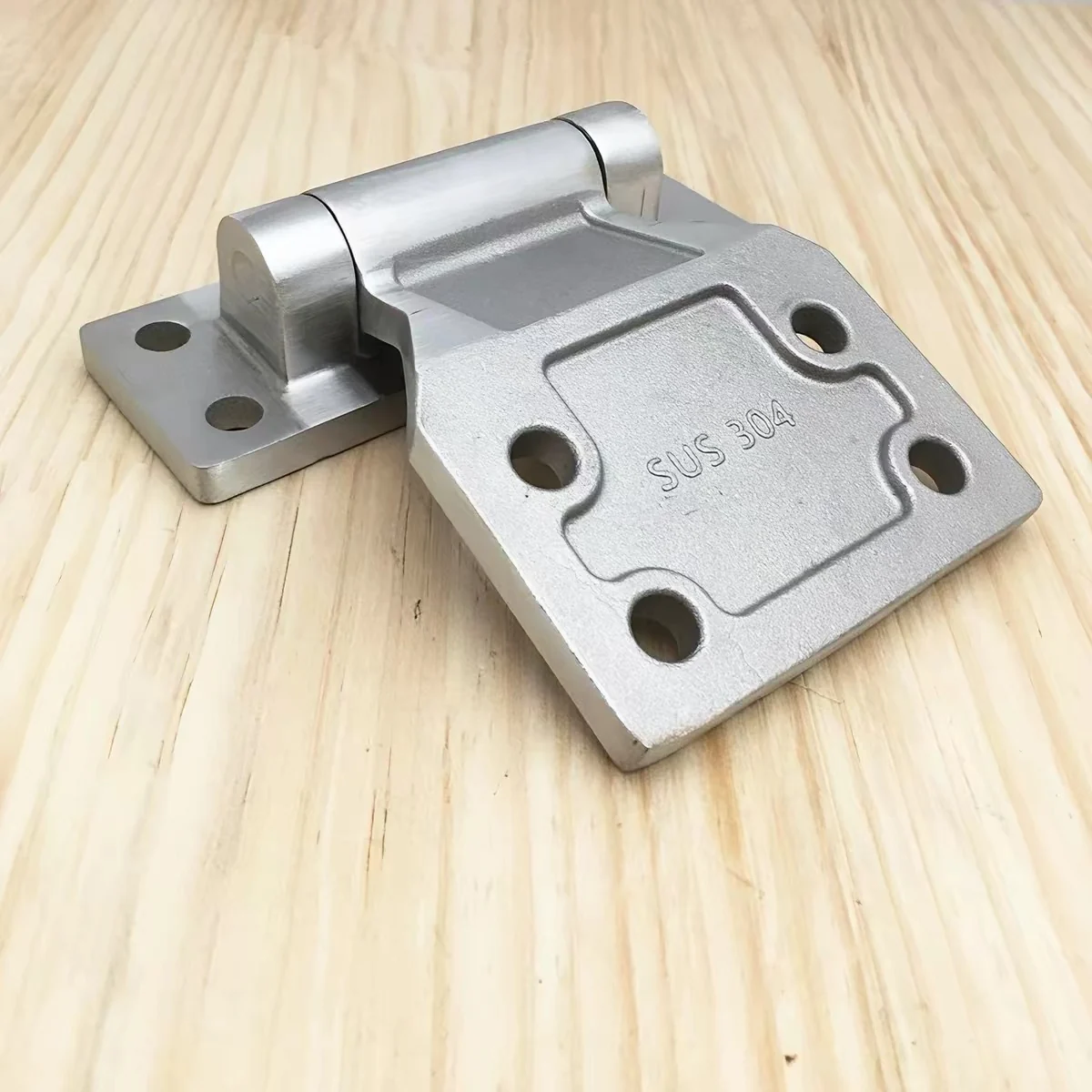
304 stainless steel heavy-duty offset gate hinges use thick unequal mounting leaves, a reinforced pivot barrel and an offset transition to support industrial equipment doors, access panels and large gate assemblies. The photographed model is marked SUS304 and uses a brushed finish with four mounting holes on each leaf.
Product Overview
Unlike a conventional equal-leaf butt hinge, this heavy-duty hinge has a narrow frame-side leaf and a wider offset door-side leaf. The stepped geometry creates installation clearance between the frame and moving door while distributing the mounting pattern across thick stainless sections.
The hinge can be used on machinery enclosures, industrial cabinets, warehouse gates and fabricated access doors where corrosion resistance and robust surface mounting are required. Door weight capacity must be engineered for the complete installation rather than inferred from hinge dimensions alone.
Reference Specifications and Custom Options
| Product type | Heavy-duty surface-mounted offset gate / equipment hinge |
|---|---|
| Pictured material | SUS304 stainless steel marking visible |
| Material options | 304, 316 or customer-specified stainless steel |
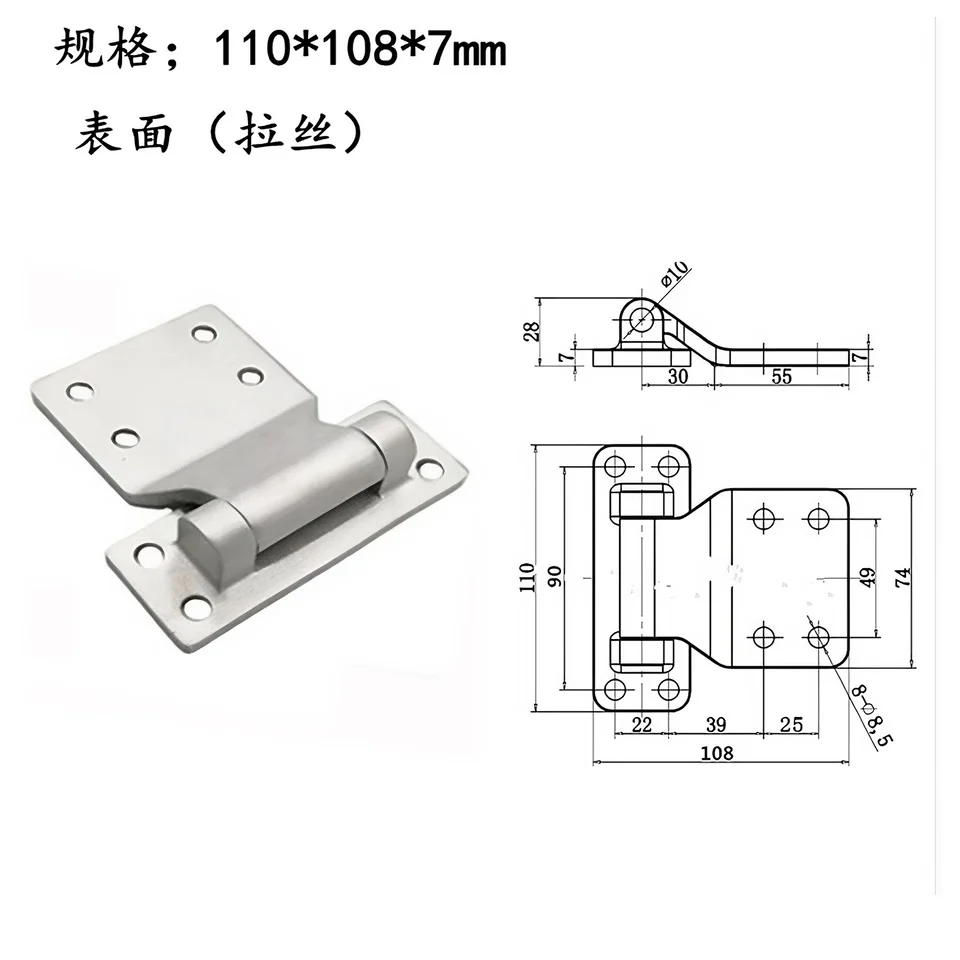
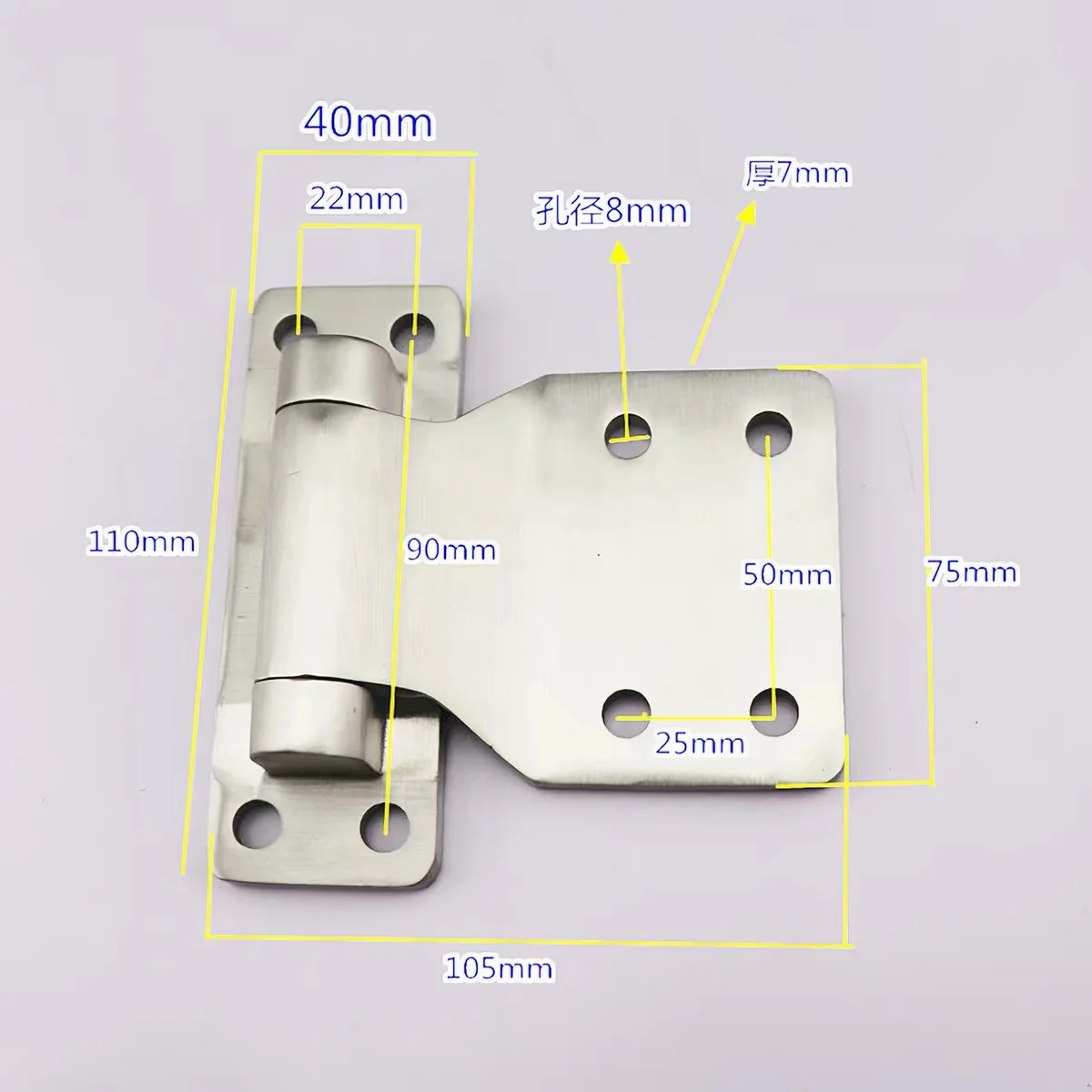
| Reference overall size | Approximately 110 x 105-108 x 7 mm, depending on version |
| Reference mounting holes | Approximately 8-8.5 mm diameter; final pattern by drawing |
| Reference pivot | Approximately 10 mm pin shown on one drawing |
| Finish | Brushed stainless steel; polished, passivated or project-specific options |
| Customization | Leaf dimensions, offset, thickness, hole pattern, pin, opening angle, finish and inspection |
Drawing note: the supplied reference images show both approximately 108 mm and 105 mm overall widths. These should be treated as separate reference variants. Quotation and production require one approved dimensional drawing.
Heavy-Duty Offset Construction
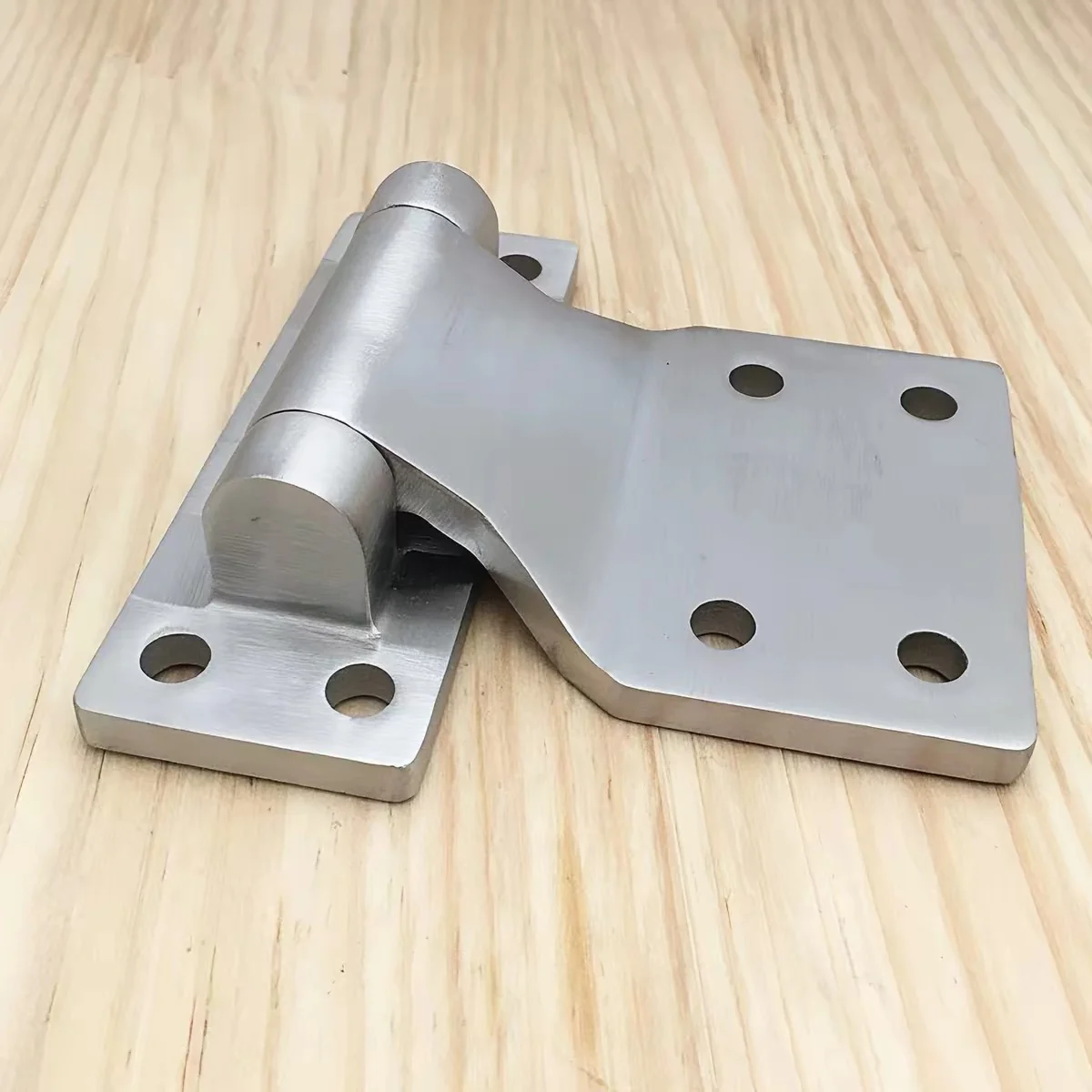
The wide leaf provides a substantial attachment area on the moving door or gate. Its shaped transition connects the leaf to the pivot region while preserving clearance from the fixed-side mounting plate. The narrow frame leaf uses a long rectangular footprint with mounting holes distributed above and below the pivot.
Thick stainless sections support rigidity, while the barrel and pin alignment control rotation. Mounting plate flatness, pivot-axis position and the relationship between the two leaves are critical for smooth operation and consistent door alignment.
Material and Surface Finish
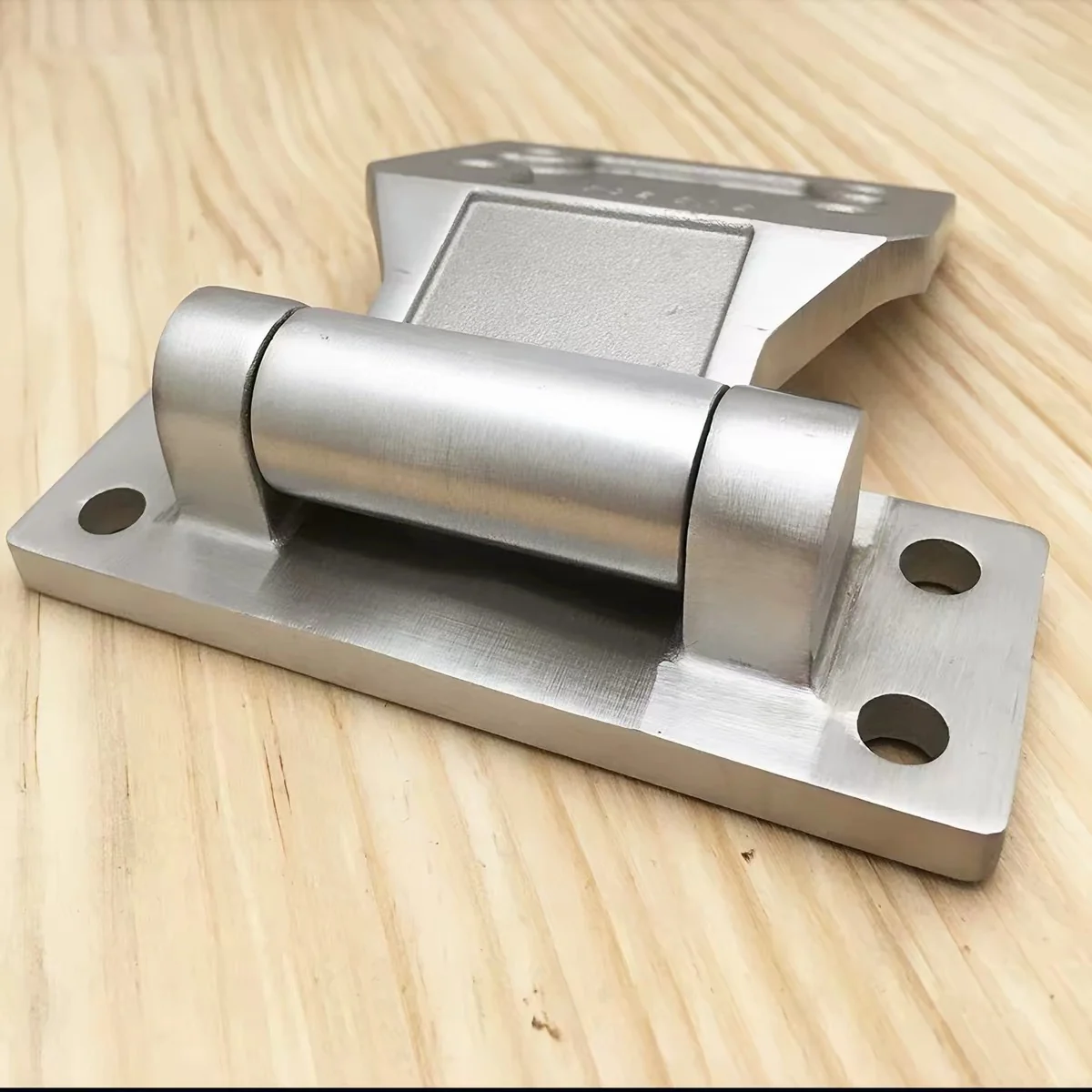
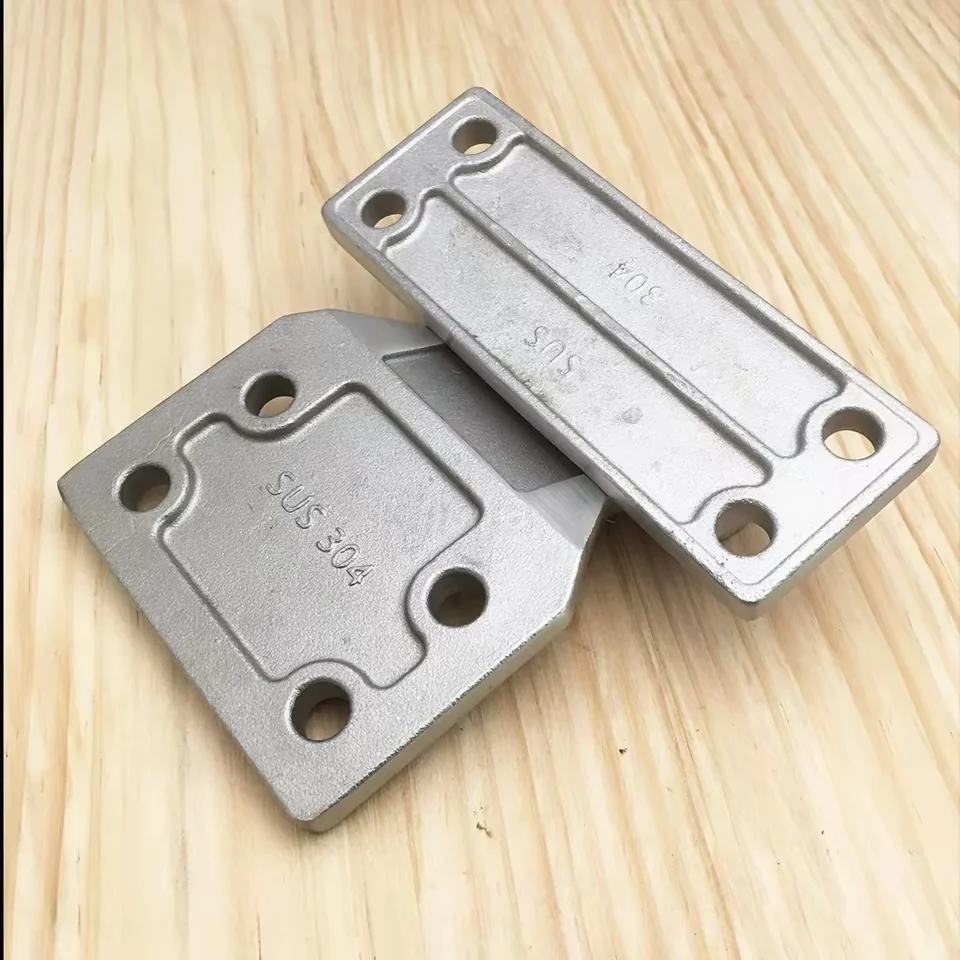
The product images show SUS304 identification. Grade 304 is suitable for many industrial, architectural and outdoor environments. For coastal locations, marine exposure, aggressive washdown or chloride-rich service, 316 stainless steel may provide better corrosion resistance.
The visible surfaces use a brushed finish. Depending on the manufacturing route, cast areas can be blended with machined and brushed faces. Passivation can be added when required to remove free iron contamination and support corrosion performance.
Manufacturing Route
A practical production route may combine investment casting or other near-net-shape forming with CNC machining of mounting faces, pivot bores and holes. The pin and barrel interfaces are finished to the required fit before assembly. Visible faces can then be brushed, polished or passivated.
Process selection depends on dimensions, annual volume, required load performance, appearance and inspection level. The route must follow the approved drawing and specification rather than appearance alone.
Typical Applications
- Industrial machinery access doors and safety enclosures
- Electrical cabinets, control boxes and equipment housings
- Warehouse, workshop and factory gates
- Stainless steel fabricated doors and service panels
- Outdoor utility, food-processing and washdown equipment
- Custom architectural or marine-related doors using the approved material grade
Load Selection and Hinge Quantity
A heavy visual profile does not establish a certified load capacity. Hinge selection must consider door mass, door width, center-of-gravity distance from the hinge axis, number and spacing of hinges, opening angle, mounting orientation, frame stiffness and dynamic loads from slamming, vibration or wind.
Fastener diameter, fastener grade, edge distance and backing structure can govern the installation before the hinge itself reaches its limit. For large gates and safety-related equipment doors, the complete assembly should be calculated and tested using the buyer-defined acceptance criteria.
Reference Dimensions
One supplied drawing identifies an approximately 110 mm frame-leaf length, 108 mm overall width, 7 mm plate thickness, 10 mm pivot and 8.5 mm mounting holes. Another image shows approximately 110 mm height, 105 mm overall width, 75 mm wide moving leaf, 40 mm frame leaf and 8 mm holes.
These dimensions are useful for preliminary evaluation but should not be combined into a single tolerance drawing. AODSON will quote against the selected version or a customer-approved replacement drawing.
Installation Considerations
- Align all hinge axes before fully tightening the mounting fasteners.
- Use a rigid frame and adequate backing plates for the calculated door moment.
- Confirm bolt size, grade, thread engagement and edge distance.
- Check opening clearance around the offset leaf and adjacent structure.
- Avoid forcing misaligned leaves, which can create pin binding and uneven load.
- Validate opening cycles and retention under the actual installed load.
Quality Control
Inspection can include material identity, leaf dimensions, thickness, hole diameter and position, mounting-face flatness, pivot alignment, pin fit, opening movement, surface finish and marking. Project-specific options may include dimensional reports, PMI, cycle testing, static load testing, salt-spray testing or other tests defined by the buyer.
RFQ Information
For an accurate quotation, send the selected drawing or a physical sample together with door and frame information. State whether the reference 105 mm or 108 mm overall-width version is required.
- Door mass, width, height and center of gravity
- Number of hinges and planned hinge spacing
- Material grade and operating environment
- Leaf dimensions, offset, thickness and hole pattern
- Opening angle, mounting orientation and cycle requirement
- Finish, testing, documentation, quantity and packaging
Send your gate or equipment hinge drawing for review. Continue with Architectural Hardware, Precision Casting, CNC Machining and Quality Control & Traceability.
Frequently Asked Questions
How much door weight can this hinge support?
A reliable rating cannot be assigned from hinge size alone. Door width, center of gravity, hinge spacing, installation direction, mounting fasteners, frame stiffness and dynamic loads must be reviewed together.
Is this hinge made from 304 stainless steel?
The photographed component is marked SUS304. Contract orders should still define the material standard and any certificate or PMI requirements.
Can it be supplied in 316 stainless steel?
Yes. Grade 316 can be reviewed for coastal, marine, washdown and chloride exposure. Machining, finishing and testing are confirmed with the requested grade.
Which dimensions are standard?
The supplied images show at least two close variants, approximately 110 x 108 x 7 mm and 110 x 105 x 7 mm. Final dimensions, holes and tolerances must follow one approved drawing.
Can the hole pattern and offset be customized?
Yes. Leaf width, length, offset, thickness, hole diameter, spacing, pin geometry and opening clearance can be produced from an approved drawing, subject to manufacturing review.