




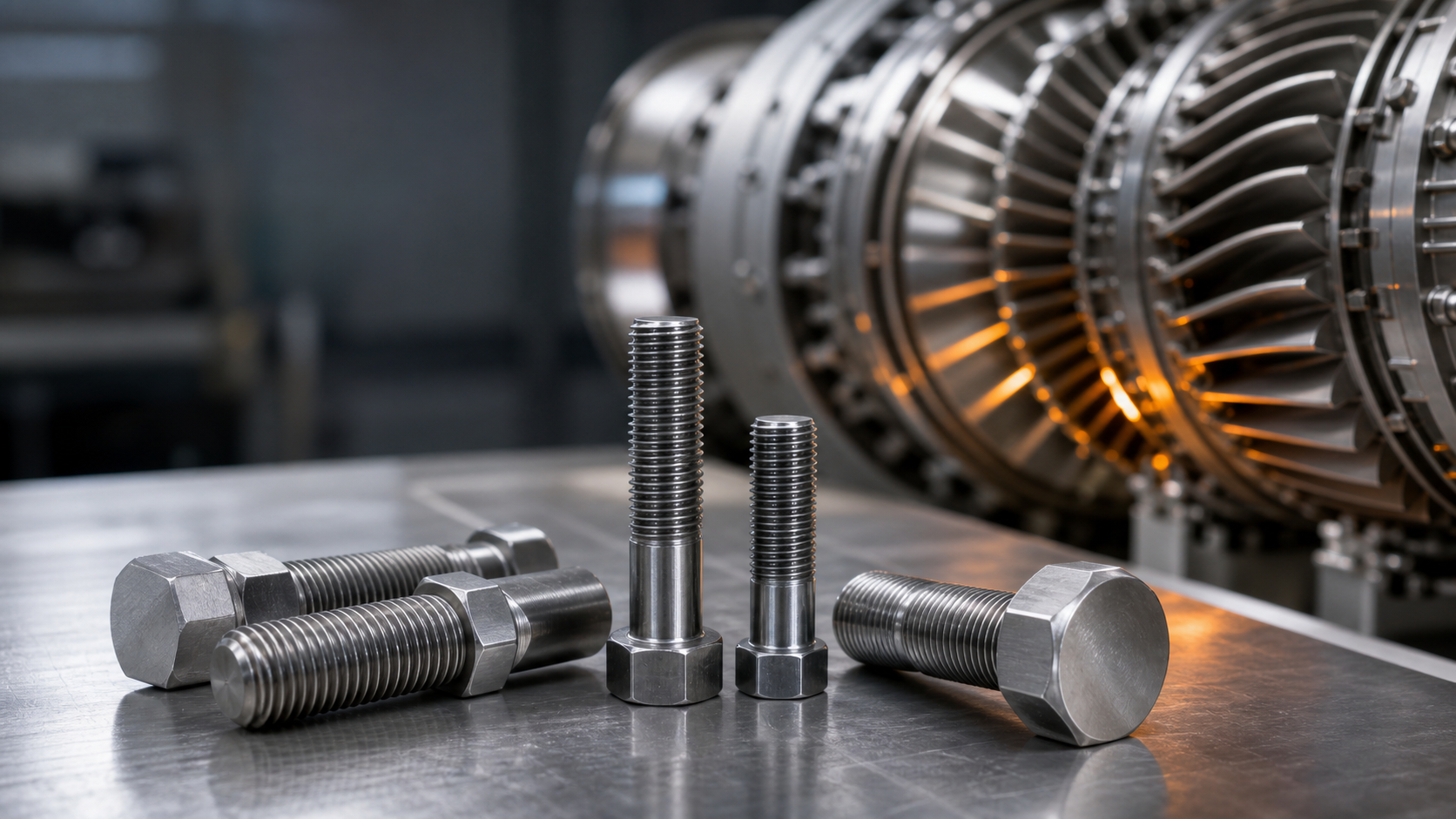
High-temperature alloy bolts are specialized fasteners engineered to retain strength, preload stability and oxidation resistance under sustained heat. Unlike ordinary carbon or alloy steel fasteners, they are commonly made from nickel-based or iron-based superalloys designed for demanding service in gas turbines, aerospace equipment, petrochemical units and power-generation systems.
A small fastener can become a critical reliability point in a high-temperature assembly. This guide explains why material selection matters, compares widely used alloy grades and outlines practical factors to consider when specifying bolts for elevated-temperature service.
Why High-Temperature Service Requires Special Bolt Materials
When operating temperatures rise above approximately 400°C, conventional steels can lose mechanical strength rapidly and become increasingly vulnerable to creep, the time-dependent deformation that occurs under sustained load. Oxidation and corrosive process media can further shorten fastener life.
High-temperature alloys address these challenges through carefully balanced additions of chromium (Cr), molybdenum (Mo), tungsten (W), niobium (Nb), aluminum (Al) and titanium (Ti). These elements support oxidation resistance and precipitation strengthening, helping fasteners preserve useful mechanical performance from intermediate heat levels to severe thermal environments, depending on the selected grade and heat treatment.
Common High-Temperature Alloy Bolt Grades
| Material Grade | Alloy Type | Approx. Service Temperature | Key Characteristics | Typical Applications |
|---|---|---|---|---|
| GH2132 (A-286) | Iron-based superalloy | Up to about 650°C | High strength, good oxidation resistance and comparatively economical selection | Aero-engine fasteners and turbine bolting |
| GH4145 (Inconel X-750) | Nickel-based superalloy | Up to about 700°C | Excellent relaxation resistance, creep strength and corrosion resistance | Gas turbine bolting, springs and nuclear equipment |
| GH4169 (Inconel 718) | Nickel-based superalloy | Up to about 650°C | Very high strength, good weldability and fatigue resistance | Aerospace structural fastening and oilfield tools |
| GH3030 | Nickel-based superalloy | Up to about 800°C | Strong oxidation resistance and good long-duration performance | High-temperature components and resilient fastening applications |
| GH4738 (Waspaloy) | Nickel-based superalloy | Up to about 815°C | High strength and corrosion resistance at elevated temperature | Turbine discs, shafts and critical fasteners |
Temperature limits in any application must be confirmed against the governing specification, product form, heat treatment, loading condition and required service life. The highest nominal temperature does not automatically make a grade the best or most economical choice.
Selecting a Grade for the Operating Condition
| Working Temperature | Mechanical Demand | Environment | Preferred Grades | Selection Notes |
|---|---|---|---|---|
| 500°C to 650°C | High stress and fatigue resistance | Air or mildly corrosive service | GH4169, GH2132 | GH4169 is suited to very high strength requirements; GH2132 can provide a balanced alternative. |
| 650°C to 750°C | High stress and creep resistance | Oxidizing atmosphere | GH4145, GH3030 | GH4145 is valuable where preload retention and relaxation resistance are important. |
| Above 750°C | Moderate to high stress and oxidation resistance | Strong oxidizing or sulfur-bearing service | GH4738, GH3030 | Oxidation resistance, creep data and long-term validation become central to selection. |
Dimensions and Performance Requirements
Material grade is only one part of a reliable bolted connection. Thread form, diameter, length, fit, heat treatment, surface condition and test requirements must be matched to the equipment drawing and service conditions. Important specifications may include room-temperature and elevated-temperature tensile strength, 0.2% proof stress, creep rupture performance, stress relaxation and corrosion or oxidation resistance.
| Performance Item | Why It Matters | Typical Verification |
|---|---|---|
| Tensile strength (Rm) | Resists mechanical failure under applied loading | Room-temperature and elevated-temperature tensile test |
| 0.2% proof stress (Rp0.2) | Supports joint preload and dimensional stability | Material certificate and mechanical testing |
| Creep and stress relaxation | Controls preload loss during long-term hot service | Grade-specific high-temperature data and validation |
| Chemical composition | Confirms the specified superalloy grade | Material certificate and spectrometric analysis |
High-Temperature Alloy Fasteners from Aodson Metal Technology Co., Ltd.
Aodson Metal Technology Co., Ltd. supplies precision metal components and fastener solutions for demanding industrial applications. For high-temperature alloy bolt projects, our team can support material selection, drawing-based production, dimensional requirements and documentation needs according to customer specifications.
For critical applications, buyers should request material certificates and define mechanical or elevated-temperature testing requirements before production. Where necessary, independent laboratory verification can provide added confidence for safety-critical service.
Frequently Asked Questions
Which is more heat-resistant for bolts: GH4169 or GH4145?
GH4169 (Inconel 718) is widely chosen for exceptional strength below roughly 650°C. GH4145 (Inconel X-750) is commonly preferred when longer-term preload retention, creep resistance or stress-relaxation behavior at higher temperatures is a priority. The correct choice depends on temperature, load duration and the applicable engineering specification.
Can GH2132 (A-286) be used for bolts operating at 1000°C?
No. GH2132 is generally selected for considerably lower continuous service temperatures, typically around the 650°C range depending on design requirements. For an application approaching 1000°C, a specialist material assessment is required and conventional high-strength bolting grades may no longer be suitable.
How can purchasers verify genuine high-temperature alloy bolts?
Start with a complete material certificate and confirm the specified grade through chemical composition analysis when needed. For important assemblies, dimensional inspection, mechanical testing and relevant high-temperature performance testing should be defined in the purchase specification. Aodson Metal Technology Co., Ltd. can work with customer drawing and documentation requirements for qualified fastener supply.