




For an international buyer looking to source stainless steel from China, procurement is not simply a search for the lowest quotation. A part that arrives late, fails a salt-spray requirement, carries the wrong material certificate, or triggers an unexpected customs cost is not economical at any price. The real purchasing question is whether a supplier can connect material selection, engineering, controlled production, quality evidence and reliable international delivery.
China has become a powerful sourcing base for stainless steel because these links increasingly exist in one manufacturing and logistics ecosystem. Buyers can procure stainless steel castings, CNC-machined components, marine hardware, architectural parts, pump and valve components, fabricated assemblies and finished OEM products with export-ready support. This guide explains where that advantage comes from, how goods can be shipped worldwide, and how to source responsibly from China.
China’s Stainless Steel Strength in Numbers
Scale matters, although scale alone is not a quality certificate. The world stainless association reported that China produced 39.441 million metric tonnes of stainless steel melt shop output in 2024, out of a worldwide total of 62.621 million tonnes. In the first nine months of 2025, China’s production reached 30.453 million tonnes, up 4.7% year on year. This production base gives downstream processors broad access to common austenitic grades such as 304 and 316L as well as application-driven alloys and duplex grades.
China is also not producing only for a domestic market. Based on General Administration of Customs data reported by Mysteel, China’s stainless steel net exports rose 11.9% year on year to 3.51 million tonnes in 2025. For overseas buyers, this indicates an industry accustomed to export packaging, documentation, freight coordination and cross-border commercial requirements.
Why Global Buyers Source Stainless Steel from China
1. A Deep Manufacturing Ecosystem, Not Just Raw Capacity
A stainless steel component often passes through several processes: alloy selection, tooling, casting or forming, heat treatment, machining, welding, polishing or passivation, inspection, packaging and shipment. China’s industrial clusters make it practical to coordinate these steps without sending a project through disconnected supply chains in multiple countries.
For a buyer, this can mean shorter engineering feedback loops and fewer hand-offs. A drawing for a cast pump component, a mirror-polished marine fitting or a machined valve body can be reviewed with manufacturing method, tolerances, finishing requirements and packaging in the same procurement conversation.
2. Flexibility Across Applications and Volume
International demand is rarely uniform. One customer may require prototype investment castings before approving a production batch; another may need stable repeat shipments of finished hardware. A capable Chinese manufacturer can combine tooling, small-batch validation and scaled production, provided that the buyer makes the acceptance criteria explicit from the beginning.
The useful advantage is therefore not “cheap stainless steel.” It is the ability to match a production route to the application: corrosion-resistant hardware for marine use, precision cast and machined flow components for pumps and valves, attractive polished surfaces for architecture, or durable OEM parts for machinery.
3. Value Through Finished Components
Buying a semi-finished part and completing machining, polishing and inspection elsewhere may multiply logistics and quality risk. Many global buyers instead source finished or near-finished components from China: cast, machined, surface-treated, inspected and packed for assembly. When specified and controlled correctly, consolidation reduces handling and gives the importer a clearer landed-cost calculation.
4. Quality Can Be Specified and Verified
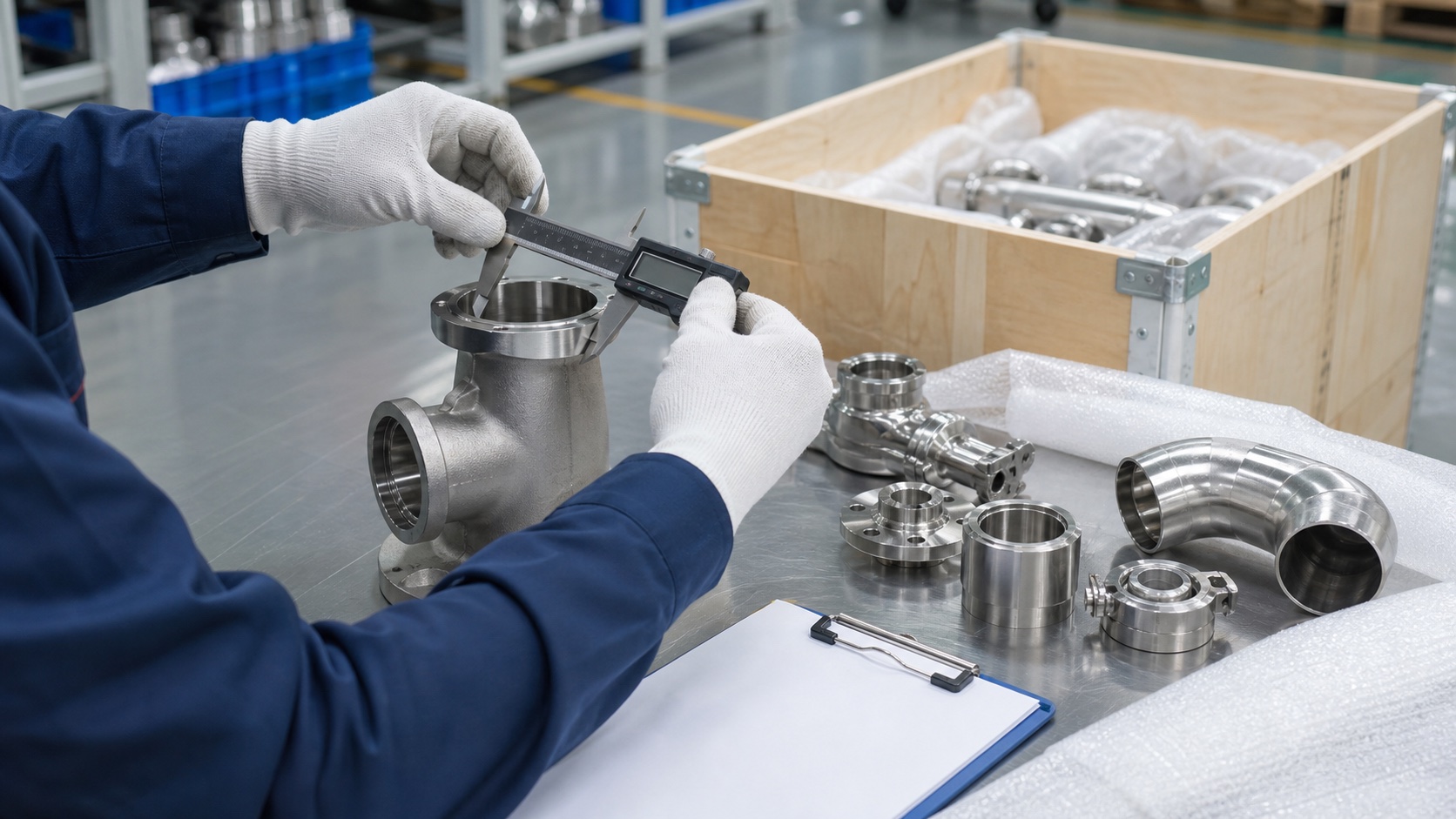
Country of origin does not replace supplier qualification. A serious purchasing process asks for the material grade and applicable standard, chemical composition evidence, dimensional inspection, surface-finish requirements, corrosion-related treatment where needed, and traceability between the production batch and inspection record. For critical components, buyers should require samples or first-article approval before mass production and agree on any third-party inspection before shipment.
The Global Shipping Advantage of Sourcing from China
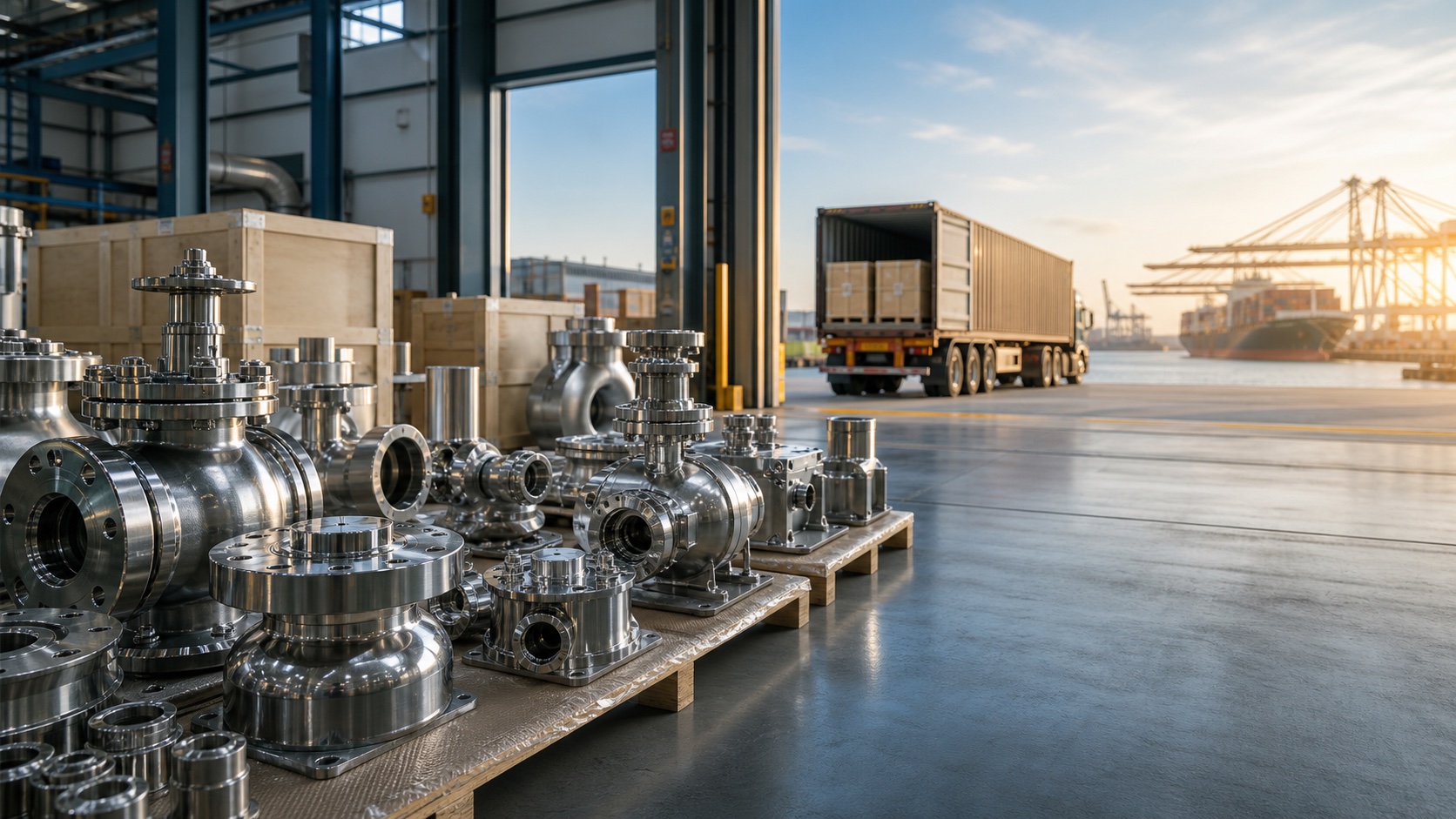
Stainless steel is dense and freight-sensitive. A good manufacturer therefore treats logistics as part of engineering: preventing corrosion in transit, protecting precision or mirror-polished surfaces, using packaging that tolerates stacking and moisture, and choosing a shipping method suited to weight, urgency and destination.
Strong Ocean-Freight Connectivity
China sits at the center of global container shipping networks. UN Trade and Development (UNCTAD) reported that its monthly Liner Shipping Connectivity Index continued to show China’s leading position through December 2025. For importers, high connectivity generally means a wider choice of sailings, carriers and transshipment options through major ports such as Shanghai and Ningbo-Zhoushan. This is particularly valuable for regular heavy cargo, where ocean freight is normally the practical option.
Multiple Delivery Modes for Different Orders
Ocean freight (FCL or LCL) is normally suitable for production orders, castings, hardware and other dense stainless steel cargo. A full container can simplify handling for higher volumes, while less-than-container-load shipping can support smaller replenishment orders.
Air freight or international courier is useful for samples, first articles, urgent replacement pieces and small high-value components. It allows a buyer to validate a project quickly before committing to ocean-shipped production volume.
Rail or multimodal solutions can be considered for certain Europe- or Central Asia-bound supply chains when routes, current transit conditions and cost align with the project. The correct choice is not fixed: it should be quoted against delivery deadline, cargo weight, port access and risk tolerance.
Export Packaging Protects the Product Value
Transport advantages are lost if stainless steel arrives scratched, contaminated or wet. Buyers should specify protective film for finished surfaces where appropriate, separation between polished parts, moisture-resistant wrapping, desiccants for suitable shipments, strong export cartons or crates, pallet requirements, labels and packing-list traceability. Marine hardware and decorative surfaces deserve particular attention because cosmetic damage may make an otherwise functional part unacceptable.
A 2026 Compliance Point Buyers Should Not Miss
Global sourcing is strongest when compliance is treated as a planning task, not an afterthought. Starting January 1, 2026, China introduced export-license management for selected steel products. According to the joint announcement by China’s Ministry of Commerce and General Administration of Customs, operators exporting covered products must provide an export contract and a manufacturer-issued product quality inspection certificate when applying for the license.
This is not a reason to avoid Chinese supply. It is a reason to ask early whether the exact product and customs code are covered, whether the exporter can handle the license process, and which quality documents will accompany the shipment. Importers must also confirm destination-country tariffs, anti-dumping or countervailing measures, product standards and import requirements with their customs broker or relevant authority before ordering. Duties can depend on the precise product classification and destination, not simply the words “stainless steel.”
How to Source Stainless Steel from China: A Practical Buyer Roadmap
Step 1: Build a Precise RFQ
Send more than a photograph and a target price. A useful request for quotation should state the application, drawing or dimensions, desired stainless grade (for example 304, 316L or duplex where relevant), required standard, manufacturing process if specified, tolerances, surface finish, quantity and annual demand, testing or certificates required, packaging expectations, destination and requested trade term.
Step 2: Select the Grade for the Environment
Do not automatically choose the least expensive grade. General indoor or mild-service applications may be suitable for 304, while chloride exposure and many marine or food-processing applications commonly justify considering 316 or 316L. More aggressive conditions may require duplex or another engineered alloy. The final grade choice should follow the service environment, design requirements and applicable standard.
Step 3: Qualify the Supplier and Its Process
Ask which production stages are carried out in-house and which are subcontracted. Review equipment relevant to the job, inspection capability, material traceability, prior experience with similar parts and the supplier’s ability to communicate changes before production. For custom products, clarify mold ownership, drawing revision control and how nonconforming parts will be handled.
Step 4: Approve Samples and Quality Evidence
Before a production order, request samples or first articles for engineered parts. Define the evidence required for approval: material certificate or chemical analysis, key dimensions, surface appearance, machining features, functional fit, passivation or other finishing evidence where specified, and any agreed testing. Keeping an approved reference sample can reduce disputes on repeat orders.
Step 5: Compare Landed Cost, Not Only Unit Price
Request a quotation that clearly identifies the Incoterm, packaging, tooling, inspection, domestic transport in China, export documentation, freight assumptions and lead time. Ask a qualified customs broker in the destination market to confirm the correct HS classification, duties and trade-remedy exposure before shipment. A low unit quotation can become expensive when packaging, duties, delays or rework are omitted.
Step 6: Agree on Shipment and Documents Before Production Ends
Decide whether samples will travel by courier or air while production orders travel by sea. Confirm the consignee details, port or delivery point, carton and pallet marks, commercial invoice, packing list, bill of lading or air waybill, certificate of origin if applicable, material or inspection documentation, and any China export-license handling required for the product. Documentation should be checked before cargo departs, not after it arrives at customs.
Step 7: Build Repeatability Into the Supply Relationship
For recurring orders, retain approved drawings, specification revisions, sample references, packaging standards, inspection records and shipping history. Then review quality issues and delivery performance after each shipment. Good international procurement is not one lucky order; it is a repeatable system.
Working with Aodson for Stainless Steel Components
Aodson Metal, based in Jiangsu, China, supports international buyers with precision investment casting, CNC machining and finished stainless steel components for applications including machinery, marine hardware, building hardware, pumps and custom OEM parts. Projects can be evaluated from drawings and operating requirements so that material, manufacturing route, finish, inspection and export packaging are considered together.
If you are planning a stainless steel component project from China, send your drawing, grade requirement, quantity, surface finish, inspection requirements and destination. A clear technical request is the fastest route to a reliable production and delivery plan.
Sources and Further Reading
- world stainless association: Stainless steel melt shop production, first nine months of 2025, published November 27, 2025.
- world stainless association: Full-year 2024 melt shop production, published April 14, 2025.
- Mysteel report based on GACC data: China’s 2025 stainless exports and net exports, published January 20, 2026.
- UNCTADstat: Liner Shipping Connectivity Index insights, data updated January 28, 2026.
- Joint MOFCOM/GACC announcement reported by CGTN: Export licensing for selected steel products, December 12, 2025.