Local Service, Global Capabilities.
Local Service, Global Capabilities.
2026-06-06
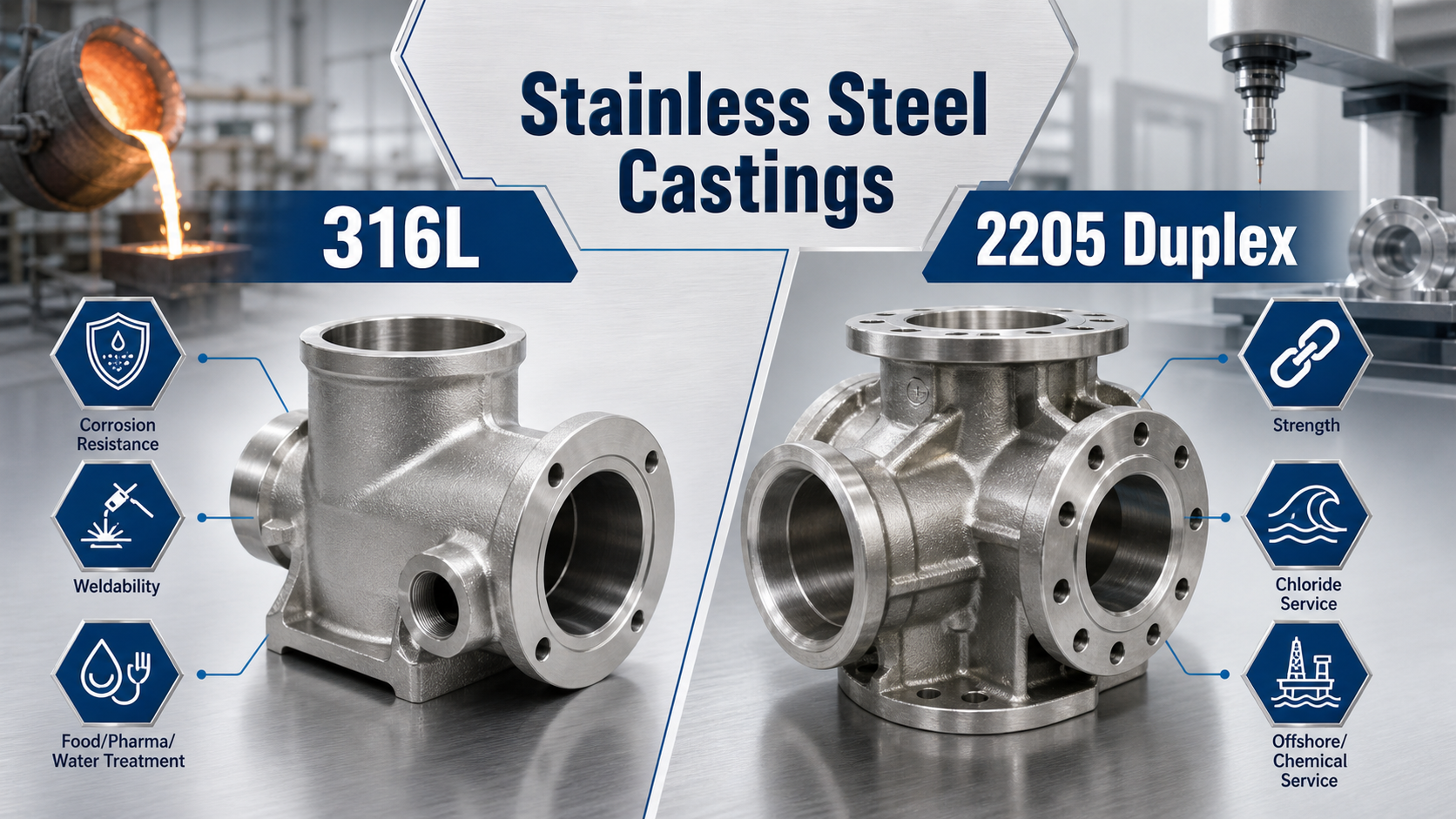
Selecting the right 316L Stainless Steel Casting or 2205 duplex stainless steel casting material is one of the most important decisions in an industrial product design. A casting may have the correct geometry, surface finish, and machining tolerance, but if the alloy is not suitable for the service environment, the part can still suffer from pitting, stress corrosion cracking, premature wear, or unexpected failure. For corrosion-resistant cast components, 316L stainless steel and 2205 duplex stainless steel are two of the most common options considered by purchasing managers, design engineers, mechanical engineers, and OEM buyers. Both materials are widely used in Stainless Steel Castings, and both can be produced by precision investment casting. However, they are not interchangeable in every application. 316L Stainless Steel Casting is well known for its balanced corrosion resistance, excellent weldability, good formability, and broad availability. 2205 Stainless Steel Casting, also known as Duplex Stainless Steel Casting, provides much higher strength and significantly better resistance to chloride-rich environments. Choosing between them requires more than comparing purchase price. Engineers should evaluate corrosion risk, mechanical loading, operating temperature, fabrication needs, machining requirements, and total life cycle cost. What Is 316L Stainless Steel? 316L stainless steel is a low-carbon austenitic stainless steel. In cast form, it is often selected when an OEM needs a reliable Corrosion Resistant Casting for general industrial, food-grade, pharmaceutical, architectural, and water handling applications. The “L” means low carbon, which helps reduce carbide precipitation during welding and improves resistance to intergranular corrosion after fabrication. Typical Chemical Composition of 316L Element Typical Range Engineering Function Chromium 16.0-18.0% Forms a passive oxide layer for corrosion resistance Nickel 10.0-14.0% Stabilizes the austenitic structure and improves toughness Molybdenum 2.0-3.0% Improves pitting resistance compared with 304 stainless steel Carbon 0.03% max Reduces sensitization risk during welding Manganese, Silicon, Nitrogen Controlled additions…