Local Service, Global Capabilities.
Local Service, Global Capabilities.
2026-06-06
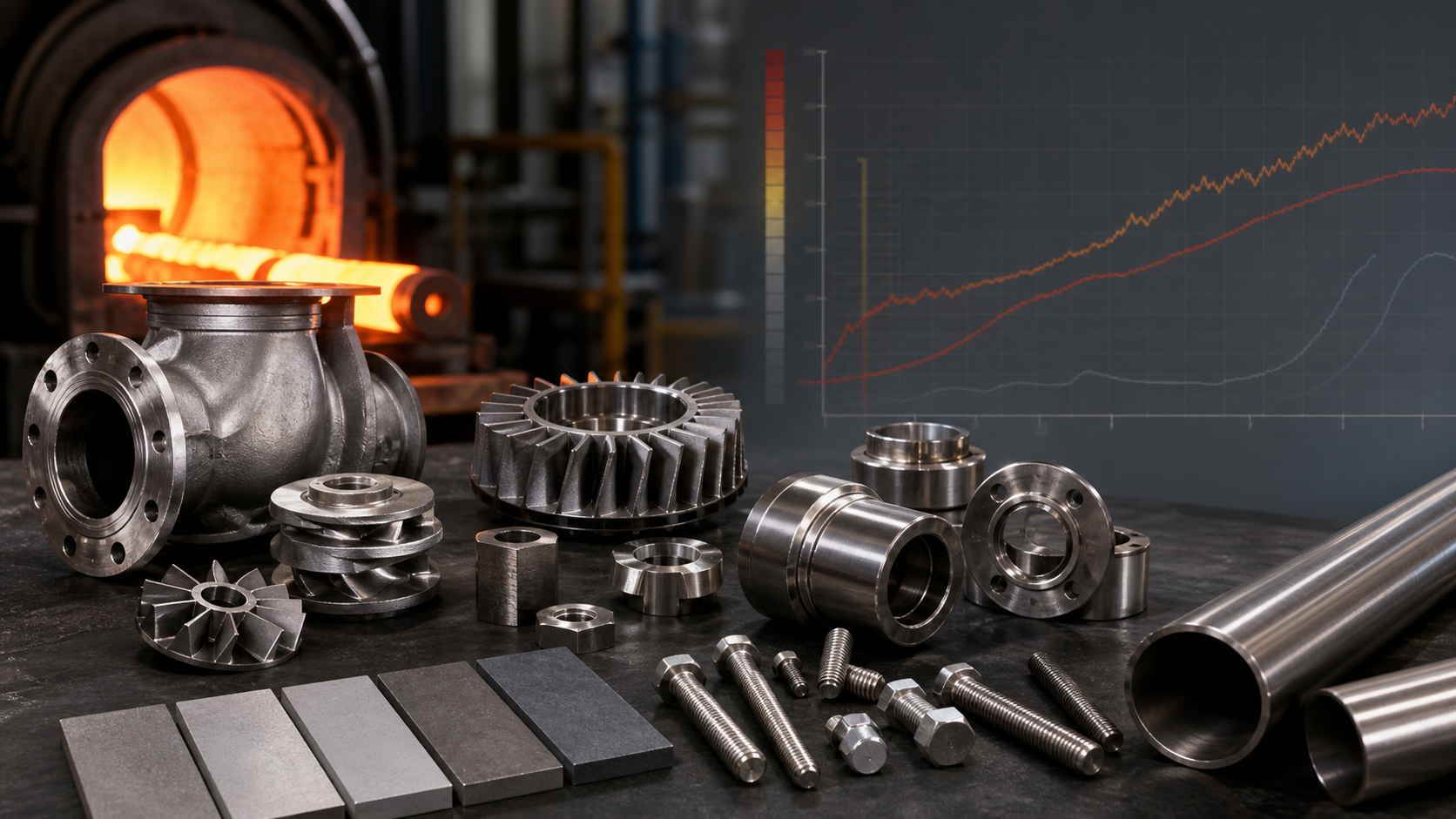
Author: AODSON Engineering Team High-temperature material selection is rarely a simple question of maximum temperature. A part that survives a brief exposure to 1000°C may fail early when the same temperature is continuous, loaded, cyclic, carburizing, sulfur-bearing, or combined with chloride contamination. Engineers also need to consider oxidation resistance, creep strength, thermal fatigue, castability, machinability, weldability, cost, and lead time. This high temperature alloy selection guide compares common heat resistant stainless steels and nickel alloys used for castings, machined parts, fasteners, furnace parts, pump components, valve components, and custom OEM metal parts. It is written as a practical engineering reference rather than a universal material guarantee. Actual performance depends on service conditions, part geometry, manufacturing process, heat treatment, inspection requirements, and the user’s acceptance criteria. Taizhou Aodson Metal Technology Co., Ltd. supports stainless steel castings, heat-resistant steel castings, high-temperature fasteners, CNC machined parts, pump and valve components, marine hardware, and custom OEM parts. The material recommendations below can help prepare a better RFQ and reduce the risk of premature failure. Why High Temperature Alloy Selection Matters Choosing the wrong material at elevated temperature can create failures that are expensive and difficult to diagnose. A part may look acceptable after installation, then gradually lose section thickness through oxidation scaling, deform under load because of creep, crack after repeated thermal cycling, or seize at threaded connections. Common consequences include oxidation scaling, deformation, creep rupture, thermal fatigue cracking, fastener seizure, loss of strength, short service life, and unexpected shutdowns. In furnace equipment, a weak tray or fixture can damage product batches. In pump and valve assemblies, hot corrosion can combine with pressure and flow to accelerate leakage or wear. In high-temperature fasteners, oxidation, galling, and creep relaxation can reduce clamp load and make maintenance difficult. A good alloy decision balances performance and manufacturability….